Crabeater Seal
Lobodon carcinophaga
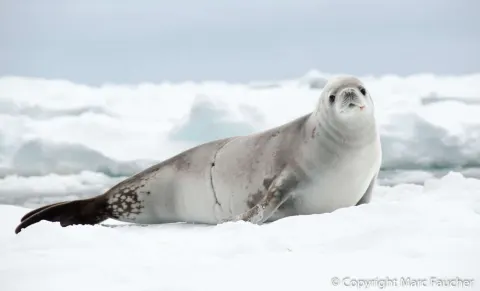
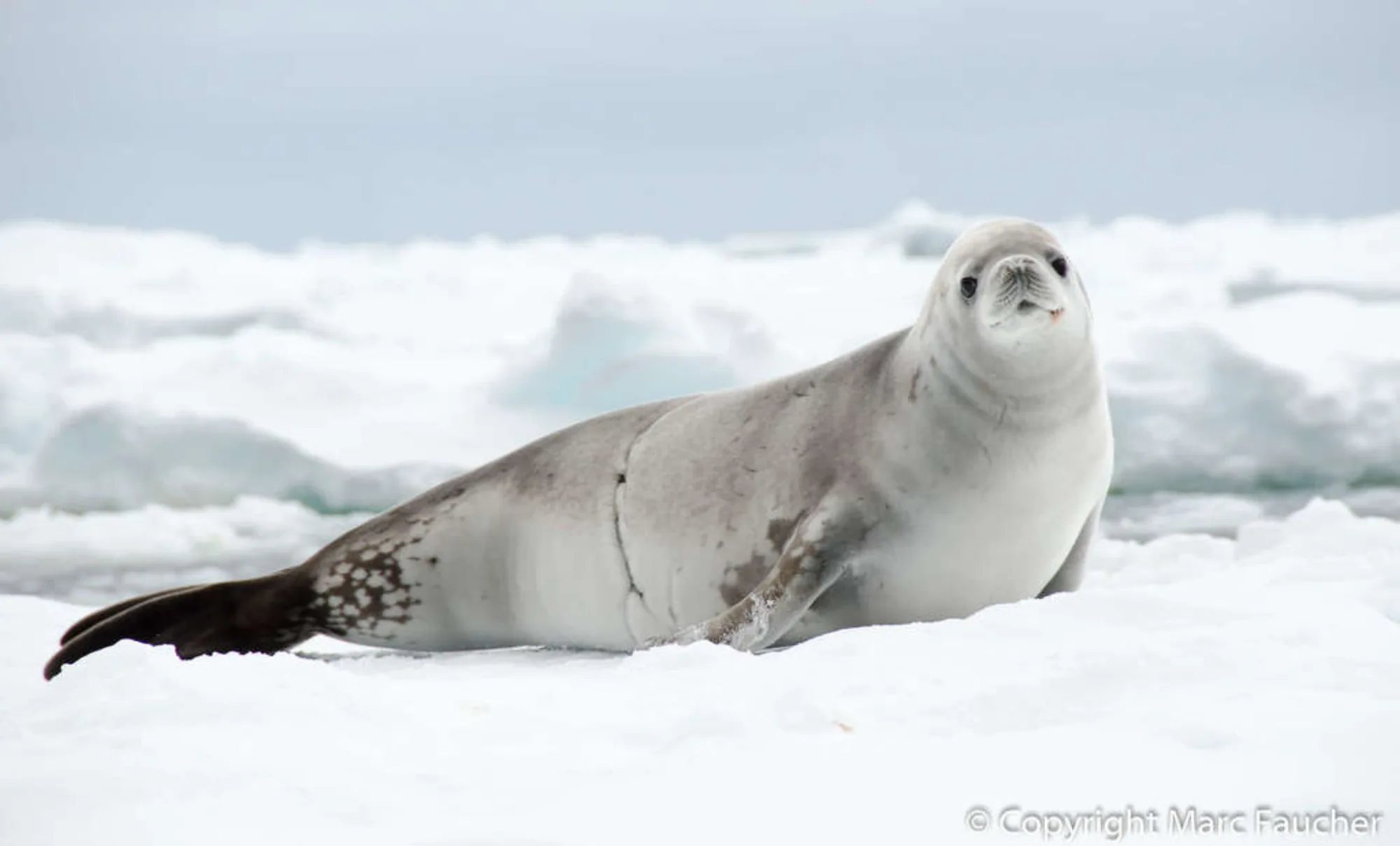
Around Antarctica, the Crabeater Seal makes its home on floating pack ice, following its seasonal advance and retreat. Adults average 2.3 m long and around 200 kg, with a relatively slender body and a pointed snout. Their fur is mostly brown or silver, darker around the flippers, and fades as the year goes on. Recently moulted seals look darker than those approaching their next moult, which can appear silvery-white.
The seals use the ice to rest, gather and reach their prey, generally staying over the continental shelf. Adults are often seen by themselves or with one or two others, while younger animals may form much larger gatherings. Groups of up to 1,000 have been seen resting on the ice, and several hundred may swim together, breathing and diving almost in unison. In the water, they sometimes leap clear of the surface or rise upright to look around. On cold days they can also move quickly across ice or land, leaving a winding track. Despite their name, they do not eat crabs: Antarctic krill make up over 90% of their diet. They also take cephalopods and Antarctic fish, using specialised teeth to strain small prey from the water. Females give birth singly on the ice between September and December, in the Antarctic spring. Pups are weaned in about three weeks and begin to moult around that time.
Leopard seals prey heavily on young Crabeater Seals, and many survivors carry scars from attacks. Killer whales hunt seals of all ages, sometimes working together to wash one off floating ice with a wave.
Written from the English Wikipedia article Crabeater seal (CC BY-SA 4.0).
- Records
- 65,846
- Countries
- 1
No atlas park has a record of the Crabeater Seal in or around it yet.
These are open occurrence records, so they show where people looked for and recorded the Crabeater Seal as much as where it lives. Cells are up to 25 km across, and every location is generalised to its cell.
Generalised encounter areas, not exact locations. Each shape is a grid cell coloured by how likely the species is there.
- Very likelyAntarctica25 km zone · high confidence · 65846 records · updated 80 days ago
Conservation status not assessed here yet, so every location is generalised to its grid cell.