Gerenuk
Litocranius walleri
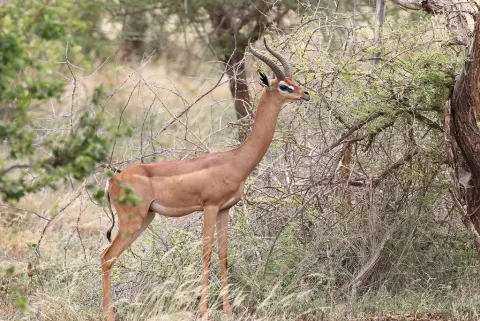
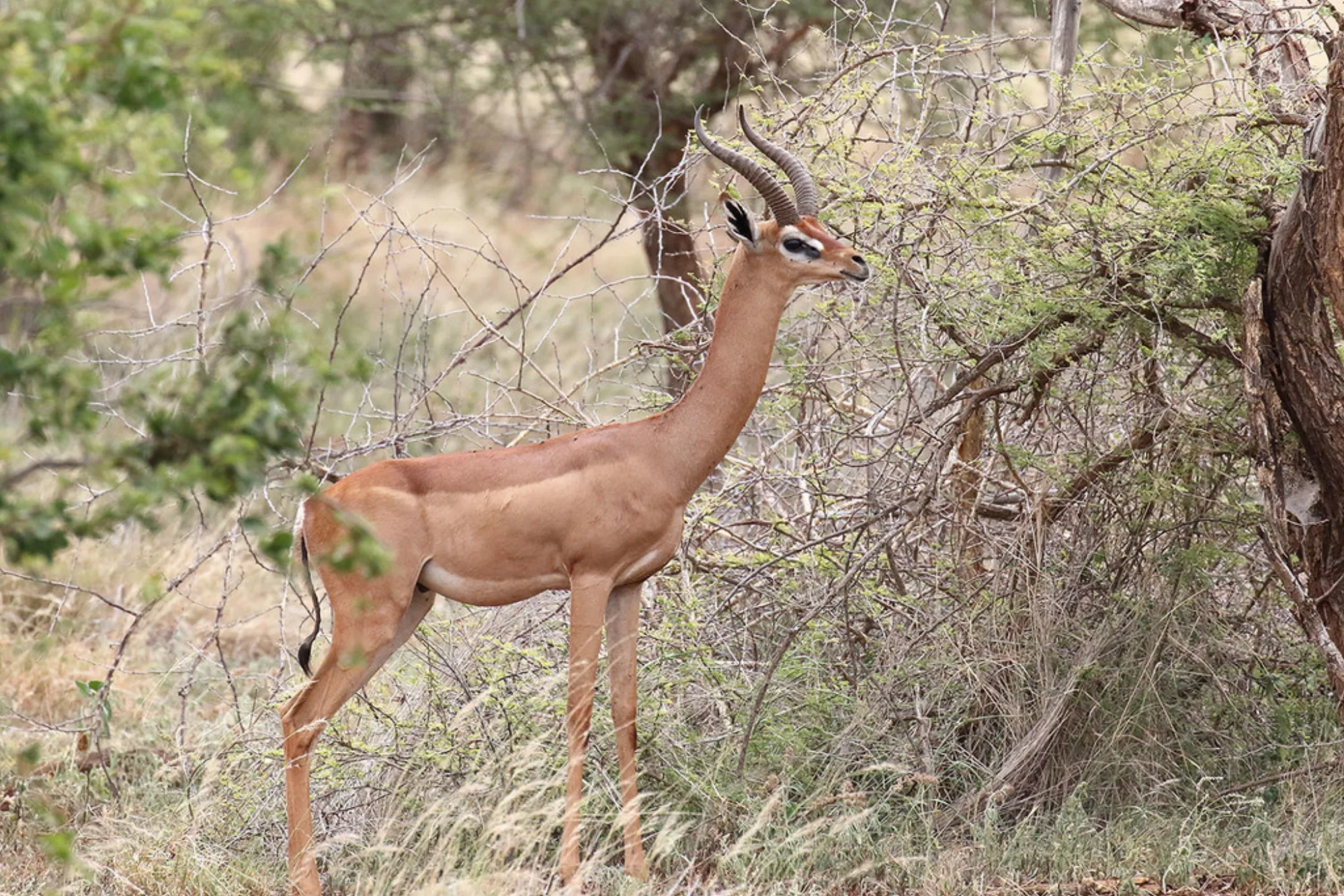
With its long neck and slender legs, the Gerenuk has a look that has earned it the name giraffe gazelle. This medium-sized antelope has a reddish brown back, lighter fawn to buff flanks, and cream colouring beneath its body and inside its legs. White fur surrounds its eyes and mouth, and its tail ends in a black tuft. Only males carry horns, which curve backwards and then slightly forwards.
Gerenuks are found chiefly in East Africa's Somali region, with ranges described from northwestern Somalia towards Djibouti and the Ethiopian border, and from northeastern Tanzania through Kenya to Somalia. They browse on bushes and trees, eating foliage, shoots, herbs, flowers and fruit. To reach higher branches and twigs, a Gerenuk can stand on its hind legs and stretch its neck, feeding more than 2 m above the ground. It eats acacia whenever available and relies on evergreen vegetation during droughts. It does not drink water regularly.
Active mainly by day, the antelope spends much of its time foraging and feeding, but usually stands or rests in shade at noon. Small herds generally contain two to six animals of one sex, with juveniles joining female herds, while some males live alone. Males scent-mark and guard territories, and the home ranges of both sexes can overlap. Gerenuks breed throughout the year, and females give birth to one young at a time after a pregnancy of about seven months. Lions, leopards and cheetahs hunt Gerenuks, as do hyenas and African wild dogs.
Written from the English Wikipedia article Gerenuk (CC BY-SA 4.0).
- Records
- 54
- Countries
- 1
- Atlas places
- 1
These are open occurrence records, so they show where people looked for and recorded the Gerenuk as much as where it lives. Cells are up to 25 km across, and every location is generalised to its cell.
Generalised encounter areas, not exact locations. Each shape is a grid cell coloured by how likely the species is there.
- Very likelyKenya25 km zone · medium confidence · 54 records · updated 80 days ago
Conservation status not assessed here yet, so every location is generalised to its grid cell.