Mississippi Gopher Frog
Lithobates sevosus
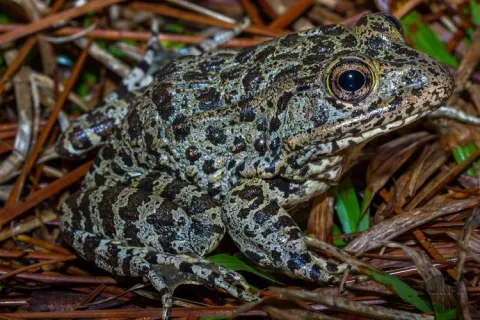
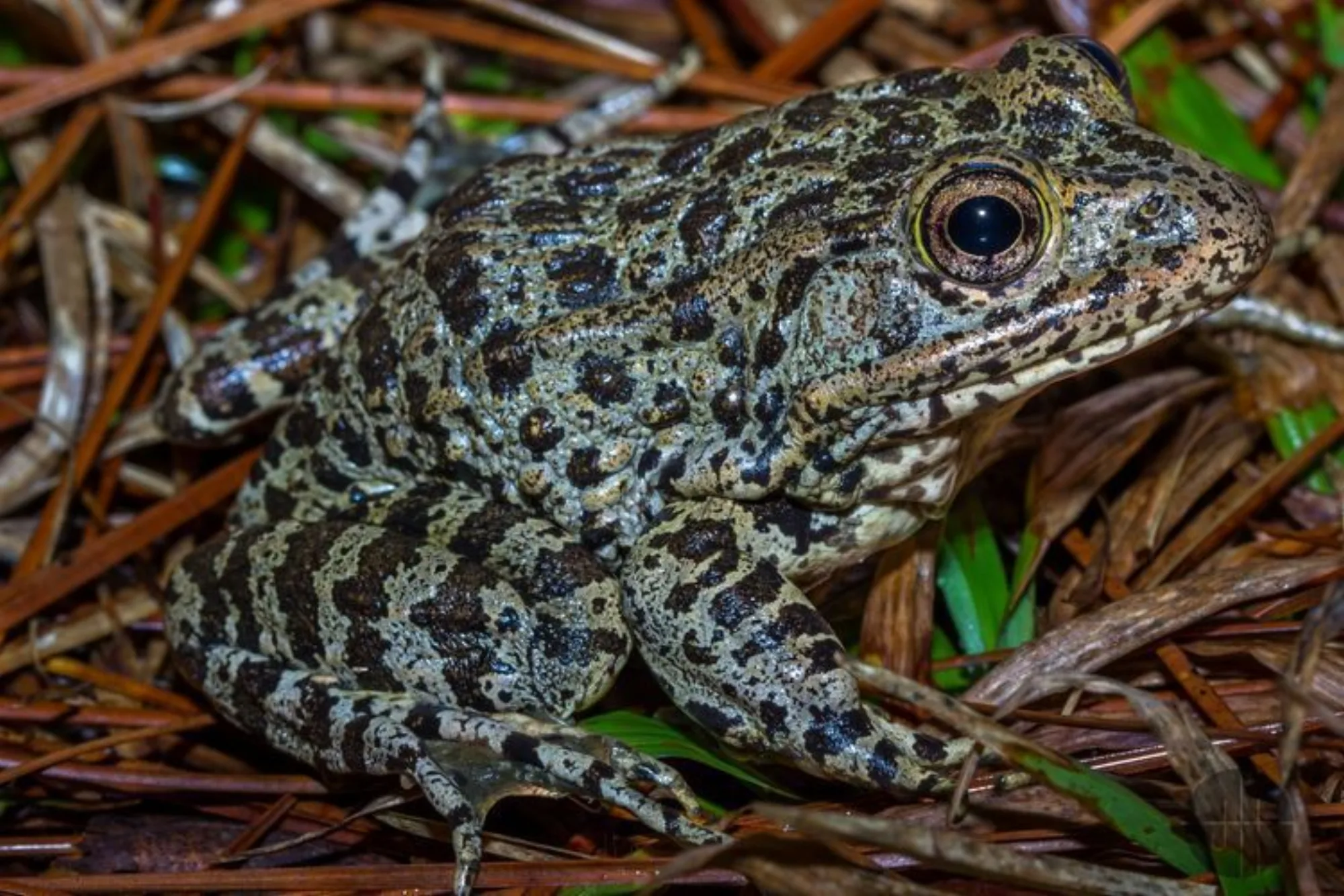
This secretive, mid-sized frog is typically 3 in (8 cm) long with a stocky build. Its back ranges from black to gray or brown and is covered in dark spots and warts. If threatened or exposed to bright light, the Mississippi gopher frog famously shields its eyes with its hands. It may also inflate its body or release a bitter, milky fluid from its warty glands. Travelers might hear the male's call, which sounds like human snoring. Adults live up to 10 years and eat insects, spiders, earthworms, and other frogs.
Once abundant across the Gulf Coastal Plain, the species is now among the rarest amphibians in North America. Currently, around 600 adults live in the wild, primarily across 15 ponds in Harrison and Jackson counties, Mississippi. They inhabit open longleaf pine forests and sandy uplands, spending most of their time in underground refuges like gopher tortoise burrows, stump holes, or root cavities. For breeding, they require isolated, grassy ponds that dry out seasonally to ensure no fish are present to eat their tadpoles.
Survival is difficult, as only a small percentage of juveniles reach adulthood. The species faces habitat destruction from urban sprawl, new highways, and deforestation. Fire suppression is also a major threat, as frequent fires are needed to maintain the open canopy and ground vegetation the frogs require. Other dangers include the loss of gopher tortoises, infectious chytrid fungus, and local changes in hydrology. Because populations are so isolated, inbreeding and a lack of genetic variability also jeopardize their future.
Written from the English Wikipedia article Mississippi gopher frog (CC BY-SA 4.0).
- Records
- 10
- Countries
- 1
- Atlas places
- 0
These are open occurrence records, so they show where people looked for and recorded the Mississippi Gopher Frog as much as where it lives. Cells are up to 25 km across, and every location is generalised to its cell.
Generalised encounter areas, not exact locations. Each shape is a grid cell coloured by how likely the species is there.
- Very likelyUnited States50 km zone · medium confidence · 10 records · updated 1 day ago