Northern Leopard Frog
Lithobates pipiens
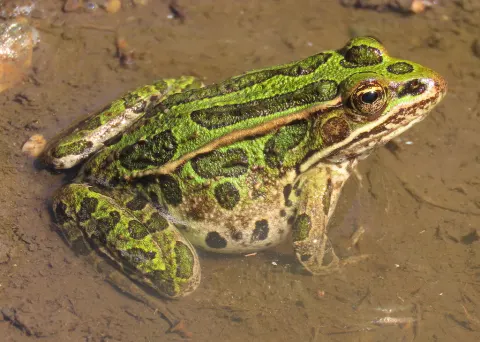
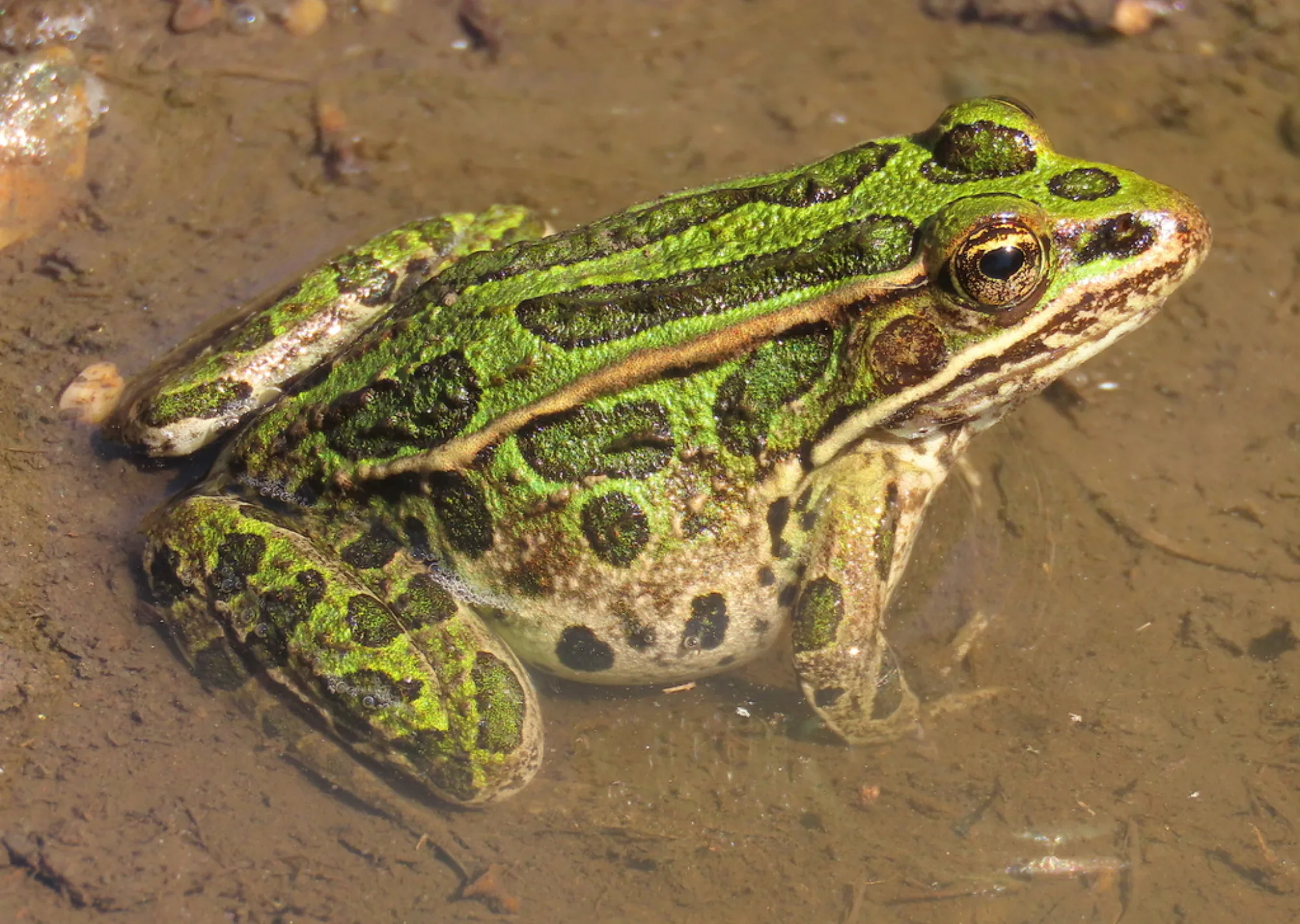
Large dark spots, usually edged with lighter rings, mark the back, sides and legs of the Northern Leopard Frog. Its back ranges from green to brown, and it can reach about 11 cm in length. Two lighter, sometimes pinkish folds run along its back, while a pale stripe extends from the nostril to the shoulder. The underside is white or pale green, and the eyes have golden irises. Some individuals lack spots on their backs, though they may retain them on their legs.
Across Canada and the United States, this native frog ranges from Great Slave Lake and Hudson Bay south to Kentucky and New Mexico. It lives around permanent ponds, swamps, marshes and slow streams in forests, open areas and urban settings, usually where water plants are plentiful. In summer it often leaves ponds for grass and lawns, and it can also be found above 3,000 m. Males call from the water in spring and summer, making a short sound like a snore. Breeding takes place in spring, with up to 6500 eggs laid in water; tadpoles develop in the breeding pond over 70 to 110 days, depending on conditions.
Northern leopard frogs eat animals ranging from crickets, flies and worms to smaller frogs, birds and garter snakes. They rely on speed to escape predators, which include fish, herons, snakes and raccoons. From the 1970s, populations declined in areas of western Canada and the US, and many have yet to recover. The cause remains uncertain, but habitat loss and fragmentation, contaminants, introduced fish, drought and disease have all been proposed as contributing factors.
Written from the English Wikipedia article Northern leopard frog (CC BY-SA 4.0).
- Records
- 4,256
- Countries
- 3
No atlas park has a record of the Northern Leopard Frog in or around it yet.
These are open occurrence records, so they show where people looked for and recorded the Northern Leopard Frog as much as where it lives. Cells are up to 25 km across, and every location is generalised to its cell.
Generalised encounter areas, not exact locations. Each shape is a grid cell coloured by how likely the species is there.
- Very likelyCanada25 km zone · medium confidence · 2685 records · updated 80 days ago
- Very likelyUnited States25 km zone · medium confidence · 1539 records · updated 80 days ago
- Very likelyCosta Rica25 km zone · medium confidence · 32 records · updated 80 days ago
Conservation status not assessed here yet, so every location is generalised to its grid cell.