Pickerel Frog
Lithobates palustris
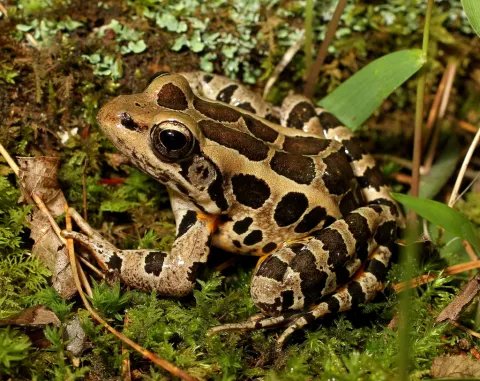
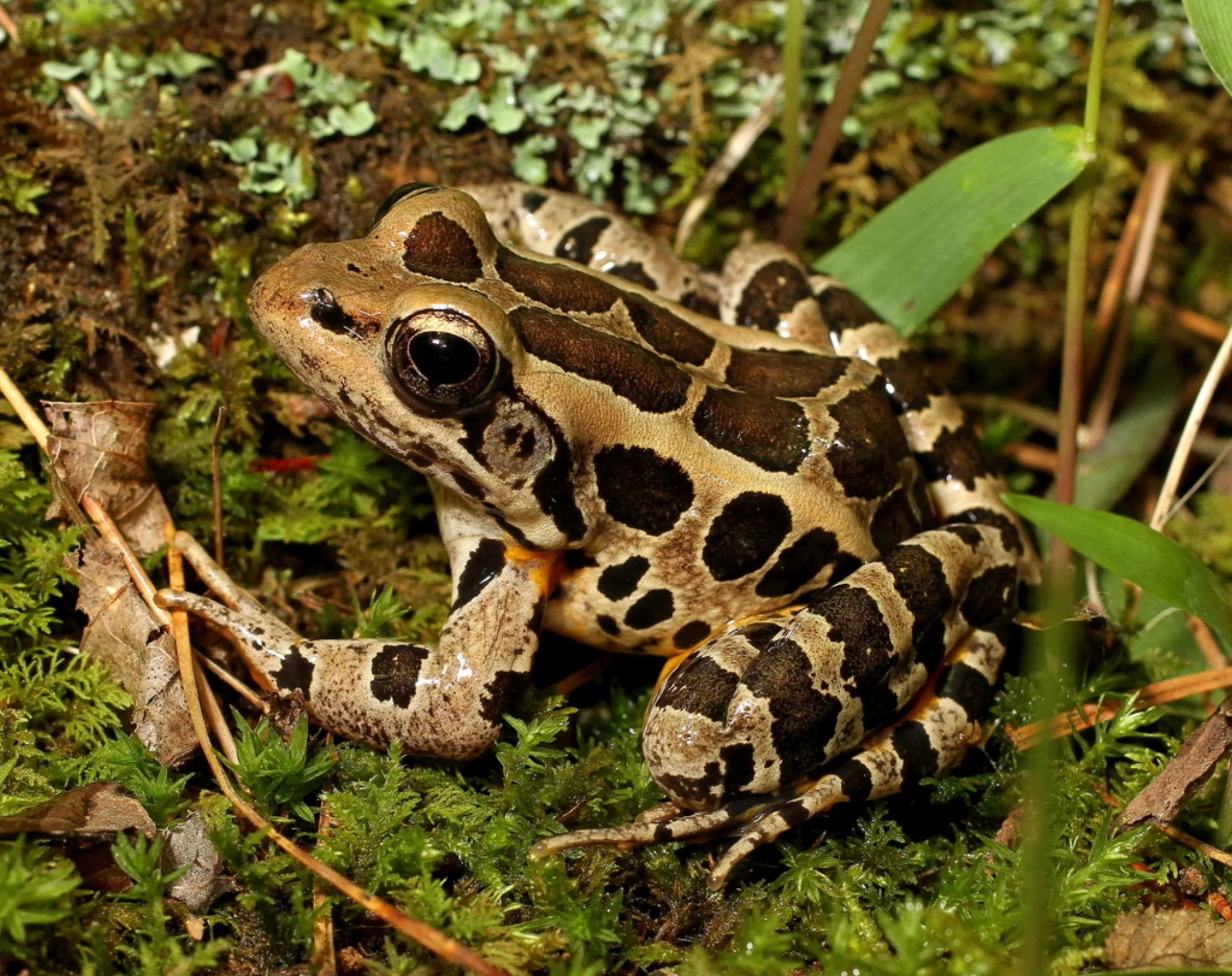
A large grey or tan frog with dark, rectangular markings, the Pickerel Frog has a pattern that can look drawn by hand. The spots run in two columns down its back and sometimes join into longer shapes. Unlike the circular spots of leopard frogs, these markings are angular. An orange or yellow patch on the inner hind legs offers another clue, although it is hidden when the legs are folded.
Its range stretches across parts of eastern North America, from eastern Texas and the southern United States north into several Canadian provinces. The distribution is patchy in the midwestern states. Northern populations favour cold, clear water near rocky ravines, bogs and meadow streams, while southern frogs prefer warmer waters, including swamps. Look for them beside streams, rivers and lakes, as well as in flooded ditches. They usually leave their winter shelter near the close of March and are active from April to October. In winter they shelter under silt and debris in water, and may also use caves during cold weather or hot summers.
Pickerel Frogs search grassy ground beside water for ants, spiders, beetles, sawfly larvae and other invertebrates. They breed in temporary and permanent ponds, apparently favouring those that hold water for long periods. At breeding ponds, they are often seen in large groups in the water, while males give low calls that can be difficult to hear. Egg masses are usually placed among vegetation, and the tadpole stage lasts roughly three months. When threatened, the frogs may jump into water and dive to the bottom. Their skin secretions deter many predators, but green frogs, bull frogs and several snakes still prey on them.
Written from the English Wikipedia article Pickerel frog (CC BY-SA 4.0).
- Records
- 2,442
- Countries
- 2
- Atlas places
- 2
These are open occurrence records, so they show where people looked for and recorded the Pickerel Frog as much as where it lives. Cells are up to 25 km across, and every location is generalised to its cell.
Generalised encounter areas, not exact locations. Each shape is a grid cell coloured by how likely the species is there.
- Very likelyUnited States25 km zone · medium confidence · 2258 records · updated 80 days ago
- Very likelyCanada25 km zone · medium confidence · 184 records · updated 80 days ago
Conservation status not assessed here yet, so every location is generalised to its grid cell.