Smooth Newt
Lissotriton vulgaris
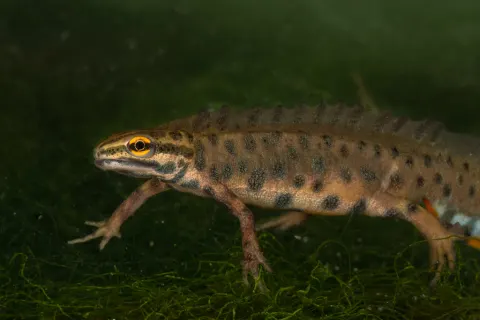
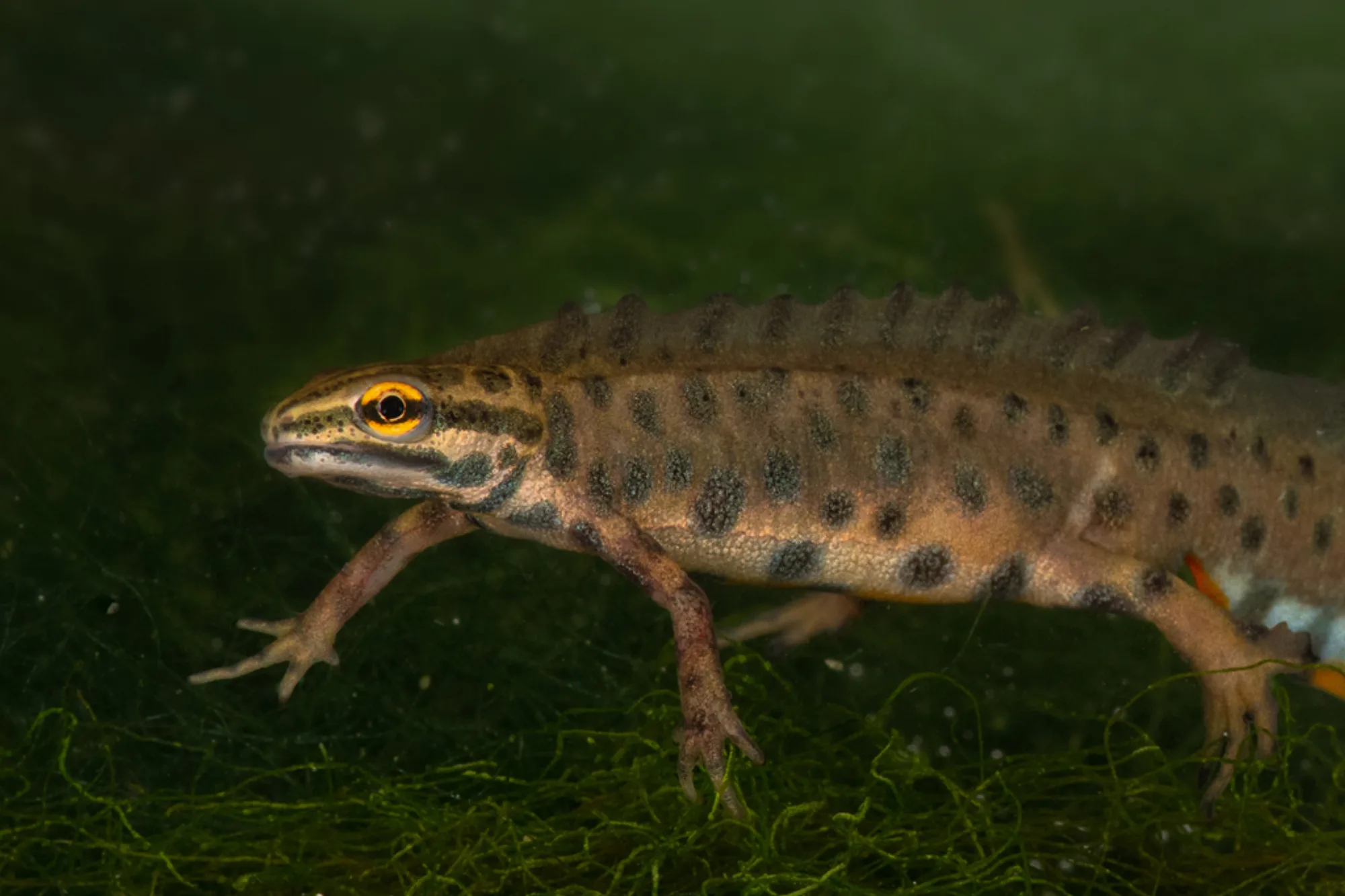
Brown above and spotted underneath, the Smooth Newt (Lissotriton vulgaris) has a belly that ranges from orange to white. Adults average 8 to 11 cm in length, with males larger than females. On land, their skin is dry and velvety; in the water, it becomes smooth. During the breeding season, males become more colourful and develop a noticeable crest along the back. Females can be difficult to distinguish from those of related newts, particularly because the clearest differences are seen in breeding males.
Smooth newts are widespread across Europe and parts of Asia, and have been introduced to Australia. They live mainly in lowlands, occupying wooded areas, damp meadows, field edges, parks and gardens. For most of the year they stay on land, hiding by day and moving about mainly at night. Logs, stones and small mammal burrows provide hiding places, and the newts sometimes climb vegetation. In winter they usually shelter on land, often in groups, although they may emerge during mild weather. Their food is mainly invertebrates, including earthworms, insects, snails and slugs.
From spring into summer, they breed in ponds and similar freshwater sites, often choosing sunny, fish-free water with shallow areas and plenty of plants. Females lay eggs on water plants; the larvae hatch after 10 to 20 days and spend around three months developing before becoming land-dwelling juveniles. Fish, birds and snakes prey on smooth newts. The loss of breeding ponds, introduced fish and roads that divide populations all pose threats, though garden ponds and former gravel pits can provide habitat.
Written from the English Wikipedia article Smooth newt (CC BY-SA 4.0).
- Records
- 74,306
- Countries
- 10
No atlas park has a record of the Smooth Newt in or around it yet.
These are open occurrence records, so they show where people looked for and recorded the Smooth Newt as much as where it lives. Cells are up to 25 km across, and every location is generalised to its cell.
Generalised encounter areas, not exact locations. Each shape is a grid cell coloured by how likely the species is there.
- Very likelySwitzerland25 km zone · high confidence · 28597 records · updated 80 days ago
- Very likelyDenmark25 km zone · high confidence · 13293 records · updated 80 days ago
- Very likelyUnited Kingdom25 km zone · high confidence · 12978 records · updated 80 days ago
- Very likelyFrance25 km zone · high confidence · 8075 records · updated 80 days ago
- Very likelyNorway25 km zone · high confidence · 7054 records · updated 80 days ago
- Very likelyGermany25 km zone · high confidence · 1874 records · updated 80 days ago
- Very likelyLiechtenstein25 km zone · high confidence · 1502 records · updated 80 days ago
- Very likelyLuxembourg25 km zone · high confidence · 427 records · updated 80 days ago
- Very likelyAustria25 km zone · high confidence · 347 records · updated 80 days ago
- Very likelyBelgium25 km zone · high confidence · 159 records · updated 80 days ago
Conservation status not assessed here yet, so every location is generalised to its grid cell.