Common Linnet
Linaria cannabina
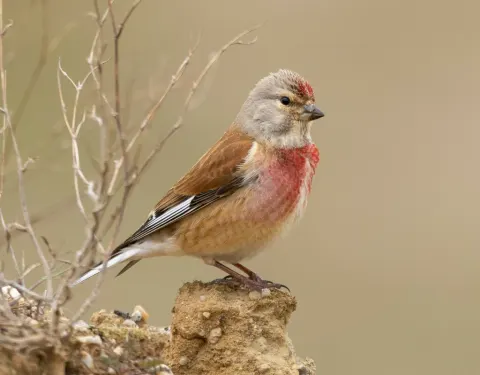
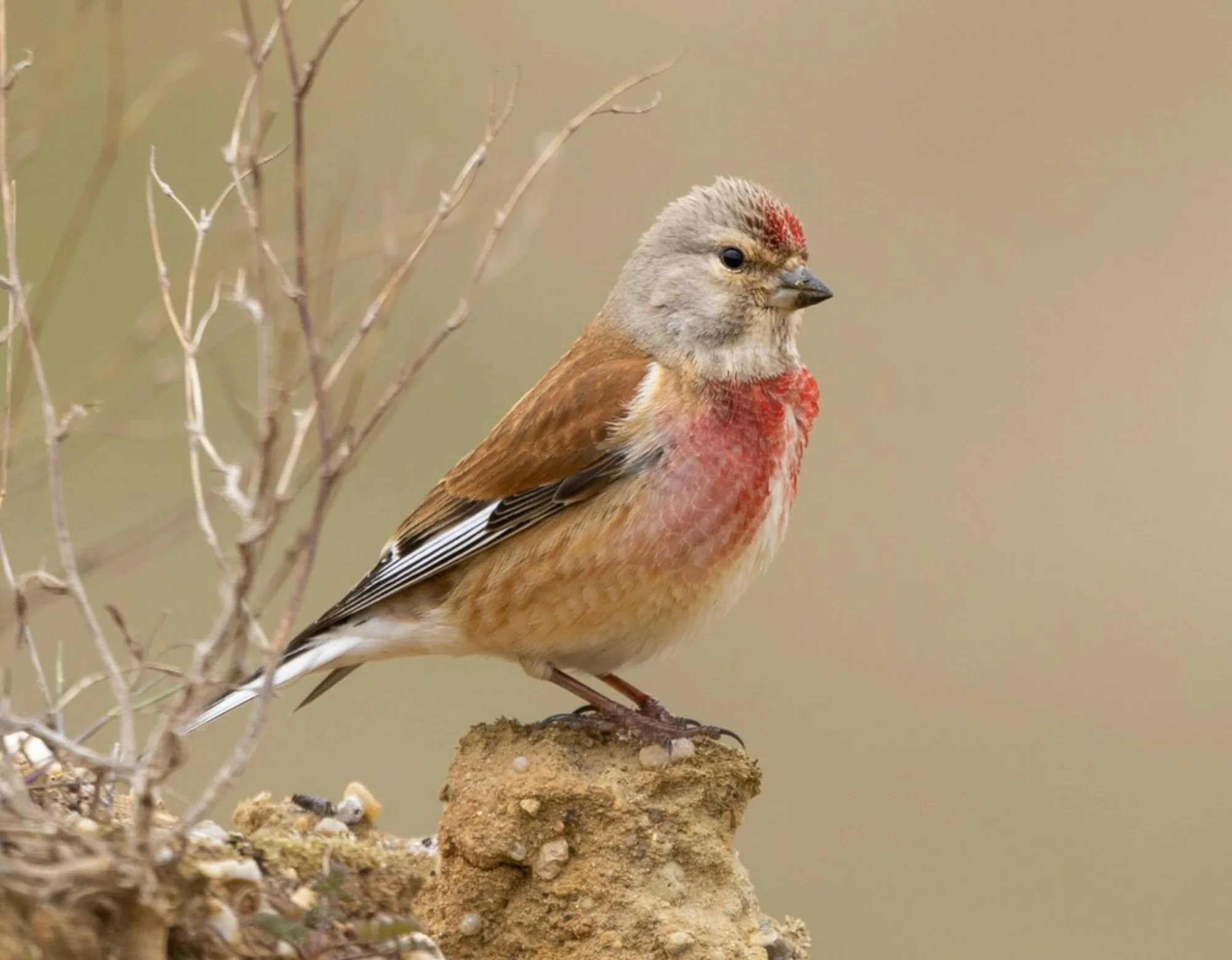
Slim and long-tailed, the Common Linnet is a small finch with brown upperparts, a grey bill and a dingy white throat. In summer, the male stands out with a red breast and head patch, set against a grey nape. Females and young birds have no red; their underparts are white, with buff streaks across the breast. Listen, too, for a song of quick trills and twitters.
The linnet breeds across Europe, the western Palearctic and North Africa, and has also been introduced to the Dominican Republic. Some stay in their range year-round, while many birds from northern and eastern areas move south within the breeding range or towards the coast. For breeding, they favour open country with dense bushes, including heathland and gardens. A nest tucked into a bush holds four to seven eggs. Away from the breeding season, linnets can gather in large flocks, sometimes alongside other finches on coasts and salt marshes.
Look for them feeding on the ground or low in bushes, where they take mostly seeds and find food for their chicks. Their varied seed menu includes plants such as dandelions, thistles, dock, hawthorn and birch, with a small amount of invertebrate food as well. In Britain, declines have been linked to greater herbicide use, heavy scrub clearance and excessive hedge trimming, with reduced seed supply also considered a likely cause. In Britain, numbers declined by 56% from 1968 to 1991; across Europe, the decrease was 62% from 1980 to 2009.
Written from the English Wikipedia article Common linnet (CC BY-SA 4.0).
- Records
- 573,572
- Countries
- 17
No atlas park has a record of the Common Linnet in or around it yet.
These are open occurrence records, so they show where people looked for and recorded the Common Linnet as much as where it lives. Cells are up to 25 km across, and every location is generalised to its cell.
Generalised encounter areas, not exact locations. Each shape is a grid cell coloured by how likely the species is there.
- Very likelyUnited Kingdom25 km zone · high confidence · 221212 records · updated 80 days ago
- Very likelySpain25 km zone · high confidence · 100890 records · updated 80 days ago
- Very likelyNorway25 km zone · high confidence · 90696 records · updated 80 days ago
- Very likelyBelgium25 km zone · high confidence · 43680 records · updated 80 days ago
- Very likelyPortugal25 km zone · high confidence · 39409 records · updated 80 days ago
- Very likelyFrance25 km zone · high confidence · 33025 records · updated 80 days ago
- Very likelySweden25 km zone · high confidence · 9657 records · updated 80 days ago
- Very likelyFinland25 km zone · high confidence · 8481 records · updated 80 days ago
- Very likelyNetherlands25 km zone · high confidence · 6613 records · updated 80 days ago
- Very likelyIreland25 km zone · high confidence · 5611 records · updated 80 days ago
Conservation status not assessed here yet, so every location is generalised to its grid cell.