Black-tailed Godwit
Limosa limosa
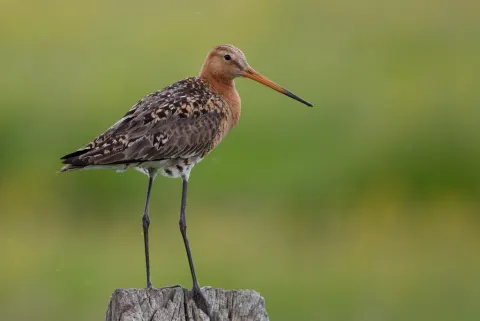
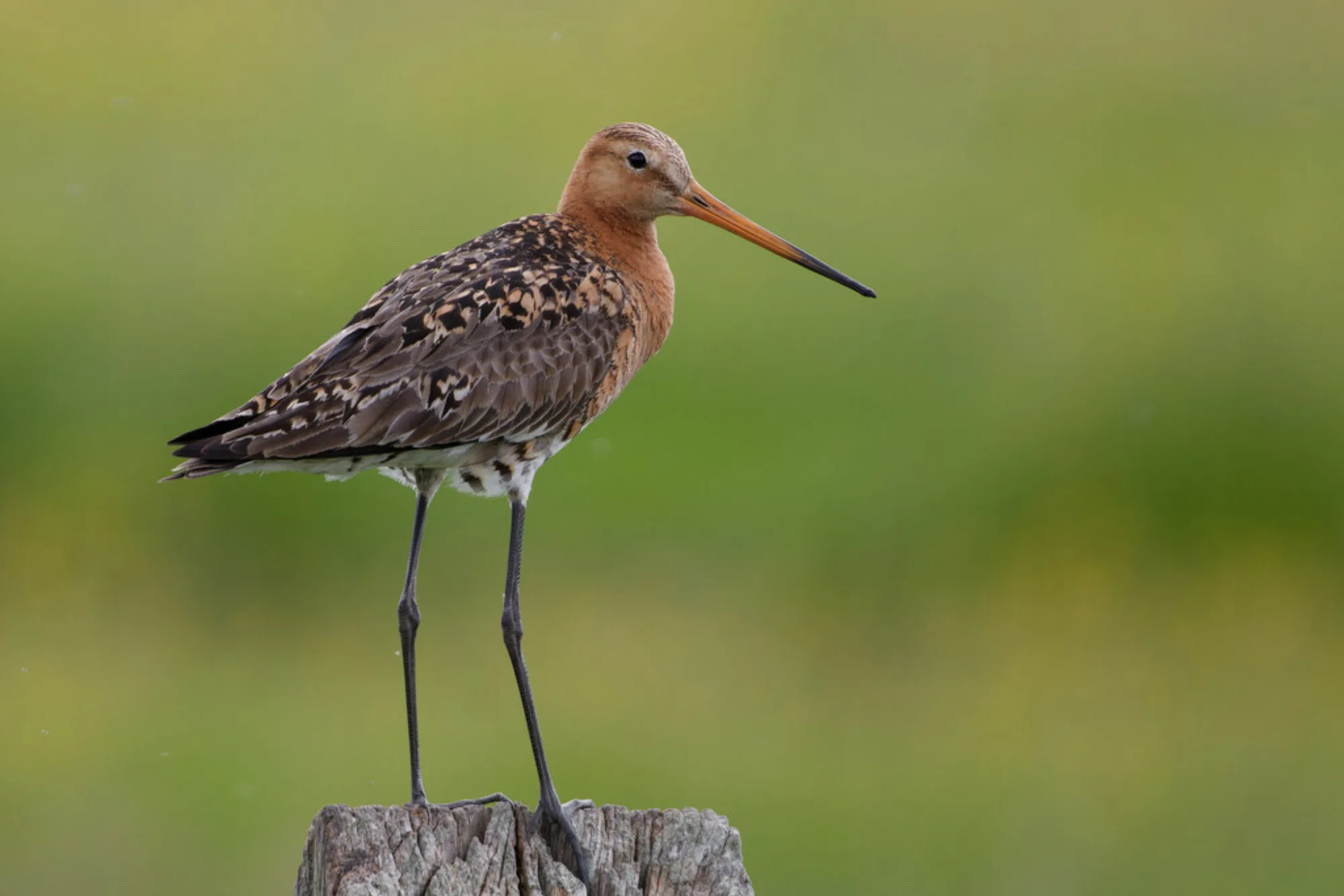
A tall wader with long legs and a long, straight bill, the Black-tailed Godwit cuts a distinctive shape on a wetland. In breeding plumage, its head, neck and chest turn orange, while winter brings a quieter grey-brown colouring. In flight, look for its white rump and striking wings patterned in black and white. On the ground, it can be hard to distinguish from the similar bar-tailed godwit, although its bill and legs are longer.
Black-tailed Godwits breed in scattered places across a range that reaches eastwards from Iceland to Russia's far eastern regions. Their breeding places include fens, damp meadows, lake edges, bogs and moorlands, as well as wet grasslands and coastal grazing marshes. They feed mainly in grasslands in spring, shifting after the breeding season to estuaries with muddy shores, where they also spend winter. They travel in flocks, wintering across areas including Australia, south Asia, Africa and western Europe, where they use wetlands such as swamps, flooded areas and inland pools.
Invertebrates make up most of their diet, with aquatic plants also eaten in winter and on migration. They probe vigorously in water, sometimes immersing the whole head, and search soft ground or pick food from the surface on land. Godwits nest in loose colonies, making shallow scrapes on the ground, usually among short vegetation. Both parents incubate the eggs, and after hatching lead the young away from the nest. In Europe, hunting in France adds pressure to the western European population. Extreme events can also cause complete breeding failures, while the species has undergone a continuing population decline.
Written from the English Wikipedia article Black-tailed godwit (CC BY-SA 4.0).
- Records
- 361,595
- Countries
- 25
- Atlas places
- 1
These are open occurrence records, so they show where people looked for and recorded the Black-tailed Godwit as much as where it lives. Cells are up to 25 km across, and every location is generalised to its cell.
Generalised encounter areas, not exact locations. Each shape is a grid cell coloured by how likely the species is there.
- Very likelyUnited Kingdom25 km zone · high confidence · 122465 records · updated 80 days ago
- Very likelyBelgium25 km zone · high confidence · 40258 records · updated 80 days ago
- Very likelyPortugal25 km zone · high confidence · 30745 records · updated 80 days ago
- Very likelySpain25 km zone · high confidence · 30206 records · updated 80 days ago
- Very likelyFrance25 km zone · high confidence · 22969 records · updated 80 days ago
- Very likelyIndia25 km zone · high confidence · 19358 records · updated 80 days ago
- Very likelyAustralia25 km zone · high confidence · 15588 records · updated 80 days ago
- Very likelyNetherlands25 km zone · high confidence · 11918 records · updated 80 days ago
- Very likelyIceland25 km zone · high confidence · 10710 records · updated 80 days ago
- Very likelyNorway25 km zone · high confidence · 9437 records · updated 80 days ago
Conservation status not assessed here yet, so every location is generalised to its grid cell.