Siberian Crane
Leucogeranus leucogeranus
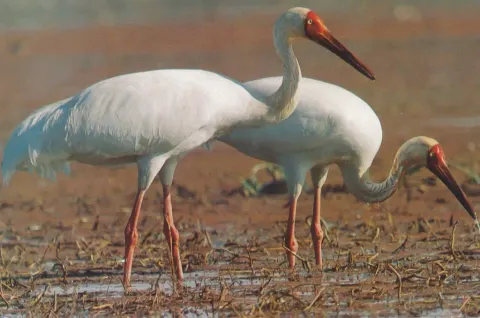
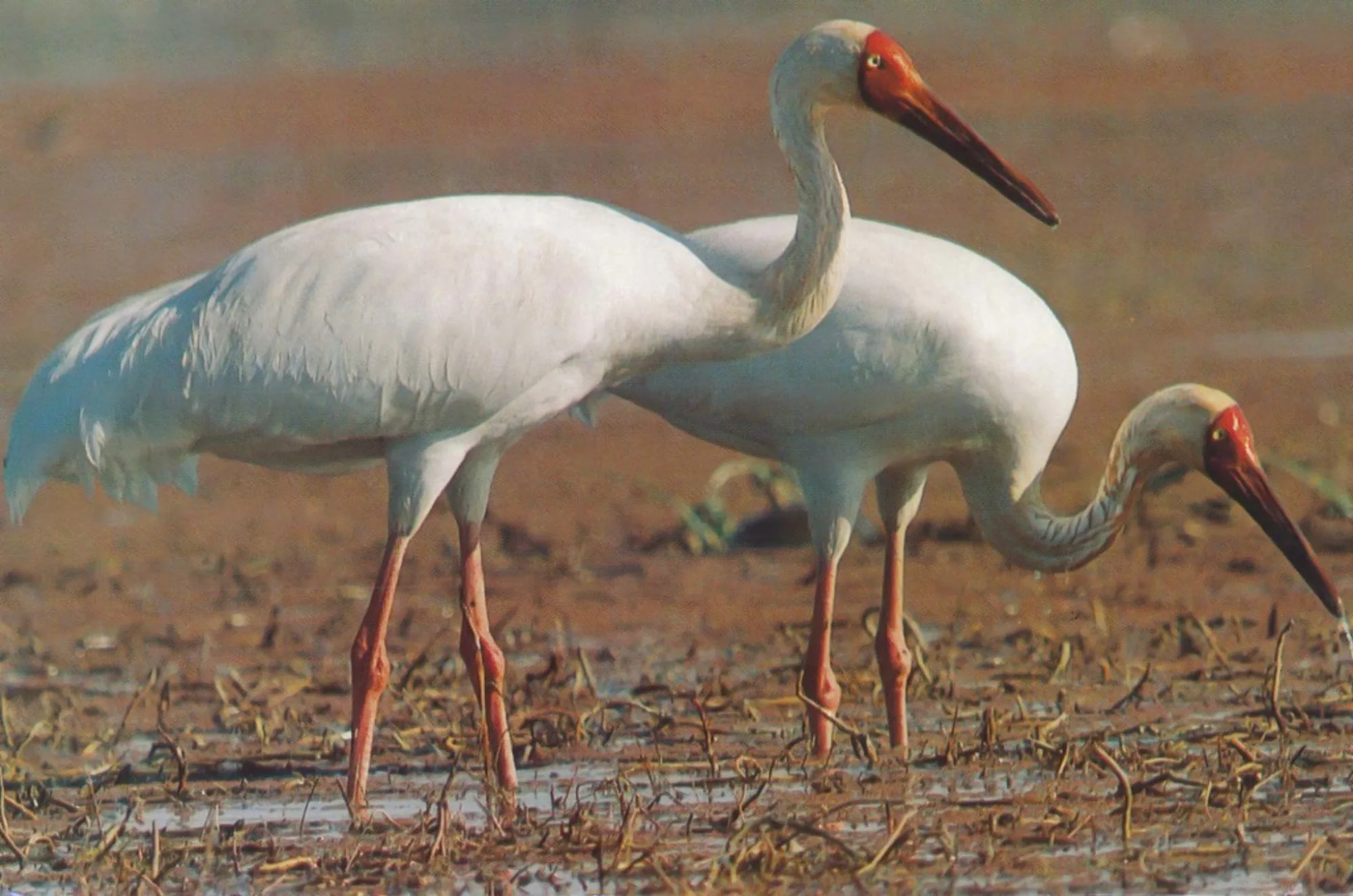
Snowy white plumage makes the adult Siberian Crane stand out, with black flight feathers appearing as it takes to the air. Its bare face and sides of the head are brick red, contrasting with a dark bill and pinkish legs. Young birds look different, with feathered faces and dull brown plumage. Listen for a high, goose-like whistle, quite unlike the trumpeting of many other cranes. Adults stand about 140 cm tall, with a wingspan of 210 to 260 cm.
The species breeds in two widely separated areas of Russia's Arctic tundra, with a larger eastern population in Yakutia and a western one in the Ob, Konda and Sossva river basins. Shallow marshes and wetlands are its habitat, although it often feeds in deeper water than other cranes. Eastern birds winter mainly around China's Poyang Lake, while the western population winters in Iran. These long-distance migrants return to the same breeding and wintering sites year after year. On the breeding grounds they are widely scattered and territorial; in winter they may form small, loose flocks and gather more closely at roosts.
Siberian Cranes feed through much of the day, sometimes putting their entire heads underwater to reach submerged vegetation. Their varied diet favours plants, but also includes small rodents, earthworms and fish. They return to the tundra around late April and early May, nesting on boggy lake edges usually surrounded by water. A typical clutch contains two eggs, though usually only one chick survives because of aggression between the young. Hunting along migration routes and the draining and degradation of wetlands have reduced populations, while water development projects threaten the Poyang wintering site. Reindeer and dogs accompanying herders can also disturb breeding birds.
Written from the English Wikipedia article Siberian crane (CC BY-SA 4.0).
- Records
- 3,040
- Countries
- 12
No atlas park has a record of the Siberian Crane in or around it yet.
These are open occurrence records, so they show where people looked for and recorded the Siberian Crane as much as where it lives. Cells are up to 25 km across, and every location is generalised to its cell.
Generalised encounter areas, not exact locations. Each shape is a grid cell coloured by how likely the species is there.
- Very likelyChina25 km zone · high confidence · 1380 records · updated 80 days ago
- Very likelyTaiwan25 km zone · high confidence · 728 records · updated 80 days ago
- Very likelyJapan25 km zone · high confidence · 323 records · updated 80 days ago
- Very likelyIndia25 km zone · high confidence · 271 records · updated 80 days ago
- Very likelyIran25 km zone · high confidence · 130 records · updated 80 days ago
- Very likelyHong Kong SAR China25 km zone · high confidence · 86 records · updated 80 days ago
- LikelyUnited States25 km zone · medium confidence · 62 records · updated 80 days ago
- LikelySouth Korea25 km zone · medium confidence · 31 records · updated 80 days ago
- PossibleRussia25 km zone · medium confidence · 14 records · updated 80 days ago
- PossibleAzerbaijan25 km zone · medium confidence · 7 records · updated 80 days ago
Conservation status not assessed here yet, so every location is generalised to its grid cell.