Ide
Leuciscus idus
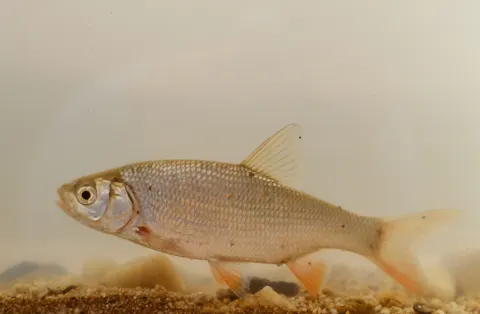
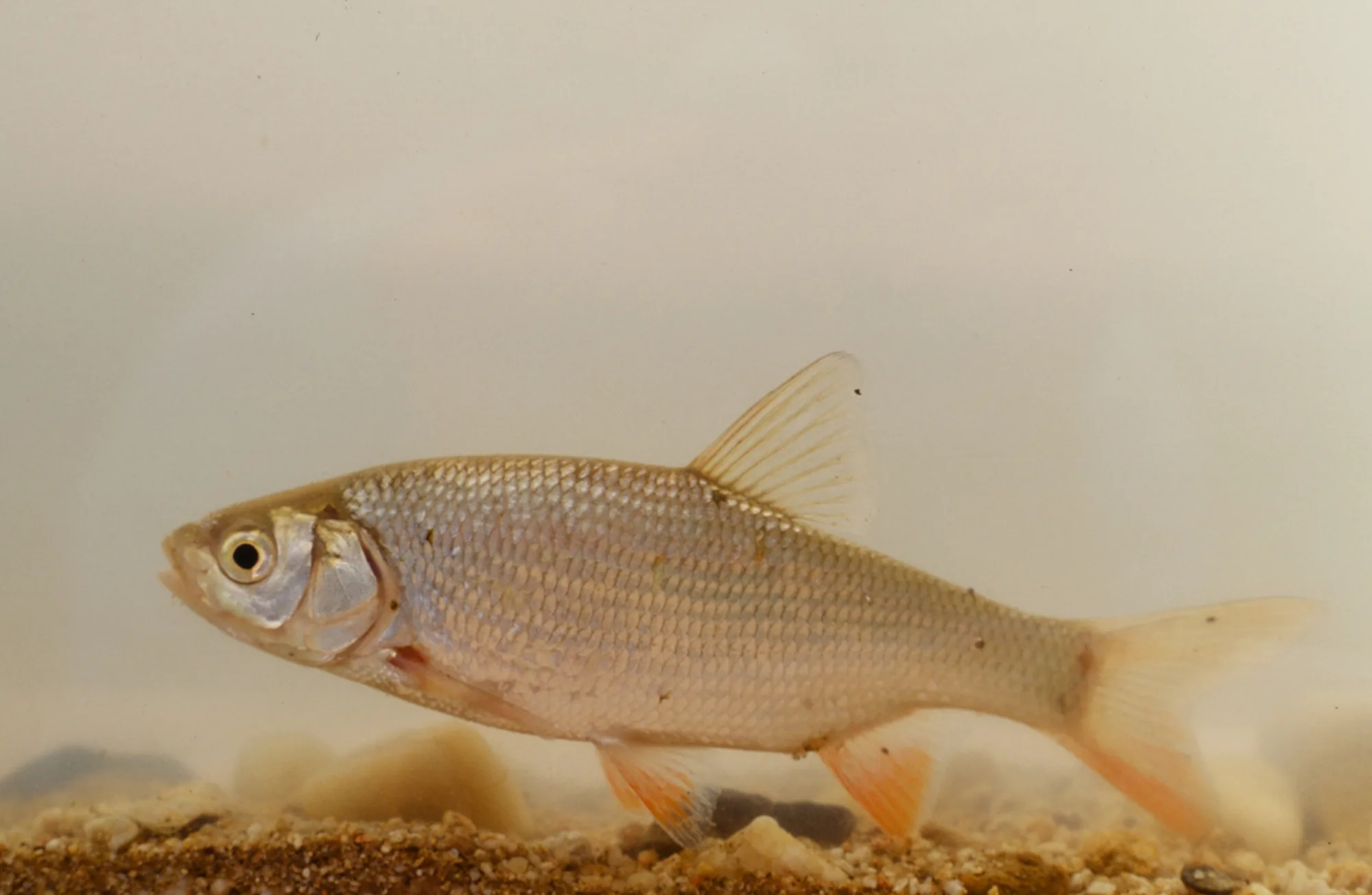
With its sturdy, fairly deep body and yellow eyes, the Ide is a freshwater fish also known as the orfe. Young fish have dark backs and silvery sides; as they age, their flanks take on a golden sheen, while their fins include reddish ones. They typically grow to 25 to 50 cm and weigh 0.5 to 1.5 kg, with weights above 2.0 kg uncommon.
Its native range extends east from rivers flowing into the North Sea, across southern Scandinavia and eastern Europe, as far as the River Lena and waters draining into the Caspian Sea. It has also been introduced beyond its native range, including to Great Britain, where it is widespread in England and Wales but localised in Scotland. Look for shoals in ponds, lakes and the clear pools of big rivers, particularly where the water is warmer. Some fish also use the Baltic Sea: in Sweden, they move downstream into the sea in summer and return to the lower reaches of rivers in autumn.
Small Ide feed near shore on insects, snails and other invertebrates, while larger fish move into deeper water and may eat other fish. Young fish can mix with shoals of related species, whereas larger adults form smaller groups of their own kind that patrol apparent regular routes. In spring, Ide spawn in shallow water, sometimes travelling up rivers and streams, and lay their eggs among gravel or on vegetation emerging from the water. They may move into deeper water for winter before returning to shallow freshwater to spawn. Dams and other human-made obstructions can harm fish that spawn in running water, and the Ide is less tolerant of nutrient enrichment than some related species.
Written from the English Wikipedia article Ide (fish) (CC BY-SA 4.0).
- Records
- 13,436
- Countries
- 9
No atlas park has a record of the Ide in or around it yet.
These are open occurrence records, so they show where people looked for and recorded the Ide as much as where it lives. Cells are up to 25 km across, and every location is generalised to its cell.
Generalised encounter areas, not exact locations. Each shape is a grid cell coloured by how likely the species is there.
- Very likelySweden25 km zone · medium confidence · 7581 records · updated 80 days ago
- Very likelyGermany25 km zone · high confidence · 2611 records · updated 80 days ago
- Very likelyNetherlands25 km zone · high confidence · 2043 records · updated 80 days ago
- Very likelyFrance25 km zone · high confidence · 676 records · updated 80 days ago
- Very likelyNorway25 km zone · medium confidence · 222 records · updated 80 days ago
- Very likelyBelgium25 km zone · medium confidence · 205 records · updated 80 days ago
- LikelyUnited Kingdom25 km zone · medium confidence · 43 records · updated 80 days ago
- LikelyRussia25 km zone · medium confidence · 31 records · updated 80 days ago
- LikelyFinland25 km zone · medium confidence · 24 records · updated 80 days ago
Conservation status not assessed here yet, so every location is generalised to its grid cell.