Asp
Leuciscus aspius
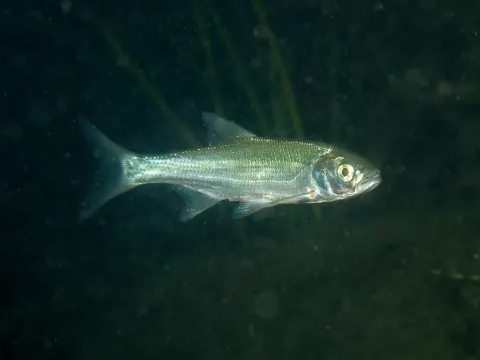
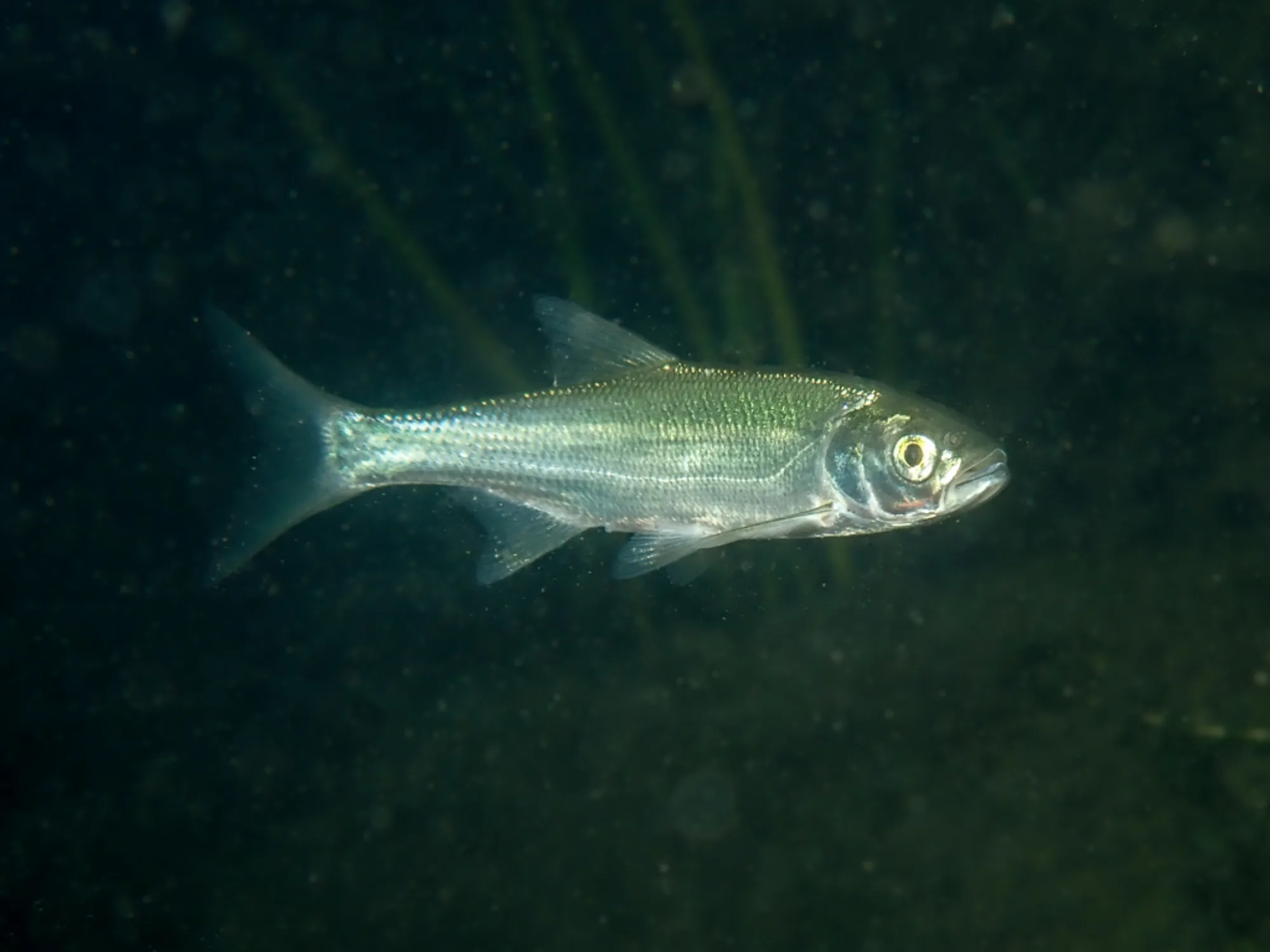
A long, pointed head and a slender-looking body give the Asp a distinctive profile. Its back is green with silver and blue tones, while its flanks are paler and its belly silvery white. The fins along its underside range from grey to brown. A typical fish measures 55 cm, though it can reach 120 cm and a recorded weight of 9 kg.
This freshwater fish occurs naturally in Europe's large rivers and lakes on low ground, and its range extends into western Asia. Its native waters include river systems flowing towards the North Sea, Baltic Sea, Black Sea, Caspian Sea and Aral Sea. In the Balkans, it occurs in the Struma and Maritsa drainages and in Greece's Lake Volvi. People have also introduced it to rivers outside its native range, including the Seine and Loire in France and the Po in Italy. Some populations feed in estuaries or brackish seas, then move into freshwater to breed.
Young Asp hunt together, while adults live alone or pursue prey in small groups. Fish are their main food throughout life, especially common bleak and European smelt, although Asp also eat small waterbirds. They can live for over 10 years. In Europe, breeding usually falls between mid-March and mid-April, though on the Volga it can continue into May. Females release eggs over gravel or submerged plants, where they stick. The species is caught for food and sport; the information provided does not identify specific threats to it.
Written from the English Wikipedia article Asp (fish) (CC BY-SA 4.0).
- Records
- 9,066
- Countries
- 14
No atlas park has a record of the Asp in or around it yet.
These are open occurrence records, so they show where people looked for and recorded the Asp as much as where it lives. Cells are up to 25 km across, and every location is generalised to its cell.
Generalised encounter areas, not exact locations. Each shape is a grid cell coloured by how likely the species is there.
- Very likelySweden25 km zone · high confidence · 5102 records · updated 81 days ago
- Very likelyGermany25 km zone · medium confidence · 990 records · updated 81 days ago
- Very likelyNetherlands25 km zone · medium confidence · 892 records · updated 81 days ago
- Very likelyFrance25 km zone · medium confidence · 679 records · updated 81 days ago
- Very likelyUkraine25 km zone · medium confidence · 631 records · updated 81 days ago
- Very likelyFinland25 km zone · high confidence · 320 records · updated 81 days ago
- Very likelyLuxembourg25 km zone · high confidence · 270 records · updated 81 days ago
- Very likelySwitzerland25 km zone · medium confidence · 46 records · updated 81 days ago
- LikelyNorway25 km zone · medium confidence · 49 records · updated 81 days ago
- LikelyBelgium25 km zone · medium confidence · 44 records · updated 81 days ago
Conservation status not assessed here yet, so every location is generalised to its grid cell.