Yarkand Hare
Lepus yarkandensis
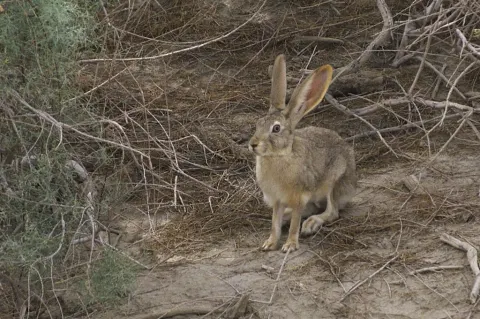
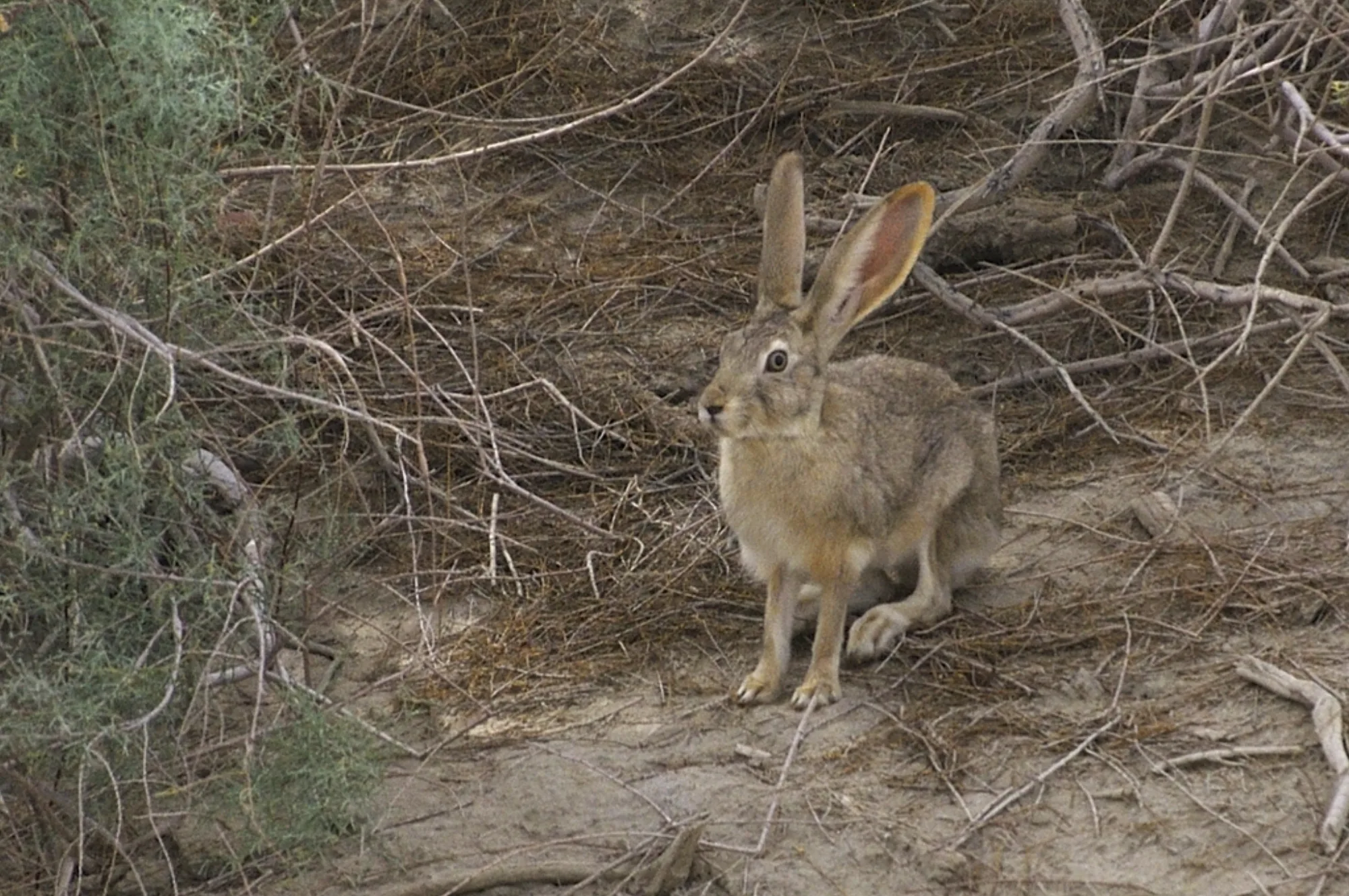
Found only in the Tarim Basin of Southern Xinjiang, China, this small mammal is identifiable by its sandy brown back marked with grayish-black stripes and its purely white belly. It reaches lengths of 285 to 430 mm and weighs between 1.1 and 1.9 kg. Unlike similar species in the region, the Yarkand Hare has long ears that lack black coloring at the tips. Its winter fur is notably lighter, and its 55 to 86 mm tail is smoke gray on top with a creamy white underside.
These hares live in a ring-shaped distribution around the Taklamakan Desert, preferring desert basins and areas with poplar, brush, or Chinese tamarisk. They often shelter in reeds along rivers but generally stay away from farmed fields. Primarily active at night, they are most likely to be seen in the early morning or late evening. During the day, they hide in vegetation or small depressions. They follow established foraging paths, sometimes 1 to 2 km long, to feed on crops and grass. The breeding season lasts from February to September, with females typically raising two or three litters of two to five young each year.
While around 200,000 individuals may live in the basin, their habitat is broken into isolated oases separated by dry desert. This fragmentation is a major concern for their survival. The population has declined by roughly 30% due to several human factors. People hunt them for their fur and as game, with 10,000 pelts produced annually in previous decades. Modern threats include petroleum exploration and the development of transportation, alongside the natural pressure of predation by eagles.
Written from the English Wikipedia article Yarkand hare (CC BY-SA 4.0).
- Atlas places
- 0
These are open occurrence records, so they show where people looked for and recorded the Yarkand Hare as much as where it lives. Cells are up to 25 km across, and every location is generalised to its cell.
No encounter zones yet
Where and when you can expect to see Yarkand Hare is calculated from observation density. No zones have been computed for this species yet.
Conservation status not assessed here yet, so every location is generalised to its grid cell.