White-tailed Jackrabbit
Lepus townsendii
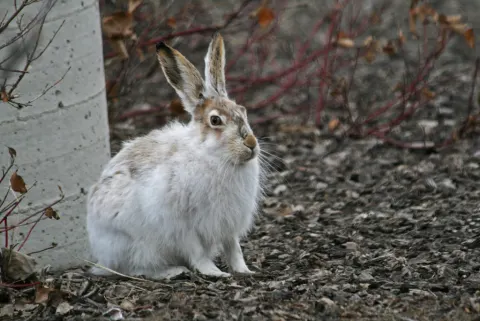
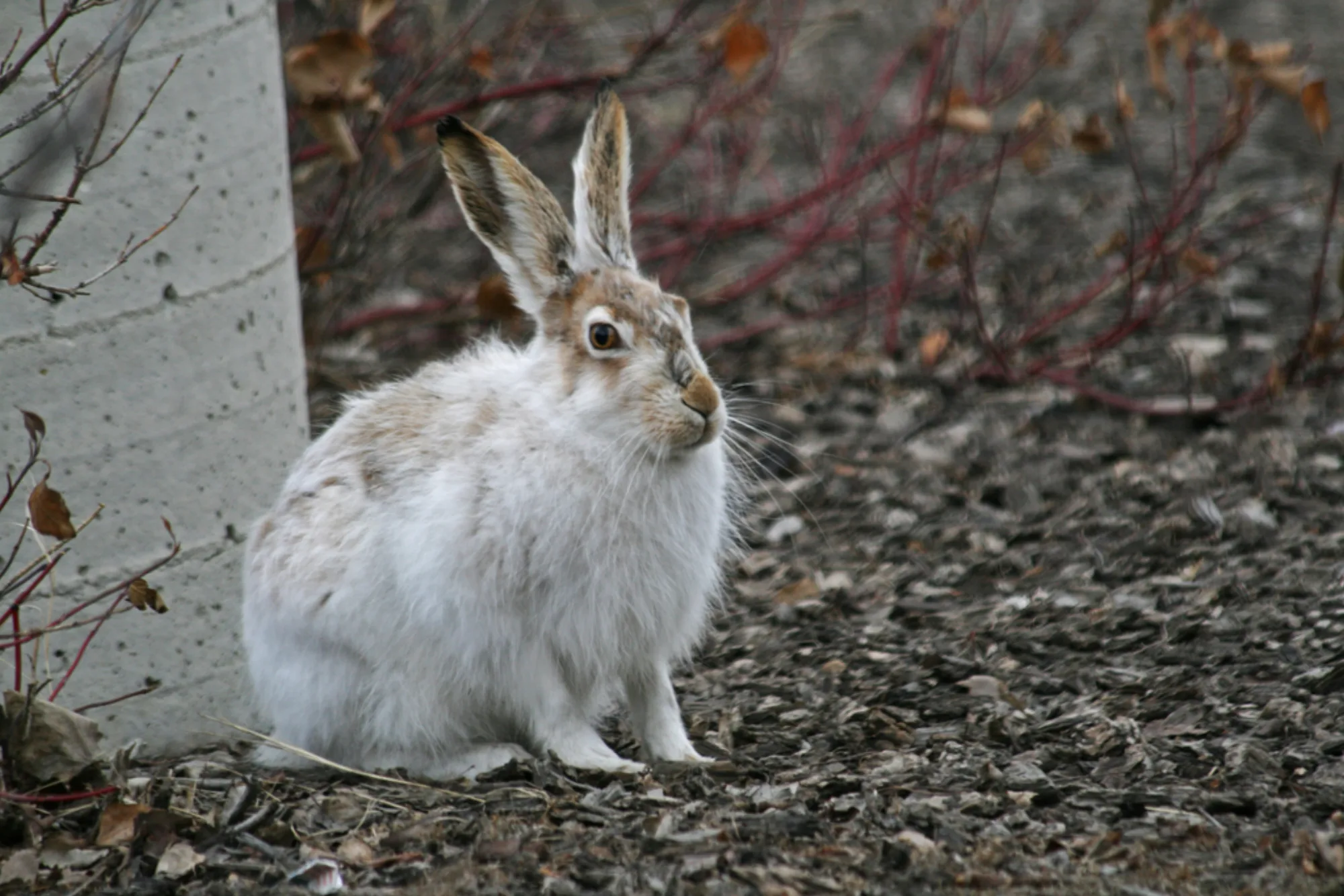
Large ears with black tips and a white tail marked by a dark stripe help distinguish the White-tailed Jackrabbit, a hare of western and central North America. Its back and sides are dark brown to greyish-brown, while its underside is pale grey. In northern populations, the coat turns white in autumn, apart from the ears. Adults measure 56 to 65 centimetres in length, including the tail, and weigh 2.5 to 4.3 kilograms.
Look for this hare in plains, prairie and alpine meadows with scattered conifers; in Colorado it occurs at elevations up to about 3,000 m. It is also often seen in urban and suburban parks in western Canada. Solitary and nocturnal, it spends the day in a shallow hollow concealed by vegetation, then comes out at dusk to feed. It eats grasses and other green plants, including crops, and takes buds, twigs and bark from low shrubs in winter. In different parts of its range, breeding extends from February to July. A female prepares a fur-lined nest beneath dense vegetation, where she usually gives birth to four or five young. Born with open eyes and full coats, the young soon begin to move around.
When danger approaches, a jackrabbit may crouch among plants, where its colour helps it remain hidden. If detected, it can bound away in a zigzag, running at up to 55 km/h and leaping up to 5 m. Coyotes, bobcats and American badgers prey on it, as do eagles, hawks, owls and sometimes snakes. People also hunt and eat it. The population may be declining slightly, and the hare has become scarce in Wyoming's Grand Teton National Park; the causes of the decline in Wyoming are unclear.
Written from the English Wikipedia article White-tailed jackrabbit (CC BY-SA 4.0).
- Records
- 479
- Countries
- 2
- Atlas places
- 4
These are open occurrence records, so they show where people looked for and recorded the White-tailed Jackrabbit as much as where it lives. Cells are up to 25 km across, and every location is generalised to its cell.
Generalised encounter areas, not exact locations. Each shape is a grid cell coloured by how likely the species is there.
- Very likelyCanada25 km zone · medium confidence · 439 records · updated 80 days ago
- Very likelyUnited States25 km zone · medium confidence · 40 records · updated 80 days ago
Conservation status not assessed here yet, so every location is generalised to its grid cell.