Mountain Hare
Lepus timidus
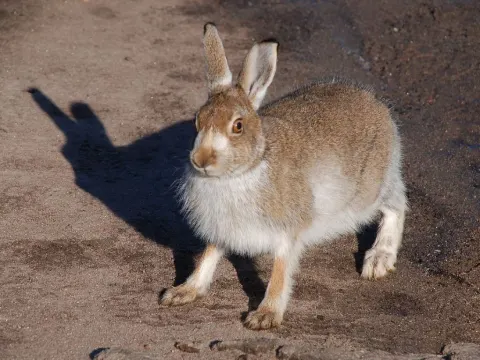
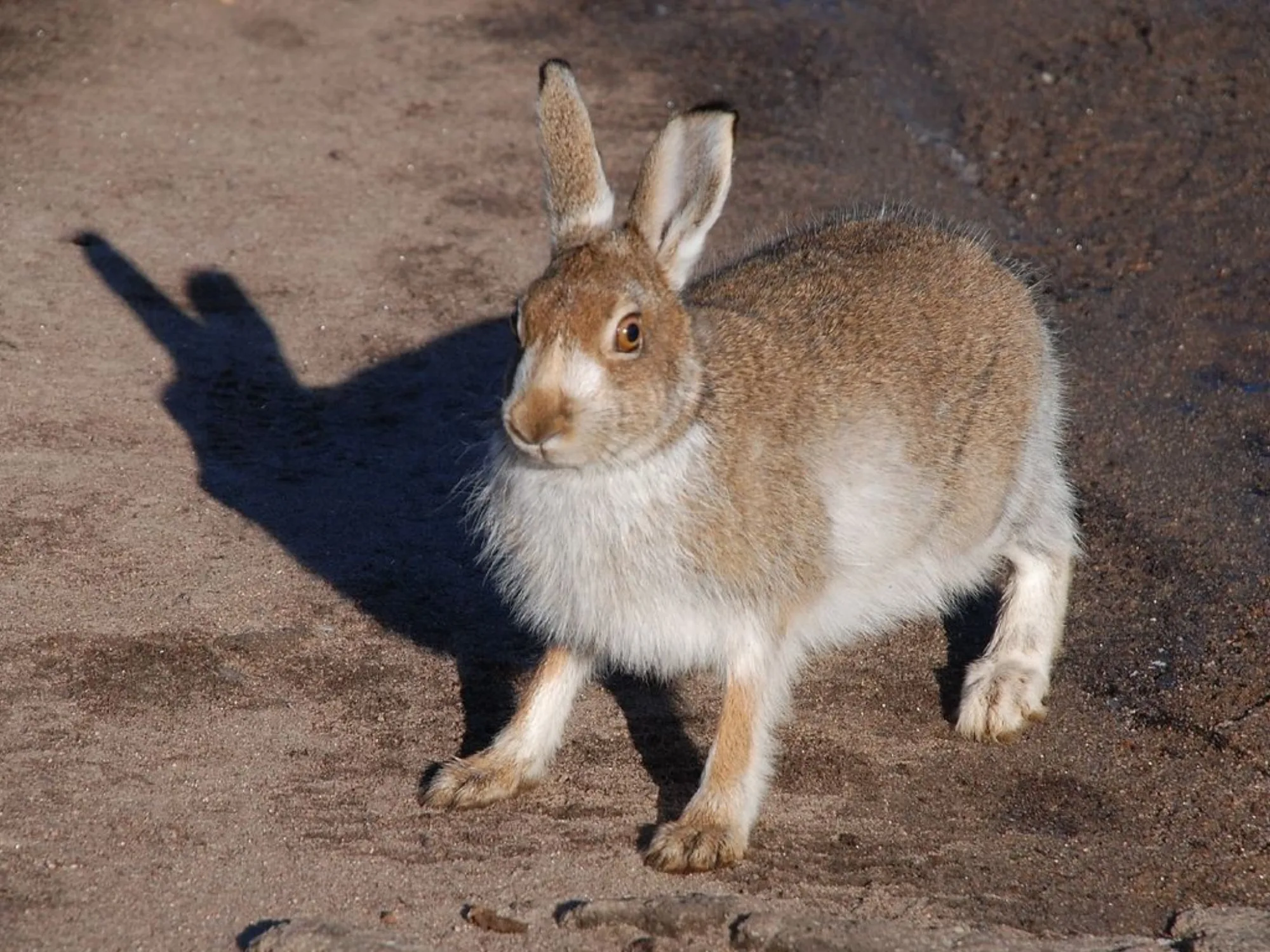
In summer, the Mountain Hare wears shades of brown, while most populations moult into white or largely white coats for winter. Its tail stays completely white throughout the year, a useful way to distinguish it from the European hare. There are local variations: Irish hares remain brown year-round, and those in the Faroe Islands turn grey in winter. This large hare reaches 45 to 65 cm in length and weighs 2 to 5.3 kg, with females slightly heavier than males. Its range stretches from Fennoscandia to eastern Siberia, with isolated populations in places including the Alps, Scotland and Hokkaidō. Beyond Ireland's mountains, it inhabits salt marshes, pastures in the lowlands and grasslands by the coast; in the Alps it occurs from 700 to 3,800 m, depending on region and season.
Food varies with the landscape: clover and grasses are favoured across much of its range, while bark, moss, lichens and twigs become food when snow restricts other options. Hares eat dwarf willow in tundra and favour common heather on Swedish islands and Scottish moorlands. During the breeding season, grass makes up a greater share of the female's diet, and heather a smaller share, compared with the male's. Red foxes are an important predator, while golden eagles, pine martens, wolves, lynxes and stoats also take mountain hares. In parts of Finland, Norway and Sweden, competition and occasional hybridisation with European hares, together with a warming climate, have contributed to population decline. Heavy winter recreation can cause behavioural and physiological changes that demand extra energy when snow limits access to food. Mountain hares have also been shot in the Scottish Highlands, and climate change threatens the long-term survival of the introduced Peak District population.
Written from the English Wikipedia article Mountain hare (CC BY-SA 4.0).
- Records
- 38,254
- Countries
- 10
No atlas park has a record of the Mountain Hare in or around it yet.
These are open occurrence records, so they show where people looked for and recorded the Mountain Hare as much as where it lives. Cells are up to 25 km across, and every location is generalised to its cell.
Generalised encounter areas, not exact locations. Each shape is a grid cell coloured by how likely the species is there.
- Very likelyNorway25 km zone · high confidence · 12895 records · updated 80 days ago
- Very likelySwitzerland25 km zone · high confidence · 11150 records · updated 80 days ago
- Very likelyFrance25 km zone · high confidence · 10309 records · updated 80 days ago
- Very likelyItaly25 km zone · high confidence · 1533 records · updated 80 days ago
- Very likelyFinland25 km zone · high confidence · 1091 records · updated 80 days ago
- Very likelyUnited Kingdom25 km zone · high confidence · 920 records · updated 80 days ago
- Very likelyRussia25 km zone · high confidence · 144 records · updated 80 days ago
- Very likelyAustria25 km zone · high confidence · 86 records · updated 80 days ago
- Very likelySweden25 km zone · high confidence · 76 records · updated 80 days ago
- LikelyFaroe Islands25 km zone · medium confidence · 50 records · updated 80 days ago
Conservation status not assessed here yet, so every location is generalised to its grid cell.