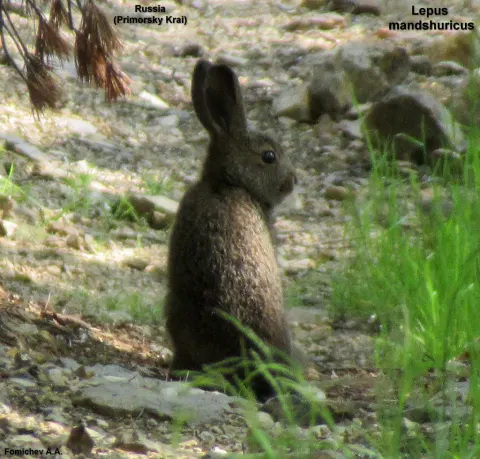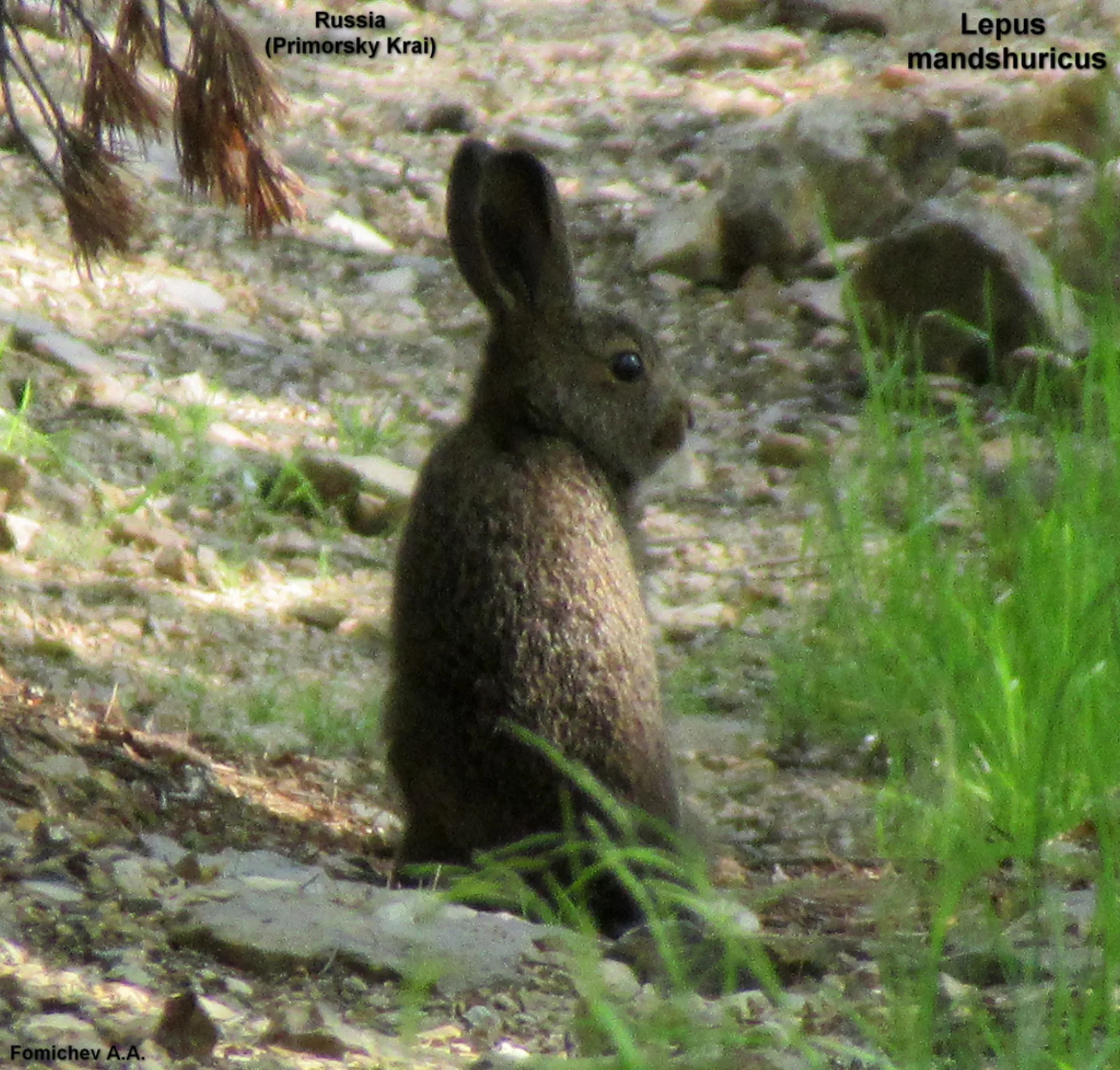
Manchurian Hare
Lepus mandshuricus
Native to the forests of northeastern China and eastern Russia, the Manchurian Hare is a nocturnal mammal that prefers the shelter of mixed woodlands. It is a medium-sized hare with a body length between 41 and 54 centimetres and a tail of 5 to 8 centimetres. An adult typically scales from 1.4 to 2.6 kilograms. Most individuals have soft, ocher brown or gray fur, though a shiny black melanistic form also exists. To distinguish it from the similar Korean hare, look for its relatively small ears and shorter hind legs.
This species avoids open spaces and human settlements, opting instead for the cover of hollow tree trunks or other closed shelters. It is active at dawn and throughout the night, feeding on a diet of herbs, fallen fruits, and shrubs, as well as the bark and twigs of trees like willow, birch, and maple. When threatened, it may make a sound like a sneeze. Breeding occurs over a five-month season beginning in March or April, with females producing two or three litters each year.
Travellers may find these hares at altitudes reaching 900 m, particularly in areas rich with Mongolian oak and hazelnut. While they can reach high densities of 55 individuals per 100 hectares, they face several pressures. The clearing of forests destroys their specific habitat, allowing the Tolai hare to move in and compete for resources. Additionally, they are the subject of subsistence hunting, and their meat was historically described as very savory.
Written from the English Wikipedia article Manchurian hare (CC BY-SA 4.0).
- Records
- 1
- Countries
- 1
- Atlas places
- 0
These are open occurrence records, so they show where people looked for and recorded the Manchurian Hare as much as where it lives. Cells are up to 25 km across, and every location is generalised to its cell.
Generalised encounter areas, not exact locations. Each shape is a grid cell coloured by how likely the species is there.
- Very likelyRussia25 km zone · medium confidence · 1 record · updated 4 days ago
Conservation status not assessed here yet, so every location is generalised to its grid cell.