European Hare
Lepus europaeus
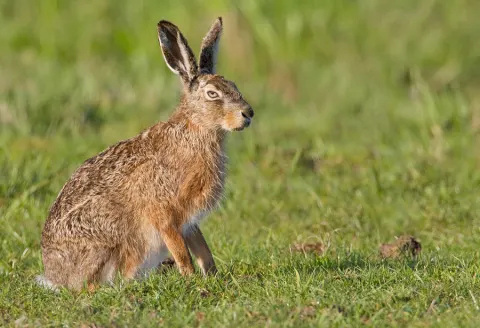
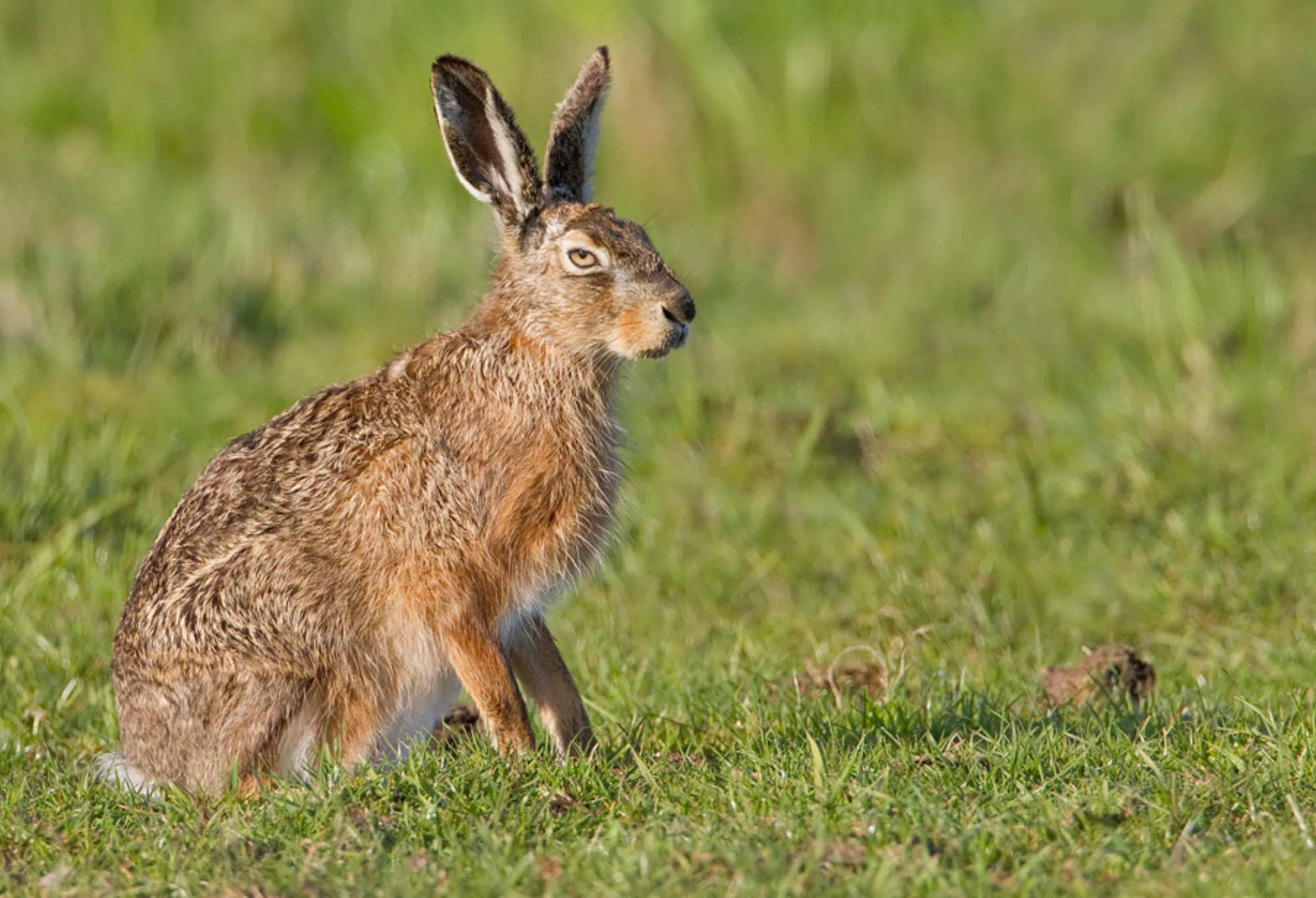
Long legs, tall ears and a lean build give the European Hare a distinctive outline in open country. Its back is grizzled yellow-brown, with reddish tones on the shoulders, legs, neck and throat. Look for a white underside and black tips to the ears and tail. This is the largest hare native to Europe, measuring 55 to 65 cm from head to body, with a tail of 7.5 to 14 cm.
Native to much of continental Europe and extending east into Central Asia, it has also been introduced to places including Ireland, Australia and New Zealand. It favours open fields and mixed farmland, using scattered vegetation for shelter. Hedges, ditches and other permanent cover provide both refuge and a variety of food, while large open fields support fewer hares. Usually shy and active at night, it spends daylight hours partly concealed in a shallow depression in the ground. In spring, hares can be seen chasing each other across fields in daylight and sometimes standing upright to box with their paws. They eat mainly grasses and herbs, adding crops, twigs, buds and bark to their diet, especially in winter. Hares also forage in groups, where individuals can spend more time feeding while others keep watch.
The breeding season runs from January to August, and females give birth in depressions in the ground. The young are born with fur and can leave the nest soon after birth. Red foxes and birds of prey hunt hares, which escape by running across open ground. Populations have declined in many areas since the 1960s, with changes in farming, climate change and increased predation associated with those declines. Hunting and disease also take a toll, while importing hares for restocking can threaten regional gene pools.
Written from the English Wikipedia article European hare (CC BY-SA 4.0).
- Records
- 301,850
- Countries
- 49
No atlas park has a record of the European Hare in or around it yet.
These are open occurrence records, so they show where people looked for and recorded the European Hare as much as where it lives. Cells are up to 25 km across, and every location is generalised to its cell.
Generalised encounter areas, not exact locations. Each shape is a grid cell coloured by how likely the species is there.
- Very likelySwitzerland25 km zone · high confidence · 154828 records · updated 86 days ago
- Very likelyFrance25 km zone · high confidence · 68719 records · updated 86 days ago
- Very likelyDenmark25 km zone · high confidence · 34518 records · updated 86 days ago
- Very likelyNetherlands25 km zone · high confidence · 16298 records · updated 86 days ago
- Very likelyAustria25 km zone · high confidence · 7350 records · updated 86 days ago
- Very likelyGermany25 km zone · high confidence · 6400 records · updated 86 days ago
- Very likelyBelgium25 km zone · high confidence · 3368 records · updated 86 days ago
- Very likelyFinland25 km zone · high confidence · 2700 records · updated 86 days ago
- Very likelyUnited Kingdom25 km zone · high confidence · 2600 records · updated 86 days ago
- Very likelyLuxembourg25 km zone · high confidence · 2130 records · updated 86 days ago
Conservation status not assessed here yet, so every location is generalised to its grid cell.