Black-tailed Jackrabbit
Lepus californicus
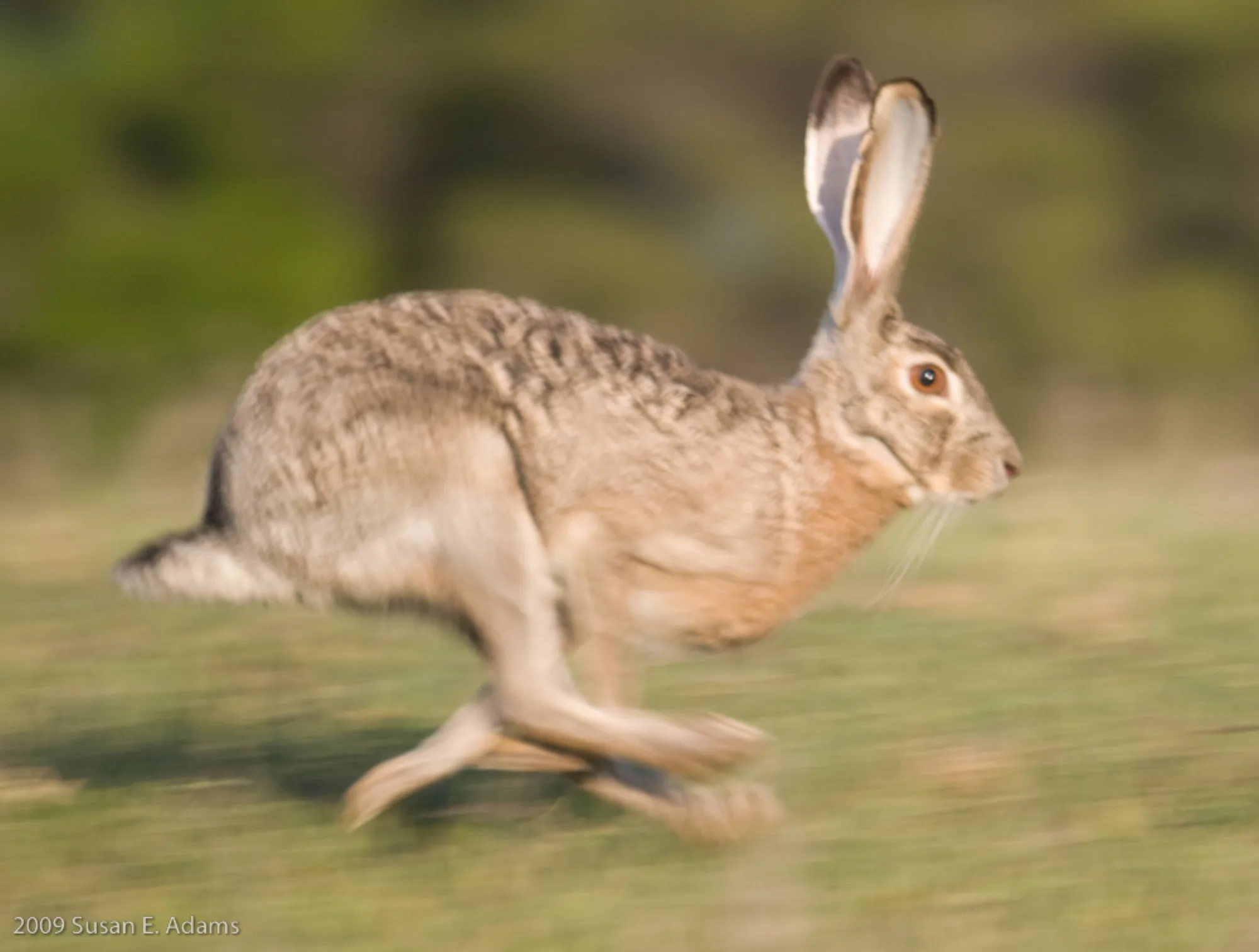
Long ears, powerful hind legs and a dark stripe running forward from the tail help distinguish the Black-tailed Jackrabbit. This large hare reaches about 61 cm in length and weighs 1.4 to 2.7 kg. Its back is dark buff flecked with black, while its belly and inner legs are creamy white; the outer ears have black tips.
The native range extends between central Washington and Missouri, reaching southwards into Mexico as far as Baja California Sur and Zacatecas; the hare has also been introduced to southern Florida and parts of the Atlantic coast. It favours landscapes that mix shrubs, grasses and other low plants, including desert shrublands, prairies and open chaparral. It also occurs in and near cropland, particularly alfalfa fields. Look for moderately open ground with shrubs or small trees for cover and grassy areas for feeding after dark.
The hare stays in the same habitat year-round, sheltering among shrubs by day and moving into open feeding areas at night. Its diet includes shrubs, small trees, grasses and other plants, as well as some fungi. Shrubs make up much of its autumn and winter food, while grasses and other low plants are eaten in spring and early summer, though the pattern varies with climate. Breeding usually peaks in spring but can continue nearly all year in warm climates. Young are born furred, with open eyes, and can move within minutes; their mother stays with them only to nurse. Hawks, owls, eagles and mammals including coyotes and foxes prey on these hares, while snakes can take young. Disease and parasites also affect them, and people hunt them for pest control or sport.
Written from the English Wikipedia article Black-tailed jackrabbit (CC BY-SA 4.0).
- Records
- 3,143
- Countries
- 2
- Atlas places
- 4
These are open occurrence records, so they show where people looked for and recorded the Black-tailed Jackrabbit as much as where it lives. Cells are up to 25 km across, and every location is generalised to its cell.
Generalised encounter areas, not exact locations. Each shape is a grid cell coloured by how likely the species is there.
- Very likelyUnited States25 km zone · medium confidence · 3009 records · updated 80 days ago
- Very likelyMexico25 km zone · medium confidence · 134 records · updated 80 days ago
Conservation status not assessed here yet, so every location is generalised to its grid cell.