Arctic Hare
Lepus arcticus
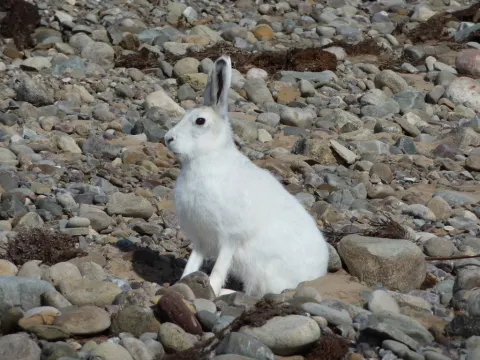
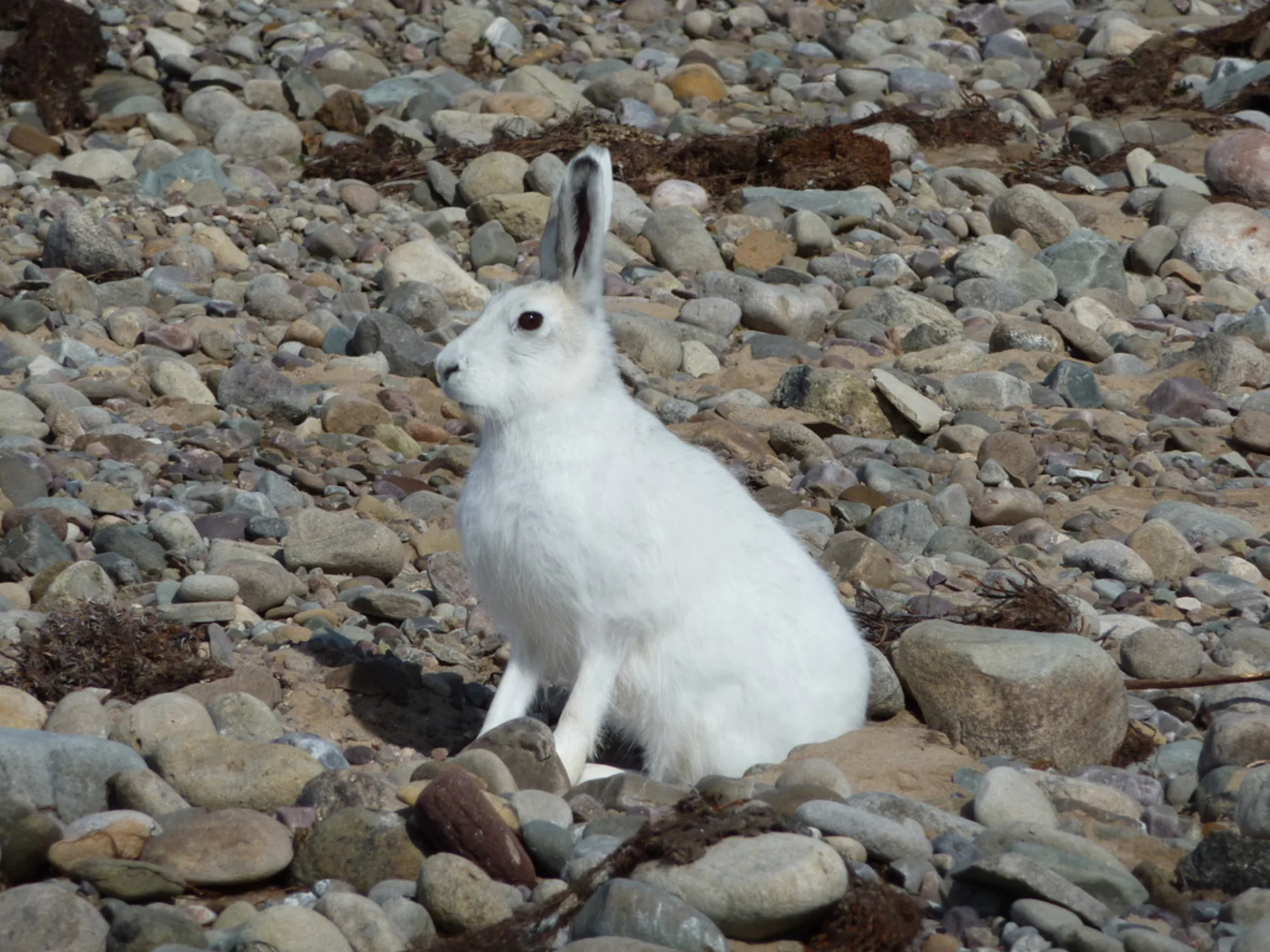
Built for cold, the Arctic Hare has a thick coat, short ears and limbs, and a small nose. It resembles a rabbit, but stands taller and has shorter ears. In Newfoundland and southern Labrador, its coat changes from brown or grey in summer to white in winter, while hares in the far north of Canada stay white throughout the year. Adults typically measure 43 to 70 cm long, excluding the tail, and weigh 2.5 to 5.5 kg.
Its range stretches across the far north of Greenland and Canada, including the Canadian Arctic islands, and reaches south to Labrador and Newfoundland. Look for it in tundra, on plateaus and along treeless coasts, from sea level up to 900 m. Arctic hares are usually seen alone, although they sometimes travel together in large groups. They dig holes in the ground or snow for warmth and sleep, and solitary hares may rest behind large rocks, sheltered from wind and hidden from predators. Long rests and shorter feeding bouts help them conserve energy in this cold habitat.
The hare eats mainly woody plants, including Arctic willow, as well as plants such as saxifrage and crowberry, and its diet becomes more varied in summer. It also eats snow for water. Breeding takes place around April or May, and young are born around May, June or July. A litter can have up to eight young, which stay within their mother's home range until they can survive independently. Wolves, Arctic foxes, ermines, snowy owls and other predators hunt Arctic hares, with some smaller predators chiefly taking the young. Humans also occasionally prey on them.
Written from the English Wikipedia article Arctic hare (CC BY-SA 4.0).
- Records
- 57
- Countries
- 3
- Atlas places
- 1
These are open occurrence records, so they show where people looked for and recorded the Arctic Hare as much as where it lives. Cells are up to 25 km across, and every location is generalised to its cell.
Generalised encounter areas, not exact locations. Each shape is a grid cell coloured by how likely the species is there.
- Very likelyCanada25 km zone · medium confidence · 26 records · updated 80 days ago
- Very likelySt. Pierre & Miquelon25 km zone · medium confidence · 16 records · updated 80 days ago
- Very likelyGreenland25 km zone · medium confidence · 15 records · updated 80 days ago
Conservation status not assessed here yet, so every location is generalised to its grid cell.