Greater Adjutant
Leptoptilos dubius
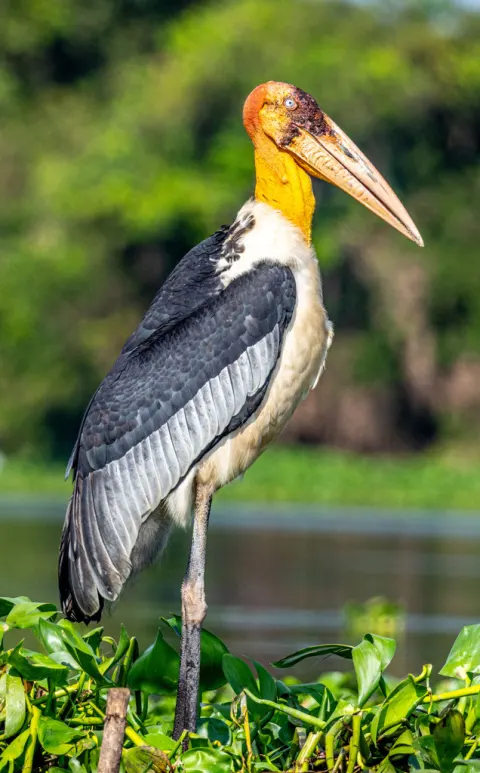
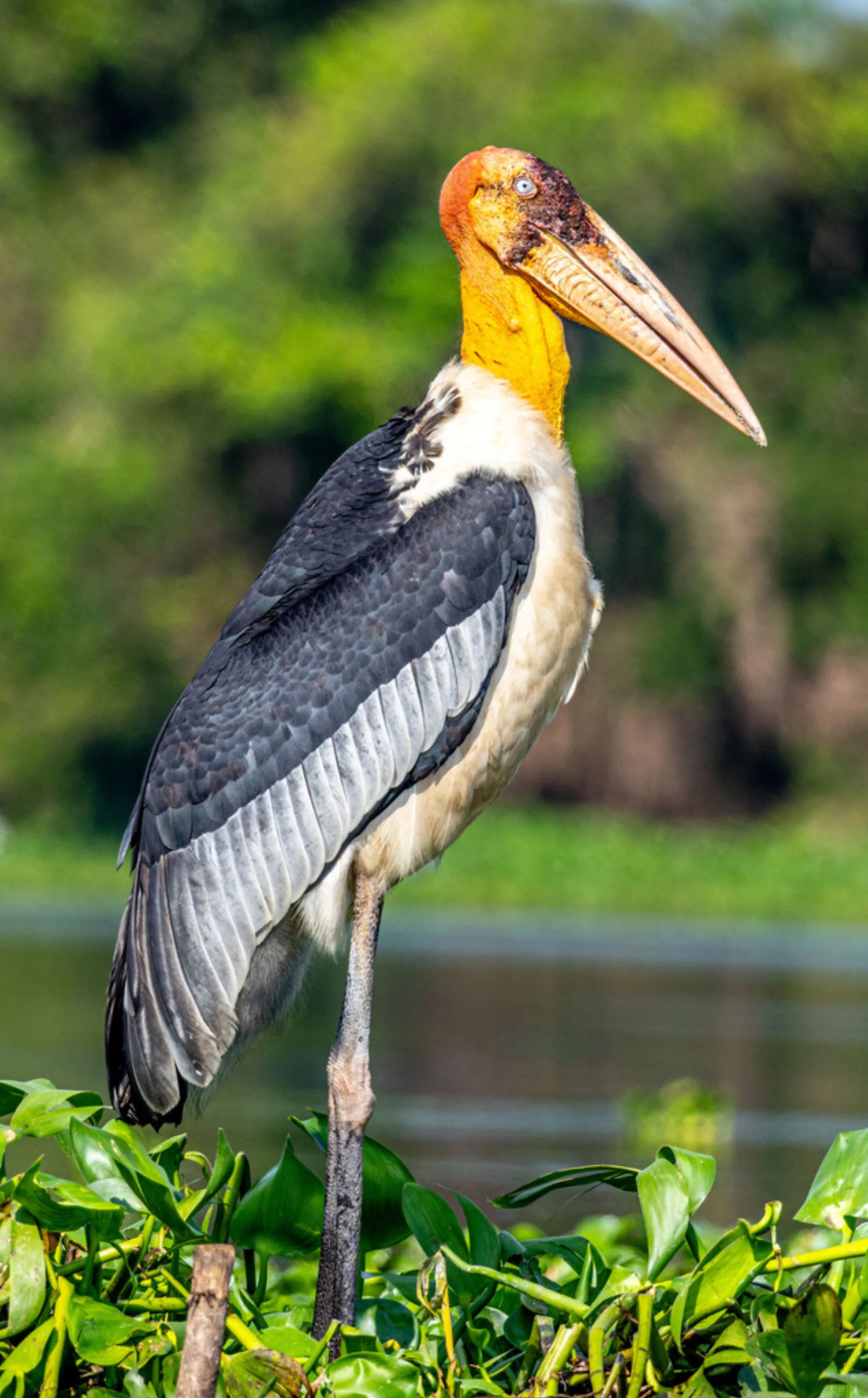
Standing 145 to 150 cm tall, the Greater Adjutant is a huge stork with a bare head, a hanging neck pouch and a massive wedge-shaped bill. Its bill is pale grey with a dark base, and a white collar frames its bare neck, which ranges from yellow to red. Dark wings contrast with light grey patches, and the underside is whitish. In the breeding season, the neck and pouch turn bright orange. On the ground it walks with a stiff, marching gait, while in flight it draws its neck back and soars on thermals.
Its breeding populations are found in Assam and around Bhagalpur in India, and in Cambodia. After breeding, birds disperse widely, with those in the Indian region moving mainly across the Gangetic Plains. Look for them alone or in small groups around shallow lakes, drying lake beds and rubbish dumps, sometimes alongside kites and vultures. They may remain hunched and still for long periods. Carrion and offal make up much of their food, but they also catch fish, frogs and other animals. In winter, they nest in colonies, building large platforms of twigs on branches of tall trees. Both parents incubate the eggs, then feed their chicks on the nest for roughly five months.
Wetland drainage, pollution and other disturbance have reduced feeding and nesting habitat, while hunting and egg collection contributed to past declines. Birds can also be killed by poisoning, shooting or collisions with telephone lines. In Assam, local residents have helped protect the storks and the trees where they breed.
Written from the English Wikipedia article Greater adjutant (CC BY-SA 4.0).
- Records
- 7,192
- Countries
- 3
- Atlas places
- 2
These are open occurrence records, so they show where people looked for and recorded the Greater Adjutant as much as where it lives. Cells are up to 25 km across, and every location is generalised to its cell.
Generalised encounter areas, not exact locations. Each shape is a grid cell coloured by how likely the species is there.
- Very likelyIndia25 km zone · high confidence · 5962 records · updated 80 days ago
- Very likelyCambodia25 km zone · high confidence · 1222 records · updated 80 days ago
- UncommonThailand25 km zone · medium confidence · 8 records · updated 80 days ago
Conservation status not assessed here yet, so every location is generalised to its grid cell.