Marabou Stork
Leptoptilos crumenifer
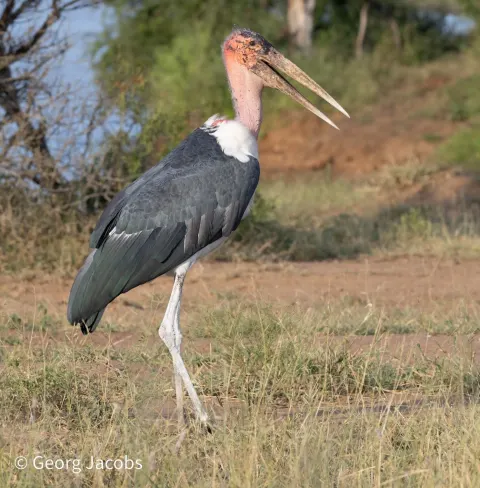
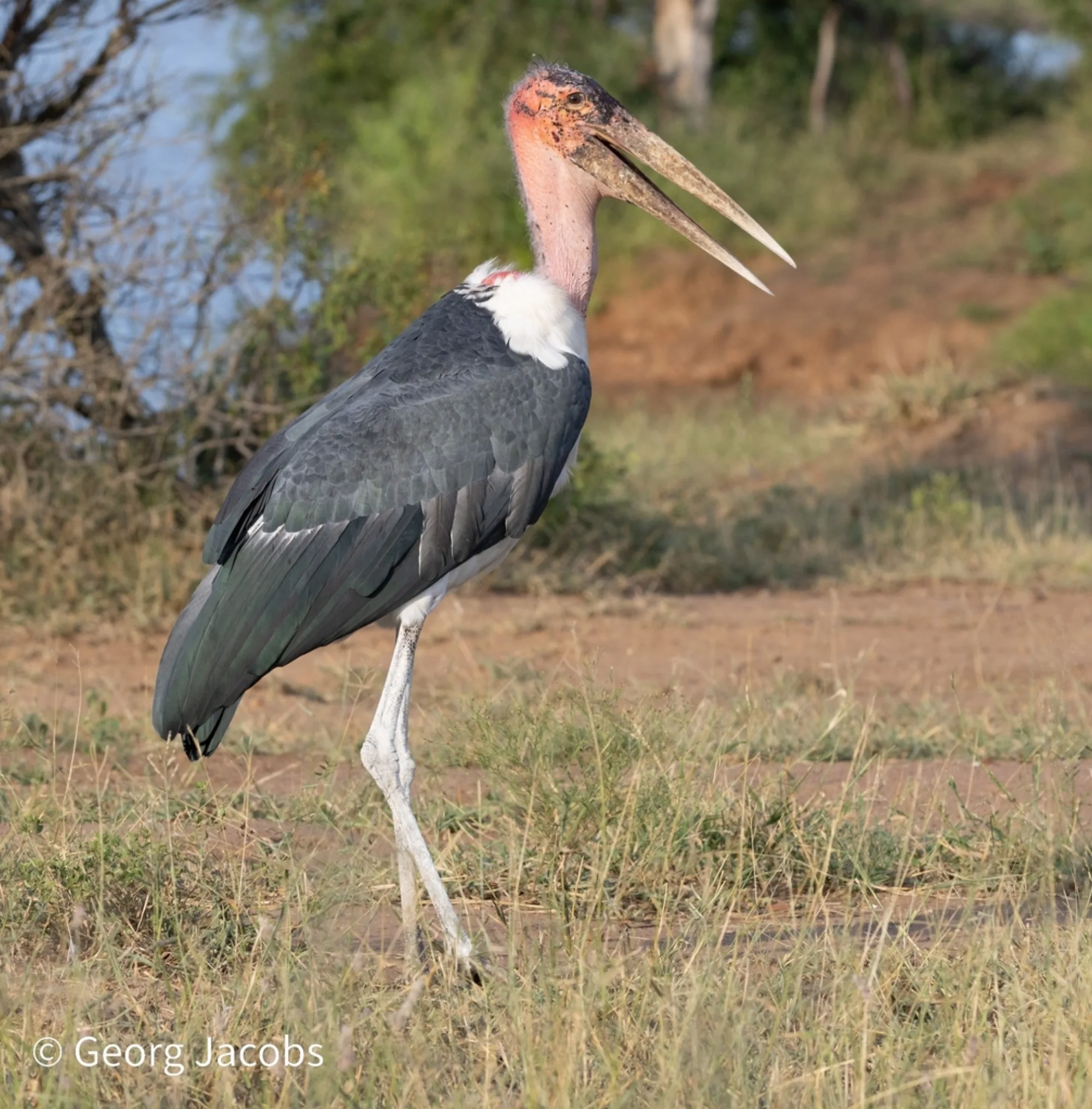
With its immense size, bare head and neck, and heavy bill, the Marabou Stork is hard to mistake. Its black back and wings contrast with white underparts and legs, while a pink pouch hangs at the throat. Young birds are browner than adults and have smaller bills. In flight, the stork draws its neck back, rather like a heron. Its wings average 2.6 metres across, with some recorded at up to 3.2 metres.
Native to sub-Saharan Africa, the bird breeds in wet and dry habitats, often close to people and landfill sites. In East Africa it breeds in towns and cities, while in southern African countries it mainly nests in less populated places. Marabou Storks gather in groups and breed in colonies during the dry season, when shrinking pools make food easier to find. A pair nests in a tree, using sticks to build a small nest for two or three eggs. The eggs hatch after 30 days.
Carrion, scraps and faeces make up much of its diet, although it will take almost any animal matter it can swallow. At a carcass, it often follows vultures, waiting for discarded meat, stealing a piece or feeding after they have finished. Breeding adults take mostly small live prey, including fish, frogs and insects, to feed their young. The birds sometimes wash food in water to clear off soil. Many now rely on human rubbish, gathering in large numbers at dumps or waiting for food in urban areas. Adults have few natural enemies, though lions have reportedly ambushed and eaten some birds.
Written from the English Wikipedia article Marabou stork (CC BY-SA 4.0).
- Records
- 71,020
- Countries
- 32
- Atlas places
- 44
- Kruger National Park· South Africa
- Serengeti National Park· Tanzania
- Okavango Delta· Botswana
- Ngorongoro Conservation Area· Tanzania
- Chobe National Park· Botswana
- Tsavo East National Park· Kenya
- Maasai Mara National Reserve· Kenya
- Tsavo West National Park· Kenya
- Etosha National Park· Namibia
- Lake Manyara National Park· Tanzania
- Murchison Falls National Park· Uganda
- Nairobi National Park· Kenya
- Queen Elizabeth National Park· Uganda
- Aberdare National Park· Kenya
- Hwange National Park· Zimbabwe
- Rwenzori Mountains National Park· Uganda
- Samburu National Reserve· Kenya
- Tarangire National Park· Tanzania
- Zambezi National Park· Zimbabwe
- Akagera National Park· Rwanda
- Bwabwata National Park· Namibia
- iSimangaliso Wetland Park· South Africa
- Kibale National Park· Uganda
- Mapungubwe National Park· South Africa
- Mount Kenya National Park· Kenya
- Nyerere National Park· Tanzania
- South Luangwa National Park· Zambia
- Amboseli National Park· Kenya
- Arusha National Park· Tanzania
- Bwindi Impenetrable National Park· Uganda
- Gonarezhou National Park· Zimbabwe
- Hell's Gate National Park· Kenya
- Kilimanjaro National Park· Tanzania
- Lake Mburo National Park· Uganda
- Lake Nakuru National Park· Kenya
- Liuwa Plain National Park· Zambia
- Lower Zambezi National Park· Zambia
- Mana Pools National Park· Zimbabwe
- Mikumi National Park· Tanzania
- Nkasa Rupara National Park· Namibia
- Pilanesberg National Park· South Africa
- Ruaha National Park· Tanzania
- Semuliki National Park· Uganda
- Udzungwa Mountains National Park· Tanzania
These are open occurrence records, so they show where people looked for and recorded the Marabou Stork as much as where it lives. Cells are up to 25 km across, and every location is generalised to its cell.
Generalised encounter areas, not exact locations. Each shape is a grid cell coloured by how likely the species is there.
- Very likelyKenya25 km zone · high confidence · 16989 records · updated 86 days ago
- Very likelySouth Africa25 km zone · high confidence · 16888 records · updated 86 days ago
- Very likelyUganda25 km zone · high confidence · 10574 records · updated 86 days ago
- Very likelyTanzania25 km zone · high confidence · 8474 records · updated 86 days ago
- Very likelyZimbabwe25 km zone · high confidence · 3473 records · updated 86 days ago
- Very likelyEthiopia25 km zone · high confidence · 3362 records · updated 86 days ago
- Very likelyBotswana25 km zone · high confidence · 3267 records · updated 86 days ago
- Very likelyZambia25 km zone · high confidence · 2600 records · updated 86 days ago
- Very likelyNamibia25 km zone · high confidence · 1572 records · updated 86 days ago
- Very likelyMozambique25 km zone · high confidence · 1199 records · updated 86 days ago
Conservation status not assessed here yet, so every location is generalised to its grid cell.