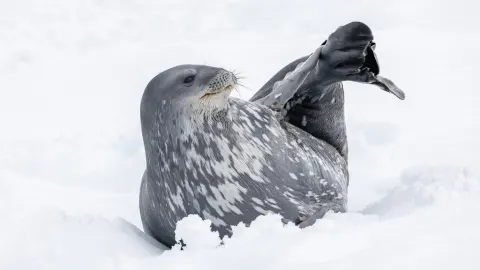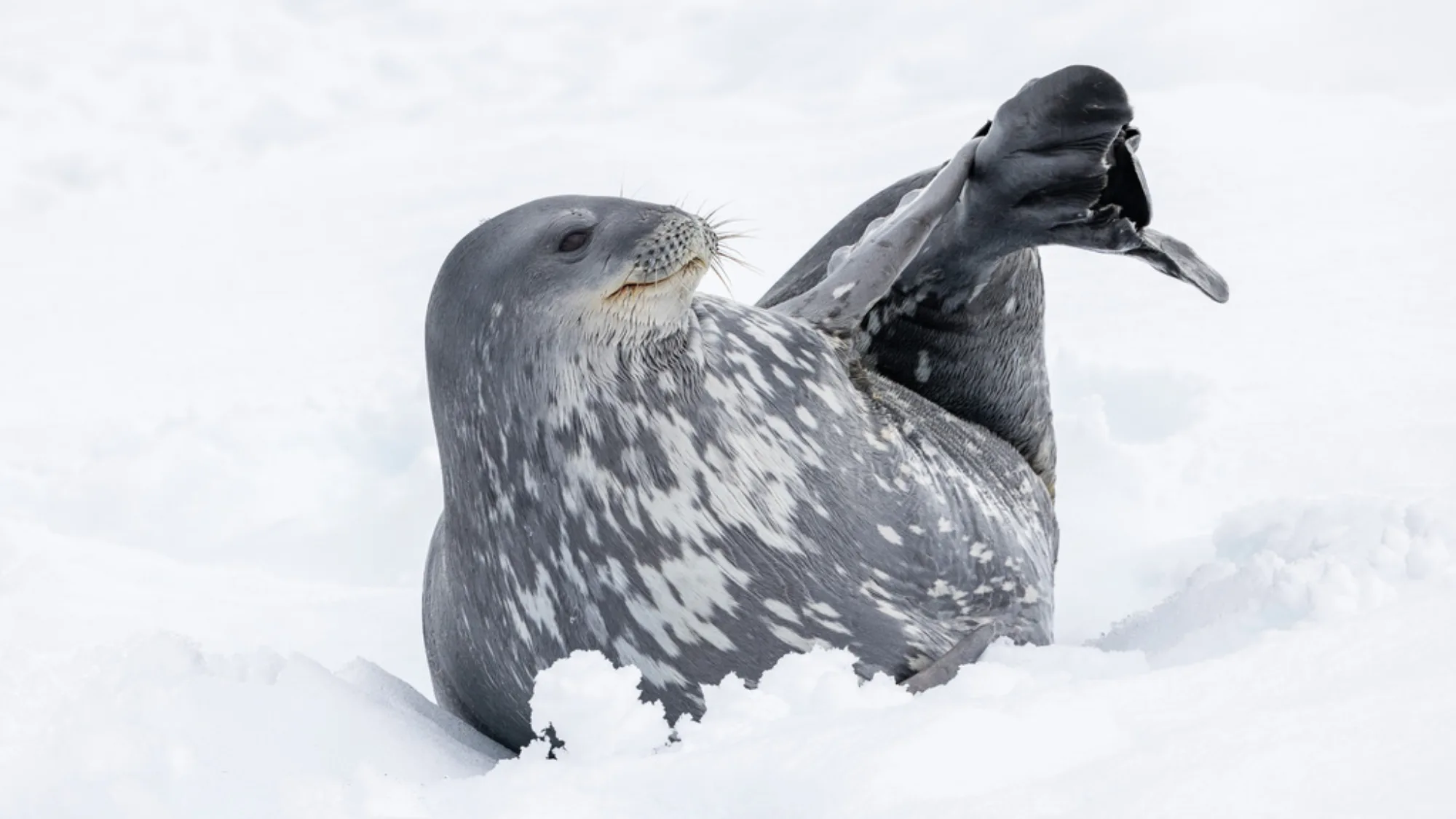
Weddell Seal
Leptonychotes weddellii
Around Antarctica, the Weddell Seal lives among ice fastened to the coast, often gathering in small groups beside cracks and breathing holes. This large, bulky seal has short front flippers and a face likened to a cat's, with a short mouth line and prominent whiskers. Adults are dark bluish-black to grey above and light grey or silver below, though their coats can turn brown before the summer moult. They measure about 2.5 to 3.5 m long and weigh 400 to 600 kg.
Weddell seals do not migrate, but move within their region as breathing holes and exit cracks change with the seasons. In winter they shelter from blizzards in the water, with their heads emerging through holes in the ice. They dive for food to depths of 600 m and can remain underwater for up to an hour. Antarctic cod and silverfish make up most of their diet, alongside prey including cephalopods and crustaceans. During the dark Antarctic winter, their whiskers help them detect the wake of swimming fish. In spring, the seals return to colonies on fast ice to give birth, often using the same breeding sites in successive seasons. Mothers usually have one pup a year; the young first swim at around one to two weeks old and begin hunting independently after weaning at six to seven weeks.
Killer whales and leopard seals prey mainly on young Weddell seals at sea or on pack ice. Earlier hunting for food and oil caused severe declines, though populations recovered after commercial sealing ended in the 1980s. Changes in sea ice and nutrient availability could reduce pup survival, while the effects of growing seasonal tourism remain unknown.
Written from the English Wikipedia article Weddell seal (CC BY-SA 4.0).
- Records
- 207,879
- Countries
- 1
No atlas park has a record of the Weddell Seal in or around it yet.
These are open occurrence records, so they show where people looked for and recorded the Weddell Seal as much as where it lives. Cells are up to 25 km across, and every location is generalised to its cell.
Generalised encounter areas, not exact locations. Each shape is a grid cell coloured by how likely the species is there.
- Very likelyAntarctica25 km zone · high confidence · 207879 records · updated 80 days ago
Conservation status not assessed here yet, so every location is generalised to its grid cell.