Serval
Leptailurus serval
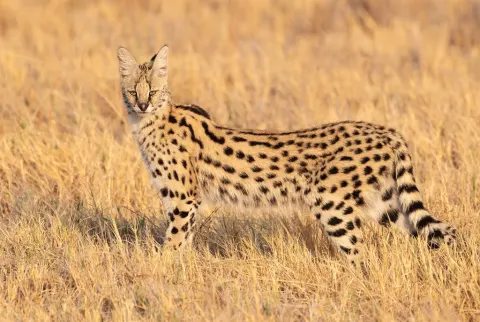
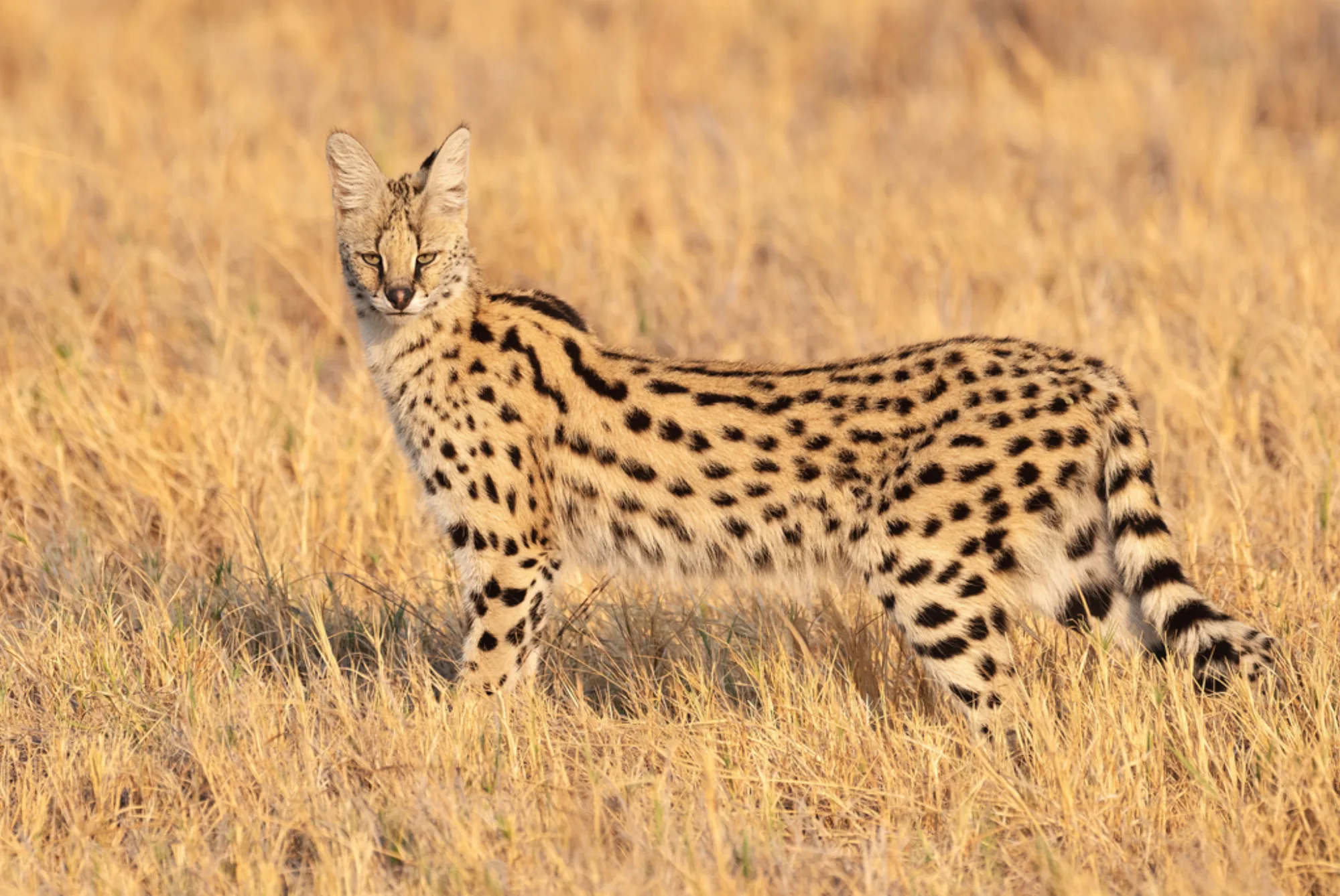
Long legs, large ears and a black-tipped tail give the Serval a distinctive outline. This slender wild cat has a small head and a golden-yellow to buff coat marked with black spots and stripes. Its legs are the longest of any cat in proportion to its body. It stands 54 to 62 cm at the shoulder.
Native to Africa, the Serval is widespread in sub-Saharan countries and occurs in protected areas across its range. It lives in grasslands, wetlands, moorlands and bamboo thickets, often favouring places near water where reeds and tall grasses provide cover. Near the Mediterranean, it lives in cork oak woodland and semi-arid country, while steering clear of rainforests and arid areas. In North Africa it is known only from Morocco, has been reintroduced in Tunisia and is feared extinct in Algeria.
Usually solitary, the Serval hunts by day and night, with activity possibly peaking in the early morning, around twilight and at midnight. It listens for rodents, especially vlei rats, as well as small birds, frogs, insects and reptiles. It can leap more than 2 m above the ground to land on prey. During hot midday hours, it rests or grooms in the shade of bushes and grasses. After a pregnancy of two to three months, a mother gives birth to one to four kittens in a secluded place. The kittens start hunting for themselves at around six months and leave their mother at about 12 months. Loss of wetland and grassland habitat threatens the Serval, while pastoralists kill it to protect livestock, even though it generally does not prey on them. Its skins are still traded in countries including Benin and Senegal.
Written from the English Wikipedia article Serval (CC BY-SA 4.0).
- Records
- 21
- Countries
- 10
- Atlas places
- 7
These are open occurrence records, so they show where people looked for and recorded the Serval as much as where it lives. Cells are up to 25 km across, and every location is generalised to its cell.
Generalised encounter areas, not exact locations. Each shape is a grid cell coloured by how likely the species is there.
- Very likelyBenin25 km zone · medium confidence · 7 records · updated 80 days ago
- Very likelyUganda25 km zone · medium confidence · 4 records · updated 80 days ago
- Very likelyUnited States25 km zone · medium confidence · 4 records · updated 80 days ago
- LikelyKenya25 km zone · medium confidence · 5 records · updated 80 days ago
- LikelyTanzania25 km zone · medium confidence · 1 record · updated 80 days ago
- LikelySouth Africa25 km zone · low confidence · 0 records · updated 80 days ago
- PossibleAngola25 km zone · low confidence · 0 records · updated 80 days ago
- PossibleCongo - Kinshasa25 km zone · low confidence · 0 records · updated 80 days ago
- PossibleZambia25 km zone · low confidence · 0 records · updated 80 days ago
- RareEthiopia25 km zone · low confidence · 0 records · updated 80 days ago
Conservation status not assessed here yet, so every location is generalised to its grid cell.