Bluegill
Lepomis macrochirus
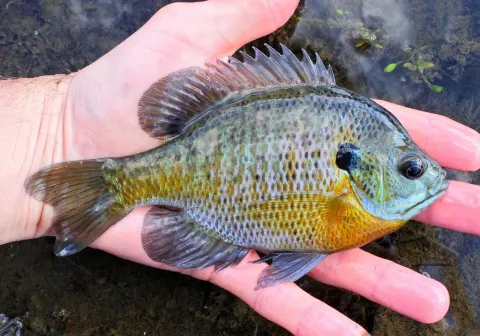
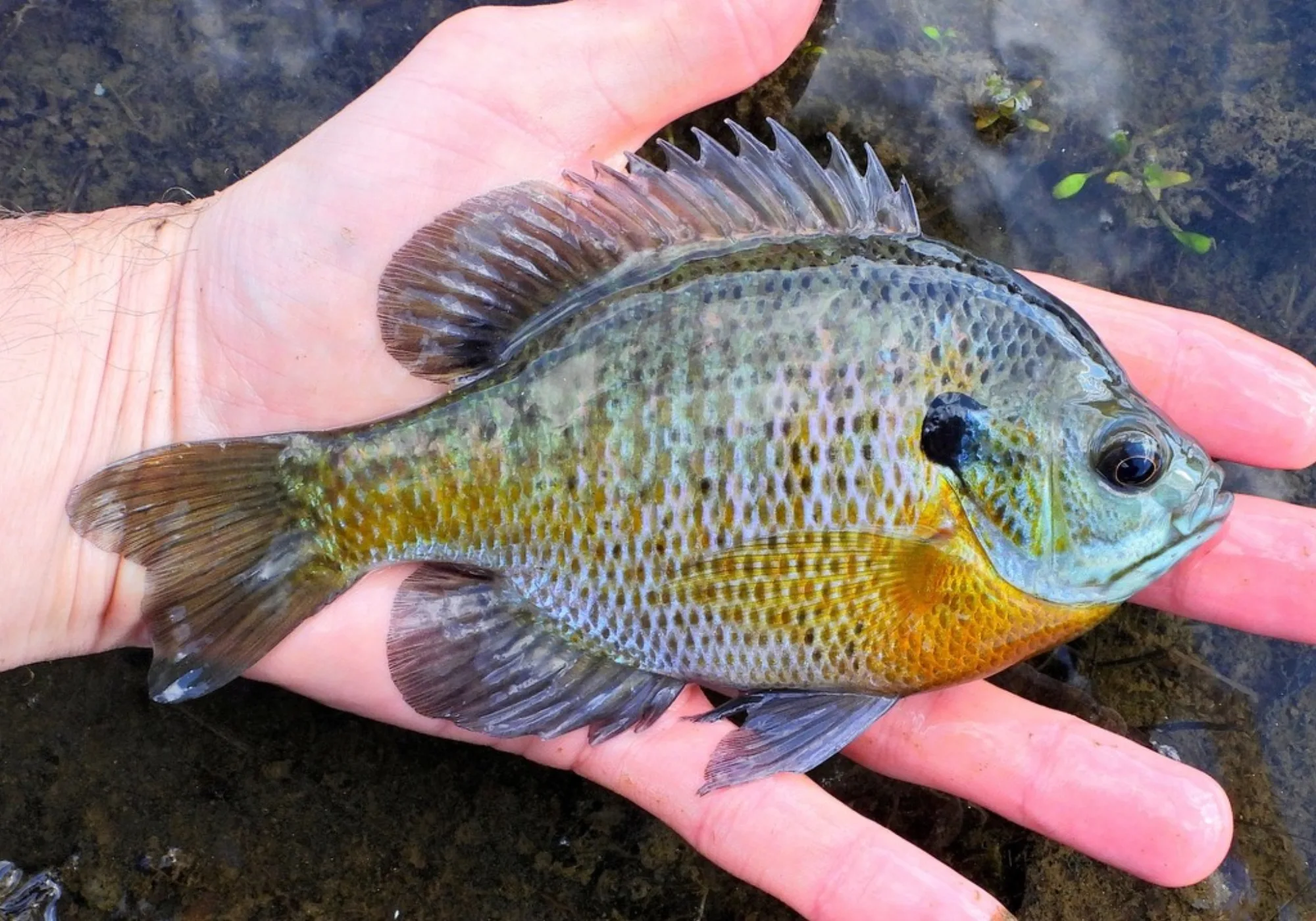
Look for the Bluegill among submerged plants and fallen wood in the fresh waters of eastern North America. This deep-bodied, flattened sunfish can reach 41 cm in length, although its colours vary between populations. Its face and gill covers are often deep blue and purple, with dark olive bands along the sides and an orange to yellow belly. A solid black mark resembling an ear sits on each side of the head, and most adults also have a dark mark near the back of the dorsal fin.
Native waters include the eastern United States from coastal Virginia southwards, reaching Texas, northern Mexico and southeastern Ontario. Bluegills inhabit lakes, ponds, streams, rivers and wetlands, often sheltering near weed beds, logs, stumps and other underwater structures. They move between cover with the time of day or season, and usually gather in schools of 10 to 20 fish. In summer, adults may move into deep, open water and feed just below the surface. Their food includes aquatic insect larvae, small fish and other small creatures, while young fish eat water fleas, copepods and insects. Most feeding takes place in daylight, peaking in the morning and especially in the evening.
Spawning runs from late May into August, when males prepare shallow nests in sand or gravel, often close together. They defend the nests and guard the young until they can swim away. Larger fish, turtles, herons, kingfishers and otters prey on Bluegills, while fishing pressure can particularly affect large males guarding nests.
Written from the English Wikipedia article Bluegill (CC BY-SA 4.0).
- Records
- 55,691
- Countries
- 2
No atlas park has a record of the Bluegill in or around it yet.
These are open occurrence records, so they show where people looked for and recorded the Bluegill as much as where it lives. Cells are up to 25 km across, and every location is generalised to its cell.
Generalised encounter areas, not exact locations. Each shape is a grid cell coloured by how likely the species is there.
- Very likelyUnited States25 km zone · high confidence · 51561 records · updated 80 days ago
- Very likelyJapan25 km zone · high confidence · 4130 records · updated 80 days ago
Conservation status not assessed here yet, so every location is generalised to its grid cell.