Pumpkinseed
Lepomis gibbosus
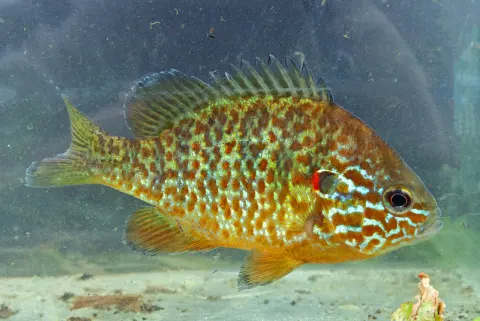
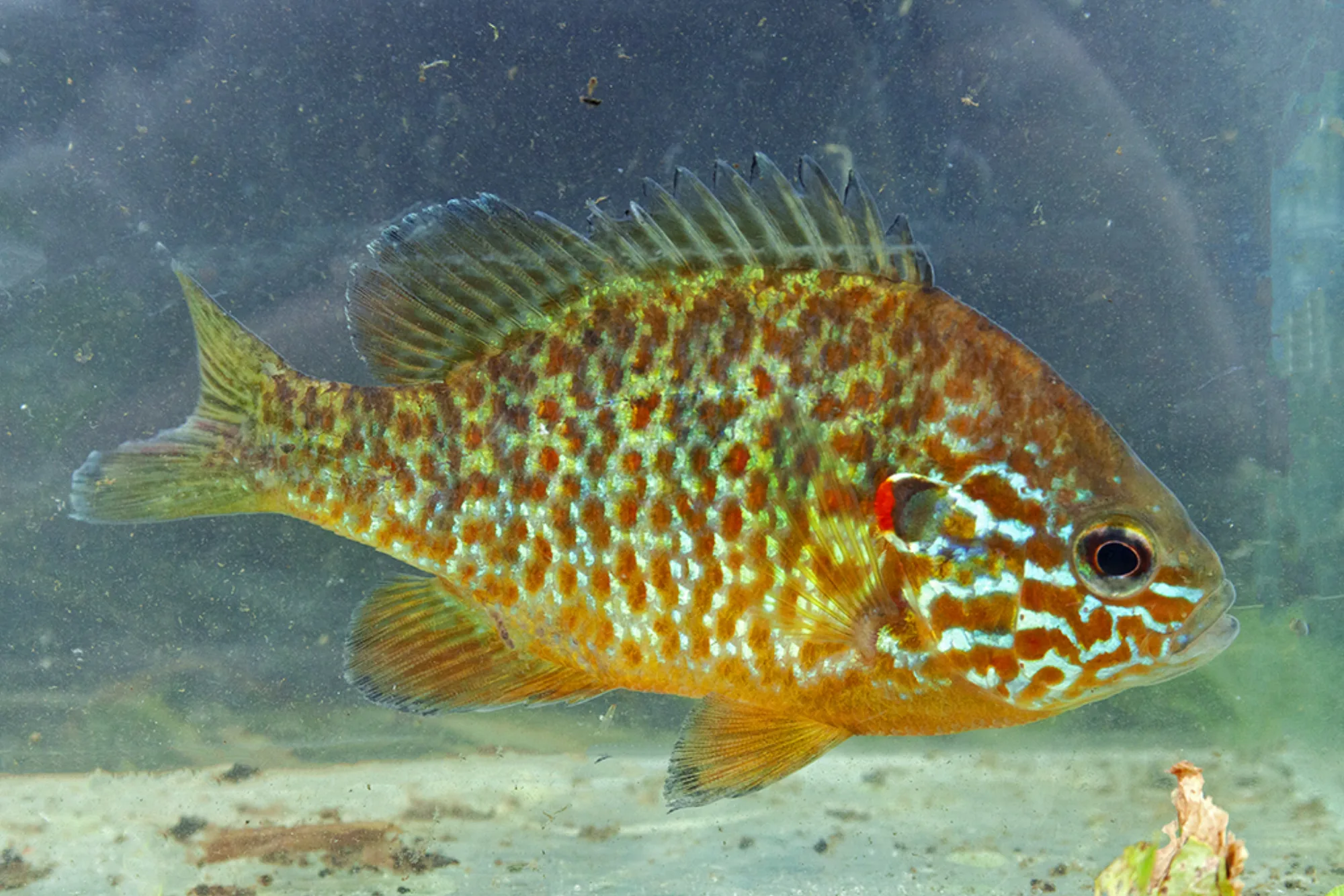
A bright red spot on the edge of its black gill cover helps identify the Pumpkinseed, a freshwater fish shaped much like its namesake seed. Usually about 10 cm long, it can reach 28 cm. Its colours can include orange, green, yellow and blue, with speckles across the sides and back, blue lines on the cheeks and a yellow-orange belly. Faint green or blue bars run down its sides, and orange spots may appear on its fins.
Native to eastern North America, the fish ranges from New Brunswick south along the United States coast to South Carolina, and inland from Pennsylvania to Iowa. It has also been introduced across much of North America and into Europe, including parts of southern England. Look for it near shore in warm, calm lakes, ponds and sheltered pools of small rivers and creeks, especially where clear water and plentiful vegetation offer cover. Young fish gather in schools close to shore, while adults usually travel together in twos, threes or fours, favouring covered water a little farther from the surface. Active during the day, they feed throughout the water column and rest near the bottom or among rocks and submerged logs at night.
Their prey includes insects, small molluscs and crustaceans, worms, young minnows and tadpoles. In late spring or early summer, males prepare shallow nests in sandy or gravelly lake beds, often in colonies. After the eggs are laid, females leave and males guard the young for about the first 11 days. Shoreline development and erosion from heavy lake use can disturb breeding grounds, while silt and pollution also affect the fish.
Written from the English Wikipedia article Pumpkinseed (CC BY-SA 4.0).
- Records
- 93,587
- Countries
- 7
No atlas park has a record of the Pumpkinseed in or around it yet.
These are open occurrence records, so they show where people looked for and recorded the Pumpkinseed as much as where it lives. Cells are up to 25 km across, and every location is generalised to its cell.
Generalised encounter areas, not exact locations. Each shape is a grid cell coloured by how likely the species is there.
- Very likelyFrance25 km zone · high confidence · 80661 records · updated 80 days ago
- Very likelyUnited States25 km zone · high confidence · 10808 records · updated 80 days ago
- Very likelySwitzerland25 km zone · high confidence · 1361 records · updated 80 days ago
- Very likelyBelgium25 km zone · high confidence · 544 records · updated 80 days ago
- Very likelyNetherlands25 km zone · high confidence · 213 records · updated 80 days ago
Conservation status not assessed here yet, so every location is generalised to its grid cell.