Kemp's Ridley
Lepidochelys kempii
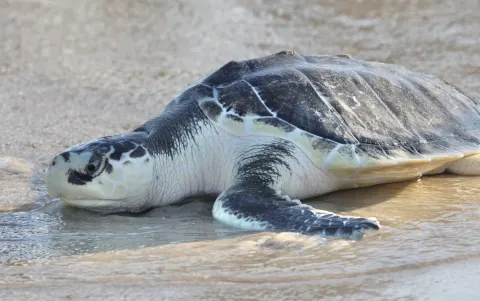
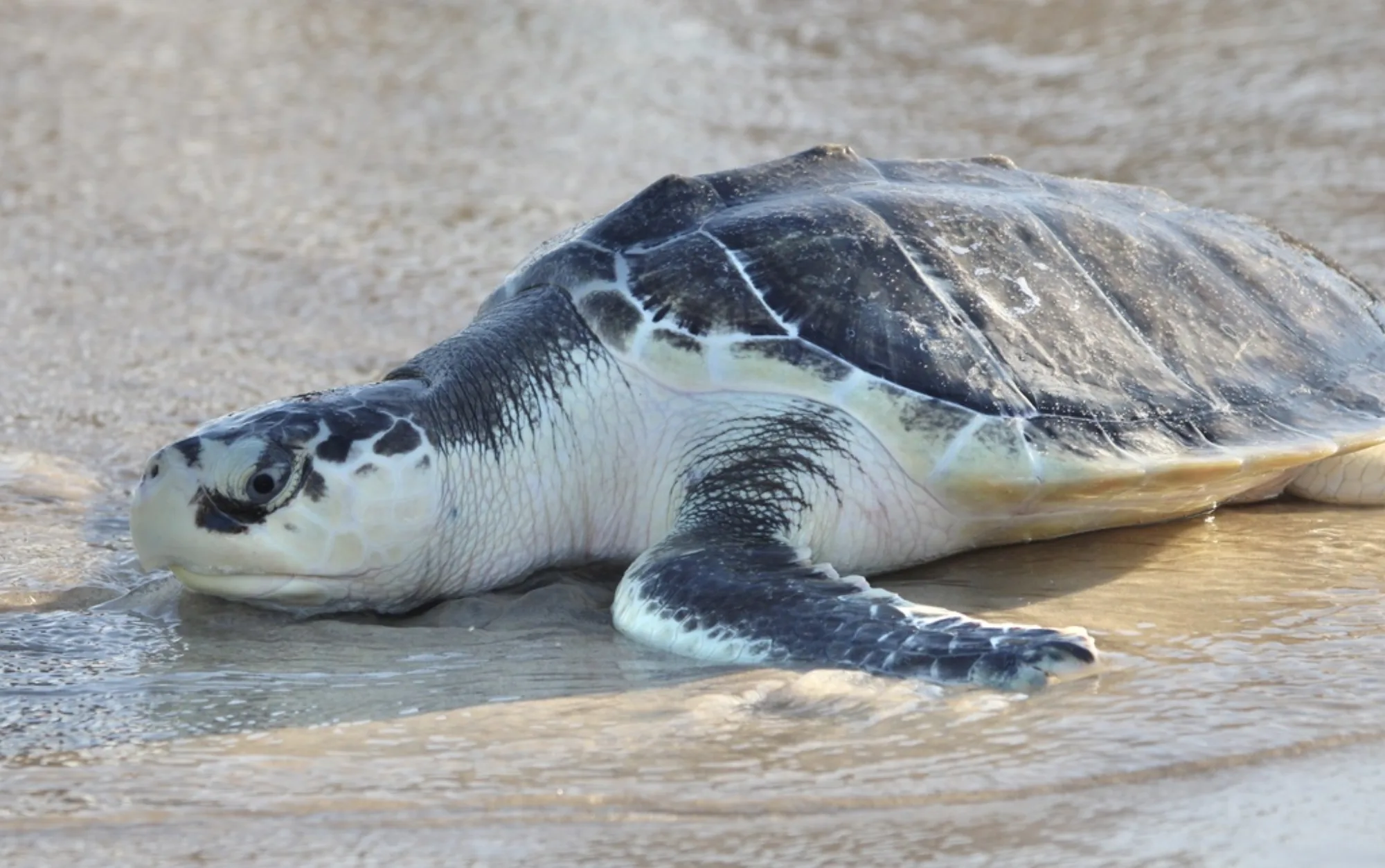
Small enough to stand apart from other sea turtles, the Kemp's Ridley has a broad, oval shell and a triangular head with a slightly hooked beak. Adults usually have an olive-grey shell, while hatchlings are almost entirely dark purple. At maturity, the shell measures 58 to 70 cm and the turtle weighs 36 to 45 kg. Adults spend most of their lives in the Gulf of Mexico, feeding over the continental shelf in water typically 50 m deep or less. Young turtles spend their first years among floating sargassum seaweed, then range between the Gulf and the northwest Atlantic as they grow. Juveniles also travel along the North American coast, from southern Florida to Cape Cod and occasionally farther north.
Young Kemp's Ridleys feed mainly at the surface in the open sea, while adults forage on the bottom and eat mostly crabs. Their wider diet includes shrimp, molluscs, jellyfish, fish, seaweed and sea urchins. Females come ashore to nest primarily in daylight, between April and August, often gathering in groups of hundreds or thousands. Most return each year to Rancho Nuevo, a beach in the Mexican state of Tamaulipas. They favour nesting areas with dunes, or sometimes swamps, and lay around 100 eggs in a clutch. The eggs take 6 to 8 weeks to hatch.
Egg harvesting and poaching reduced their numbers, while the loss of habitat, polluted waters and capture in shrimp fishing nets continue to threaten them. Oil spills have also harmed the turtles, and exposure to oil has been linked to reduced reproductive success. Warmer seas can draw young turtles into northern coastal waters for longer, leaving them exposed to cold-stunning when late-season storms arrive.
Written from the English Wikipedia article Kemp's ridley sea turtle (CC BY-SA 4.0).
- Records
- 377
- Countries
- 4
No atlas park has a record of the Kemp's Ridley in or around it yet.
These are open occurrence records, so they show where people looked for and recorded the Kemp's Ridley as much as where it lives. Cells are up to 25 km across, and every location is generalised to its cell.
Generalised encounter areas, not exact locations. Each shape is a grid cell coloured by how likely the species is there.
- Very likelyUnited States25 km zone · medium confidence · 284 records · updated 80 days ago
- Very likelyMexico25 km zone · medium confidence · 71 records · updated 80 days ago
- Very likelyFrance25 km zone · medium confidence · 21 records · updated 80 days ago
- PossibleUnited Kingdom25 km zone · medium confidence · 1 record · updated 80 days ago
Conservation status not assessed here yet, so every location is generalised to its grid cell.