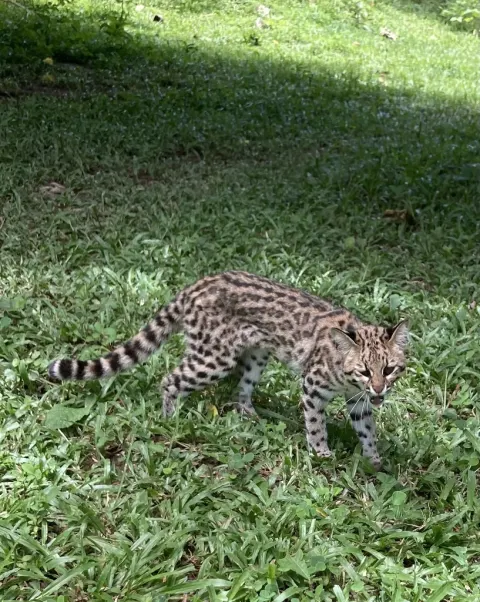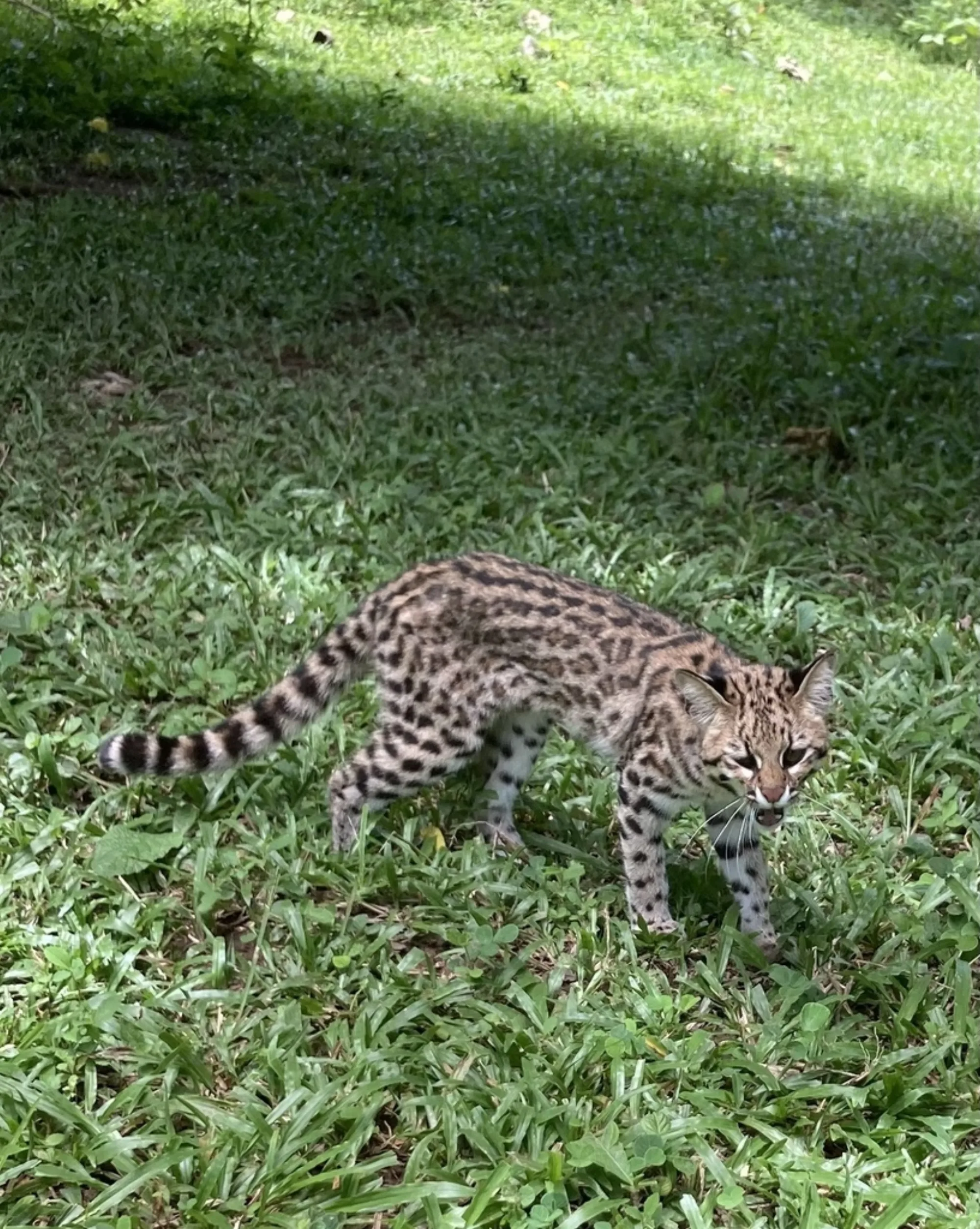
Oncilla
Leopardus tigrinus
Small and slender, the Oncilla (Leopardus tigrinus) is a spotted wild cat that resembles the larger margay and ocelot, but has a narrower muzzle. Its thick, soft coat ranges from light brown to dark ochre, with irregular dark rosettes across its back and sides. Look for a pale, spotted underside, a ringed tail and black-backed ears marked with bold white spots. The pattern helps it blend into the patchy sunlight beneath tropical forest cover, while some cats in more heavily forested areas are melanistic. Its body measures 38 to 59 cm, with a tail of 20 to 42 cm, and it weighs 1.5 to 3 kg.
The Oncilla occurs in a separate population in Costa Rica and Panama, and across the Amazon basin to central Brazil. Records come from cloud forests, the northern Andes and northern Brazil, including the dry landscapes of the Cerrado and Caatinga. Although it spends much of its time on the ground, it is also an accomplished climber. Most are active at night, but in the Brazilian Caatinga they hunt during daylight, where daytime-active lizards are their main food. Oncillas stalk their prey before pouncing, taking rodents, lizards, birds, eggs and invertebrates, as well as tree frogs on occasion.
After a gestation of 74 to 76 days, a female gives birth to a litter of one to three kittens. The kittens begin eating solid food at 38 to 56 days and are fully weaned by 90 days. Deforestation and poaching are major threats: the cats are killed for their pelts, while land conversion for agriculture and settlements reduces habitat. Coffee plantations in cloud forests also reduce the habitat they favour.
Written from the English Wikipedia article Oncilla (CC BY-SA 4.0).
- Records
- 53
- Countries
- 4
- Atlas places
- 3
These are open occurrence records, so they show where people looked for and recorded the Oncilla as much as where it lives. Cells are up to 25 km across, and every location is generalised to its cell.
Generalised encounter areas, not exact locations. Each shape is a grid cell coloured by how likely the species is there.
- Very likelyEcuador25 km zone · medium confidence · 30 records · updated 80 days ago
- Very likelyArgentina25 km zone · medium confidence · 12 records · updated 80 days ago
- PossibleColombia25 km zone · medium confidence · 11 records · updated 80 days ago
- UncommonBrazil25 km zone · low confidence · 0 records · updated 80 days ago
Conservation status not assessed here yet, so every location is generalised to its grid cell.