Pampas Cat
Leopardus colocola
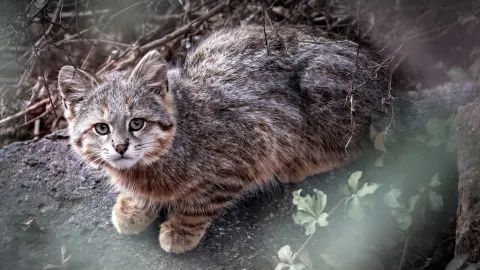
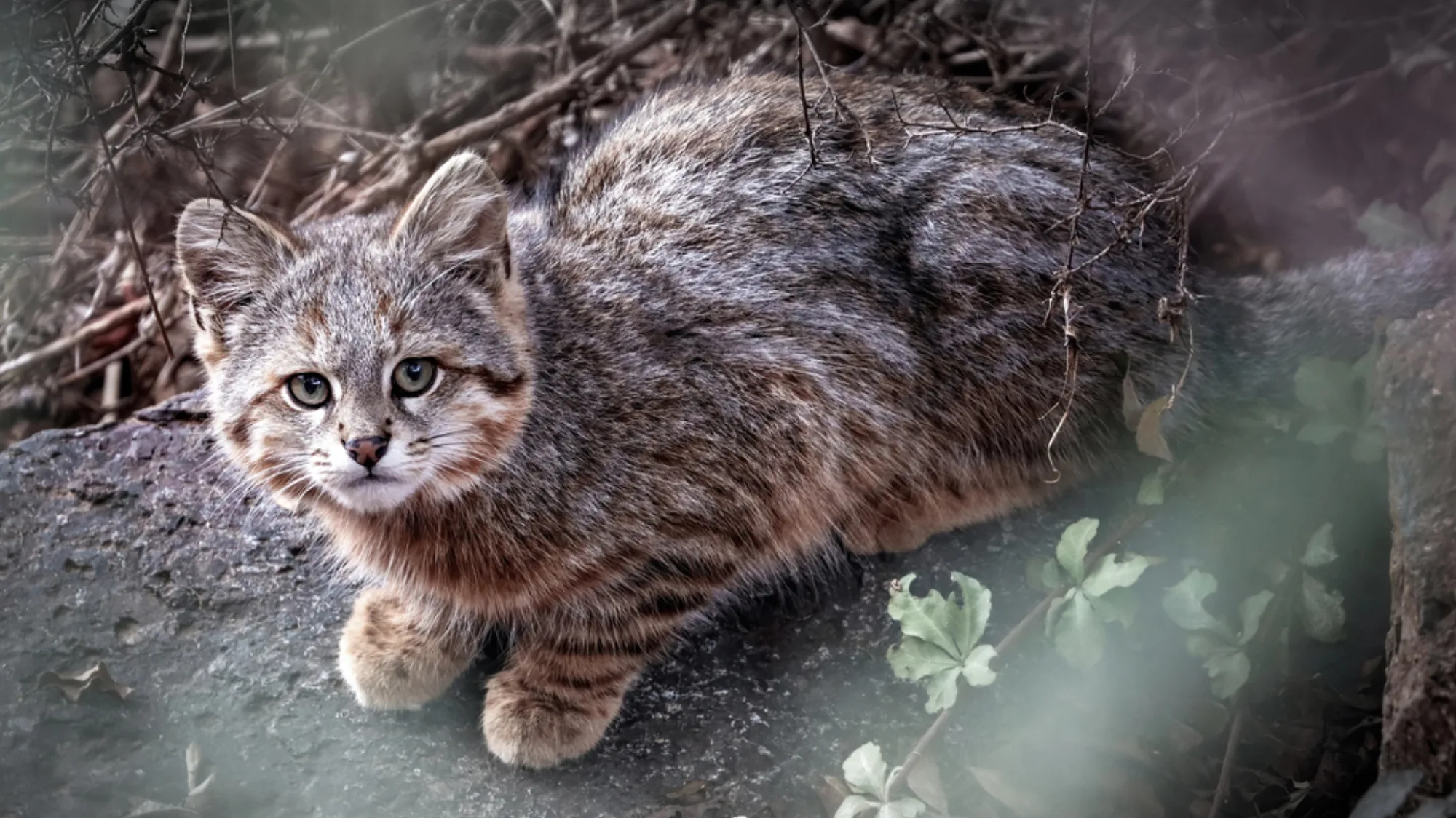
Slightly larger than a domestic cat, the Pampas Cat has a bushier tail and a coat that varies widely across its South American range. Its body measures 46 to 75 cm, with a tail 23 to 29 cm long. Whatever the coat pattern, two dark lines mark the cheeks. Some cats have reddish-brown, rosette-shaped spots on their flanks and rings on their tails, while others are greyish, with dark leg stripes and a plain tail. Another form has a largely rusty-brown coat with indistinct spots, black feet and a tail tipped in black.
Despite its name, this cat lives far beyond the Pampas, ranging across most of Argentina and Uruguay, into Bolivia, Paraguay and Brazil, and north along the Andes through Ecuador, possibly reaching southwestern Colombia. It occupies grassland, shrubland and dry forest, and lives in páramo from 1,800 to 5,000 m above sea level. Across southern Argentina and the far south of Chile, it inhabits Patagonian steppes and shrubland below 1,100 m. It has also been recorded in the Sechura Desert and dry forest of northwestern Peru.
Much remains unknown about its hunting and breeding habits. Small mammals and birds are thought to make up most of its prey, including guinea pigs, viscachas, other rodents and ground-dwelling tinamous. Accounts differ on whether it is mainly active at night or during the day. Litters usually contain one or two kittens, though three are sometimes born, and newborns weigh around 130 g. Habitat destruction and conversion could reduce its population in future.
Written from the English Wikipedia article Pampas cat (CC BY-SA 4.0).
- Records
- 0
- Countries
- 1
No atlas park has a record of the Pampas Cat in or around it yet.
These are open occurrence records, so they show where people looked for and recorded the Pampas Cat as much as where it lives. Cells are up to 25 km across, and every location is generalised to its cell.
Generalised encounter areas, not exact locations. Each shape is a grid cell coloured by how likely the species is there.
- Very likelyChile25 km zone · low confidence · 0 records · updated 80 days ago
Conservation status not assessed here yet, so every location is generalised to its grid cell.