Golden Lion Tamarin
Leontopithecus rosalia
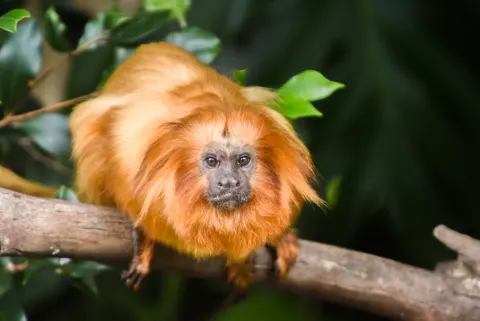
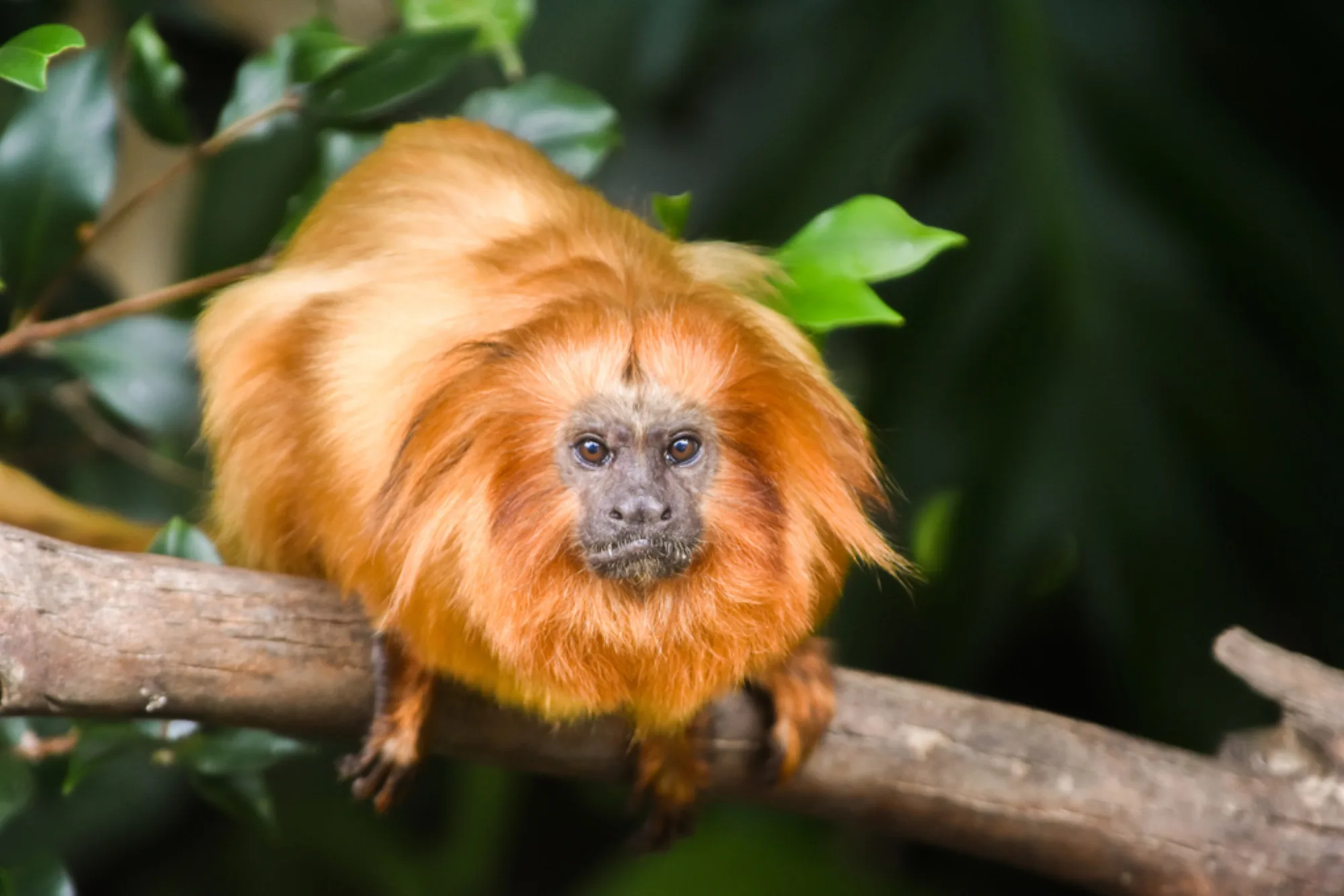
A dark, hairless face peers from a mane of long, reddish-orange hair: the Golden Lion Tamarin is a small Brazilian monkey with a distinctive appearance. It measures around 261 mm and weighs about 620 g, with little difference in size between males and females. Its range lies entirely within Rio de Janeiro state, in Brazil's Atlantic coastal forests. Today it occupies forest fragments, including Poço das Antas and União biological reserves, other protected areas and private land. Much of this habitat consists of dense evergreen or seasonal forest, while some animals near the coast live in forest on sandy soil.
Golden lion tamarins usually live in groups of two to eight and use calls to communicate as they move through the dense forest. They walk, run and bound along branches, and can cling to and climb vertical trunks. Groups defend their territories, sometimes chasing or fighting neighbours where their ranges meet. They feed mainly on fruit and small animals, along with smaller amounts of nectar and tree gum. To find prey, they search concealed spaces such as holes in trees, curled dead leaves and the spaces between bromeliad leaves. At night they favour natural tree holes, although groups use several sleeping sites over time. Births peak during the rains from September to February, and group members help rear the young, which are commonly twins.
Deforestation has removed much of the tamarin's original habitat, leaving populations in separated forest fragments. Other threats include hunting and trapping for the pet trade, disease outbreaks and introduced species. Yellow fever caused extensive deaths between 2016 and 2019, killing around 30% of the wild population.
Written from the English Wikipedia article Golden lion tamarin (CC BY-SA 4.0).
- Records
- 31
- Countries
- 2
- Atlas places
- 1
These are open occurrence records, so they show where people looked for and recorded the Golden Lion Tamarin as much as where it lives. Cells are up to 25 km across, and every location is generalised to its cell.
Generalised encounter areas, not exact locations. Each shape is a grid cell coloured by how likely the species is there.
- Very likelyBrazil25 km zone · medium confidence · 26 records · updated 80 days ago
- LikelyUnited States25 km zone · medium confidence · 5 records · updated 80 days ago
Conservation status not assessed here yet, so every location is generalised to its grid cell.