Ring-tailed Lemur
Lemur catta
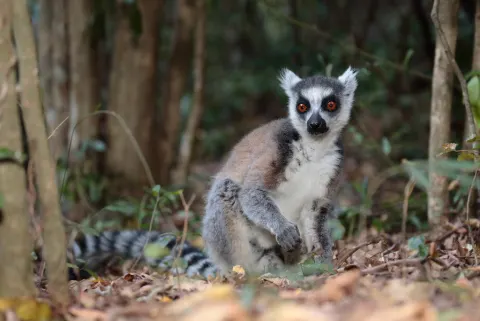
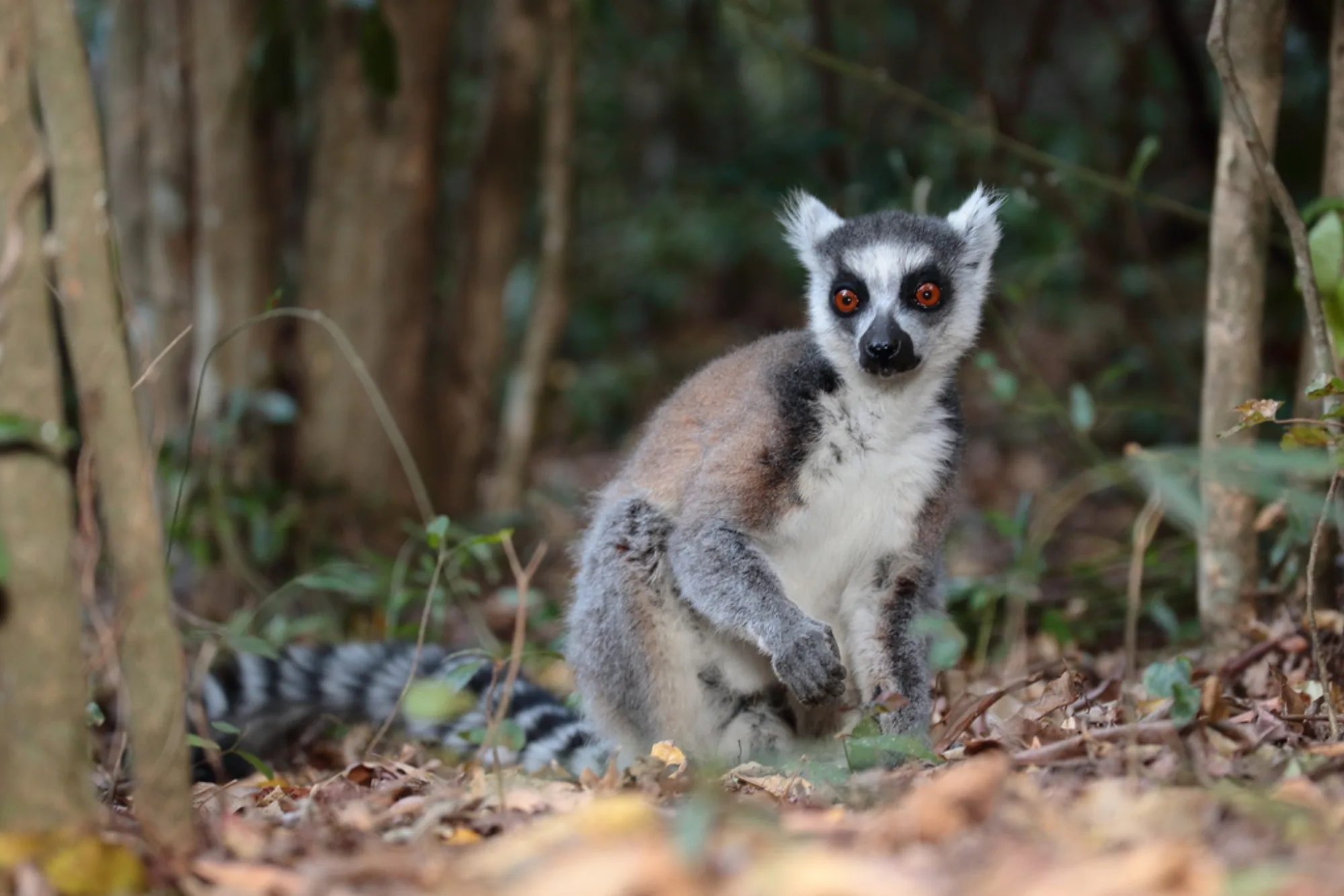
A long, bushy tail with alternating black and white bands makes the Ring-tailed Lemur easy to recognise. This medium- to larger-sized primate has a slender frame, a narrow face and dark triangular patches around its eyes. Its back ranges from grey to rosy-brown, while its chest and throat are white or cream. Found only in Madagascar, it lives in the south and southwest, from dry scrub and deciduous forest to humid mountain forest. It particularly favours the gallery forests that grow along riverbanks, though many have been cleared for livestock pasture. Travellers can see it in places including Isalo and Andringitra national parks and Anja Community Reserve.
Active during daylight, ring-tailed lemurs spend time both on the ground and in trees. They live in social troops, usually numbering 6 to 25, in which females dominate males. On cold mornings, a group may sit facing the sun to warm up; at night, troop members huddle together in sleeping parties. They also groom one another, use scent marks and make calls that help keep the group together or warn of predators. Fruit and leaves are their main foods, especially those of the tamarind tree, but they also eat flowers, bark, insects and small vertebrates. Births usually come in September, sometimes October, and a single infant is usual in the wild. The infant rides on its mother's chest at first, then on her back, and other troop members may help care for it.
Forest clearance for pasture and crops is a major threat, along with logging, mining, overgrazing and fires. Ring-tailed lemurs are also taken for food, fur and pets, while introduced predators and periodic drought add pressure to their populations.
Written from the English Wikipedia article Ring-tailed lemur (CC BY-SA 4.0).
- Records
- 180
- Countries
- 4
No atlas park has a record of the Ring-tailed Lemur in or around it yet.
These are open occurrence records, so they show where people looked for and recorded the Ring-tailed Lemur as much as where it lives. Cells are up to 25 km across, and every location is generalised to its cell.
Generalised encounter areas, not exact locations. Each shape is a grid cell coloured by how likely the species is there.
- Very likelyMadagascar25 km zone · medium confidence · 155 records · updated 80 days ago
- Very likelyDenmark25 km zone · medium confidence · 19 records · updated 80 days ago
- PossiblePoland25 km zone · medium confidence · 3 records · updated 80 days ago
- PossibleUnited States25 km zone · medium confidence · 3 records · updated 80 days ago
Conservation status not assessed here yet, so every location is generalised to its grid cell.