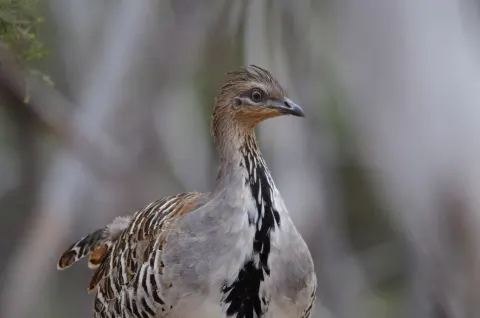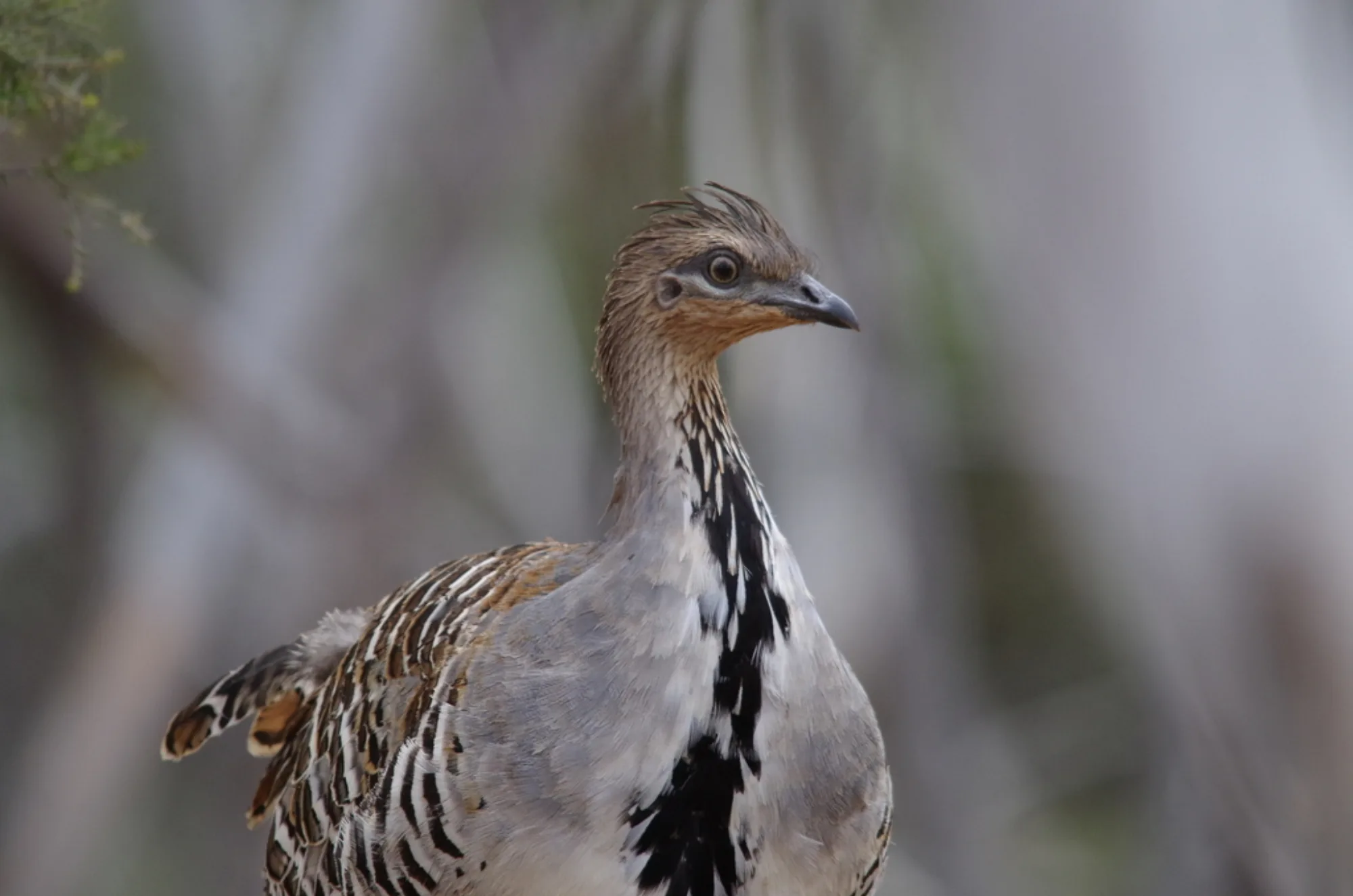
Malleefowl
Leipoa ocellata
About the size of a domestic chicken, the Malleefowl is a stocky Australian bird that spends much of its time on the ground. Its intricately patterned plumage helps conceal it in the scrub. Shy and wary, it may freeze when disturbed or slip silently into the undergrowth, usually flying only if surprised or chased, or to reach a roosting tree. It lives in semiarid mallee scrub on the fringes of southern Australia's more fertile regions. Three populations remain: one near the Simpson Desert to the west of Spencer Gulf, one in the Murray-Murrumbidgee basin and one on the semiarid edge of Western Australia's fertile southwest.
Pairs hold a territory, but usually feed and roost separately. In winter, the male scrapes a broad hollow in sandy soil, typically in an open space between stunted mallee trees. He gathers sticks, leaves and bark into a mound, then turns the material after rain to encourage decay. Laying usually takes place from September to February, if rain has been sufficient to start the litter decaying, and the male keeps tending the mound. After hatching, chicks dig their way to the surface and disappear into the scrub, without meeting adults or other chicks. They can run reasonably well within an hour and fly strongly within a day.
Introduced red foxes prey on Malleefowl, while changed fire regimes, habitat destruction and fragmentation are critical threats. Increasingly frequent and severe drought linked to climate change also puts the bird at risk.
Written from the English Wikipedia article Malleefowl (CC BY-SA 4.0).
- Records
- 9,515
- Countries
- 1
No atlas park has a record of the Malleefowl in or around it yet.
These are open occurrence records, so they show where people looked for and recorded the Malleefowl as much as where it lives. Cells are up to 25 km across, and every location is generalised to its cell.
Generalised encounter areas, not exact locations. Each shape is a grid cell coloured by how likely the species is there.
- Very likelyAustralia25 km zone · high confidence · 9515 records · updated 80 days ago
Conservation status not assessed here yet, so every location is generalised to its grid cell.