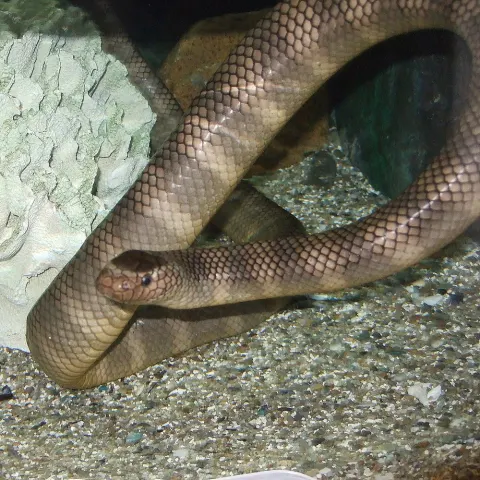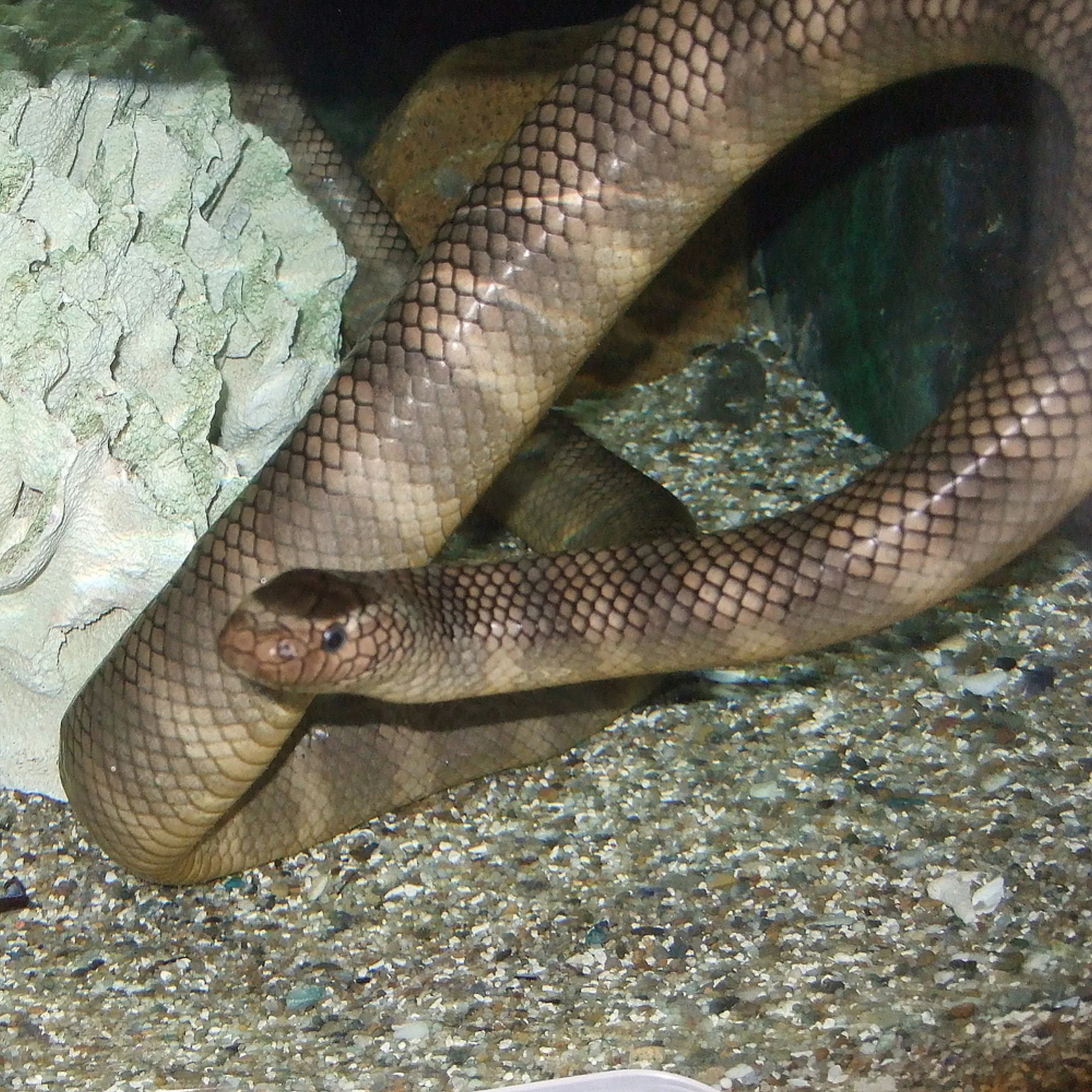
Chinese Sea Snake
Laticauda semifasciata
Known also as the black-banded sea krait or erabu, the Chinese Sea Snake is an extremely venomous marine reptile that spends much of its life in both water and on land. It has a short head, a thick body and no obvious neck, with a broad, fin-like tail. It can reach 170 cm in total length.
In the warm western Pacific, its usual range includes China, Indonesia, Japan, the Philippines and Taiwan, and it has also been found in waters off southern South Korea. It frequents coral reefs, where its shape helps it search confined spaces for food. Mainly active at night and rarely seen by day, it must surface at least once every six hours to breathe. It is too slow to chase prey in open water, so it searches reef crevices for hidden fish and other animals of suitable size. Moray eels are among its main prey, and its venom paralyses the animals it bites. It has been observed hunting alongside other black-banded sea kraits and with bluefin trevally, which wait to catch smaller fish or crustaceans flushed from the coral.
Near shore, the snakes gather to breed in reef cracks and caves. Females lay 3 to 7 eggs on land, and the young hatch after 4 to 5 months. In some warm years, snakes gather in sea caves and tide pools along the Ryukyu cliffs, seeking fresh water and possibly mates. People catch them in these coastal caves for food in southern Japan. Climate change has damaged their habitat and has been linked to their spread northwards. Although their bite is highly venomous, they generally strike at humans only when cornered or threatened.
Written from the English Wikipedia article Black-banded sea krait (CC BY-SA 4.0).
- Records
- 22
- Countries
- 6
No atlas park has a record of the Chinese Sea Snake in or around it yet.
These are open occurrence records, so they show where people looked for and recorded the Chinese Sea Snake as much as where it lives. Cells are up to 25 km across, and every location is generalised to its cell.
Generalised encounter areas, not exact locations. Each shape is a grid cell coloured by how likely the species is there.
- Very likelyJapan25 km zone · medium confidence · 8 records · updated 80 days ago
- Very likelyPanama25 km zone · medium confidence · 5 records · updated 80 days ago
- Very likelyTaiwan25 km zone · medium confidence · 4 records · updated 80 days ago
- LikelyCosta Rica25 km zone · medium confidence · 3 records · updated 80 days ago
- LikelyPhilippines25 km zone · medium confidence · 2 records · updated 80 days ago
- RareIndonesia25 km zone · low confidence · 0 records · updated 80 days ago
Conservation status not assessed here yet, so every location is generalised to its grid cell.