Barramundi
Lates calcarifer
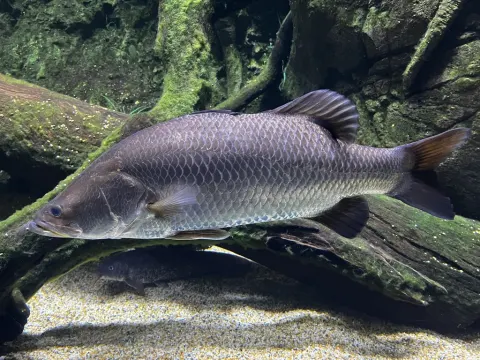
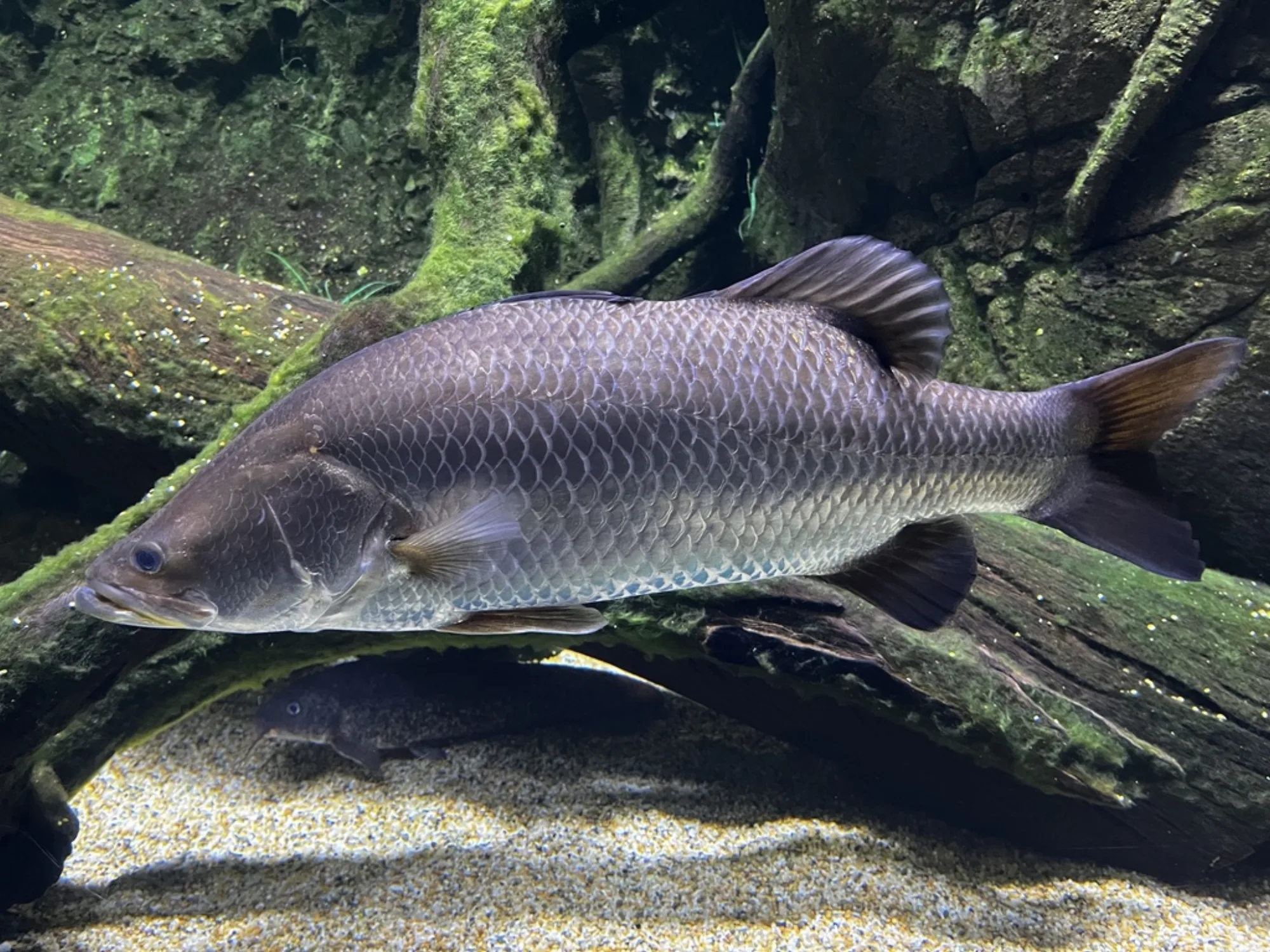
With its long body, large mouth and silvery scales, the Barramundi is a sizeable fish of both fresh and salt water. Its scales can grow lighter or darker according to its surroundings, and its head has a noticeably concave profile. An average fish measures about 0.6 to 1.2 m, while the largest reported length is 1.8 m, although evidence of catches at that size is scarce. Also known as Asian sea bass or giant sea perch, it ranges across the Indo-West Pacific, from the Middle East through South, Southeast and East Asia to Oceania. Look for its habitat in coastal waters, estuaries, lagoons and rivers, where the water may be clear or cloudy. Some populations live entirely at sea in places far from fresh water.
Barramundi feed on crustaceans, molluscs and smaller fish, including other barramundi, while juveniles eat zooplankton. They live in rivers and move down to estuaries and tidal flats to spawn. At the beginning of the monsoon, males travel downstream to meet females, each of which can produce several million eggs. Adults leave the eggs and young unguarded, and the young need brackish water to develop. Most barramundi mature as males and become females after at least one spawning season, so larger fish are mostly female. They do not make extensive migrations within or between river systems.
Fishing brings barramundi into contact with people across their range: the species is fished internationally and pursued by sport anglers in fresh and salt water. Saltwater crocodiles also eat barramundi and have been known to snatch them from fishermen.
Written from the English Wikipedia article Barramundi (CC BY-SA 4.0).
- Records
- 38,424
- Countries
- 12
- Atlas places
- 4
These are open occurrence records, so they show where people looked for and recorded the Barramundi as much as where it lives. Cells are up to 25 km across, and every location is generalised to its cell.
Generalised encounter areas, not exact locations. Each shape is a grid cell coloured by how likely the species is there.
- Very likelyAustralia25 km zone · medium confidence · 38122 records · updated 80 days ago
- Very likelyBangladesh25 km zone · high confidence · 182 records · updated 80 days ago
- Very likelyIndia25 km zone · high confidence · 73 records · updated 80 days ago
- Very likelyChina25 km zone · medium confidence · 13 records · updated 80 days ago
- Very likelyTaiwan25 km zone · medium confidence · 12 records · updated 80 days ago
- LikelyFrench Polynesia25 km zone · medium confidence · 5 records · updated 80 days ago
- LikelyMalaysia25 km zone · medium confidence · 5 records · updated 80 days ago
- LikelyIndonesia25 km zone · medium confidence · 3 records · updated 80 days ago
- LikelyMyanmar (Burma)25 km zone · medium confidence · 3 records · updated 80 days ago
- LikelyPhilippines25 km zone · medium confidence · 3 records · updated 80 days ago
Conservation status not assessed here yet, so every location is generalised to its grid cell.