American Herring Gull
Larus smithsonianus
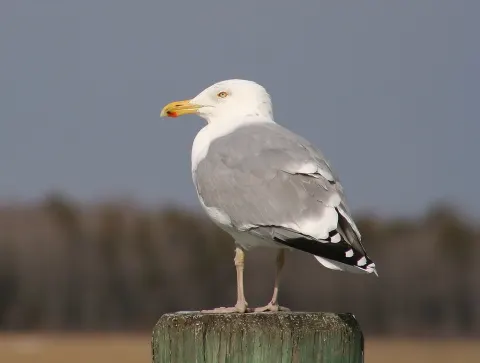
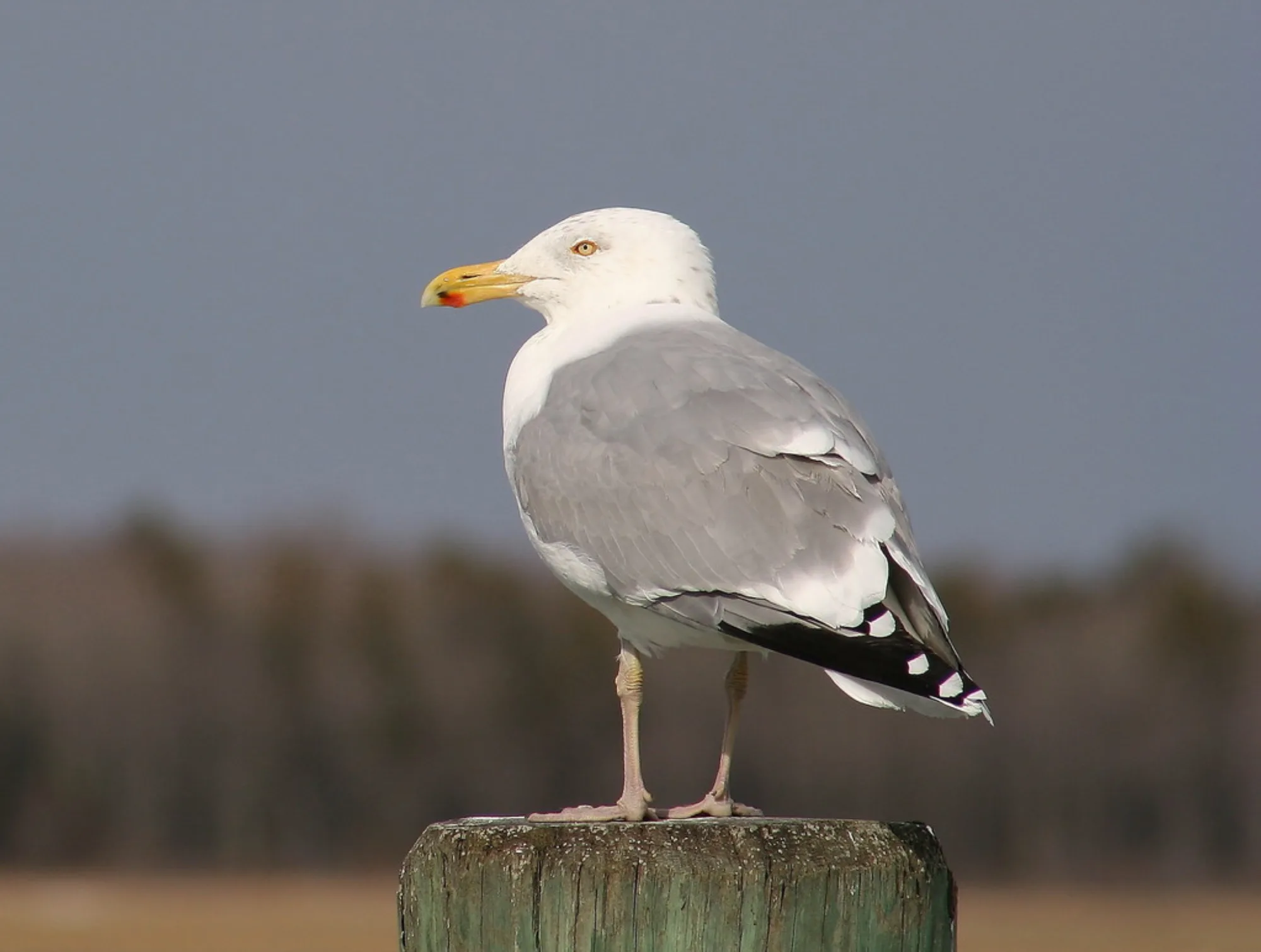
Look for the American Herring Gull along North American shores and waterways, or even among the cars in a parking lot. This large, heavily built gull has a powerful bill, pink legs and, as an adult, a white body with a pale grey back and wings. Its black wingtips carry white spots, while its yellow bill has a red spot. In winter, brown streaks mark the head and neck. Young birds look different: they are grey-brown with dark tails, and take four years to acquire adult plumage. The gull has no song, but its calls include a short, loud alarm and a series of loud notes given as it dips and raises its head.
The breeding range stretches from Alaska across much of Canada to the Great Lakes and the eastern United States, reaching south to North Carolina. Some birds stay year-round around the Great Lakes, southern Alaska and the north-east USA, while most winter farther south, reaching Mexico and sometimes beyond. They feed at sea and in places ranging from beaches and mudflats to fields and refuse dumps, and rest in open areas near feeding sites. Their varied diet includes fish, shellfish, insects, carrion, human refuse and other birds, including chicks and eggs. To open clams and mussels, they may drop them onto roads or rocks.
Usually nesting in colonies near water, pairs scrape a nest in the ground and line it with vegetation and feathers. Both parents build the nest, incubate the eggs and feed the young, which usually fledge after 6 to 7 weeks. Hunting for eggs and feathers made the species rare during the 19th century, and high DDT use affected it; its numbers may now be declining in some areas.
Written from the English Wikipedia article American herring gull (CC BY-SA 4.0).
- Records
- 3,847,453
- Countries
- 40
- Atlas places
- 2
These are open occurrence records, so they show where people looked for and recorded the American Herring Gull as much as where it lives. Cells are up to 25 km across, and every location is generalised to its cell.
Generalised encounter areas, not exact locations. Each shape is a grid cell coloured by how likely the species is there.
- Very likelyUnited States25 km zone · high confidence · 3103258 records · updated 86 days ago
- Very likelyCanada25 km zone · high confidence · 732211 records · updated 86 days ago
- Very likelyMexico25 km zone · high confidence · 2981 records · updated today
- Very likelyBermuda25 km zone · high confidence · 2646 records · updated today
- Very likelyBahamas25 km zone · high confidence · 1117 records · updated today
- LikelyCuba25 km zone · high confidence · 897 records · updated today
- LikelyBelize25 km zone · high confidence · 664 records · updated today
- LikelyPanama25 km zone · high confidence · 520 records · updated today
- LikelyNorway25 km zone · high confidence · 465 records · updated today
- LikelySt. Pierre & Miquelon25 km zone · high confidence · 457 records · updated today
Conservation status not assessed here yet, so every location is generalised to its grid cell.