Yellow-legged Gull
Larus michahellis
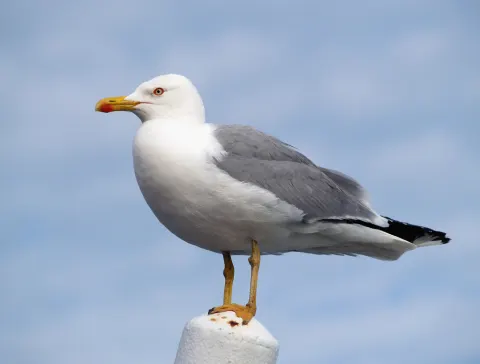
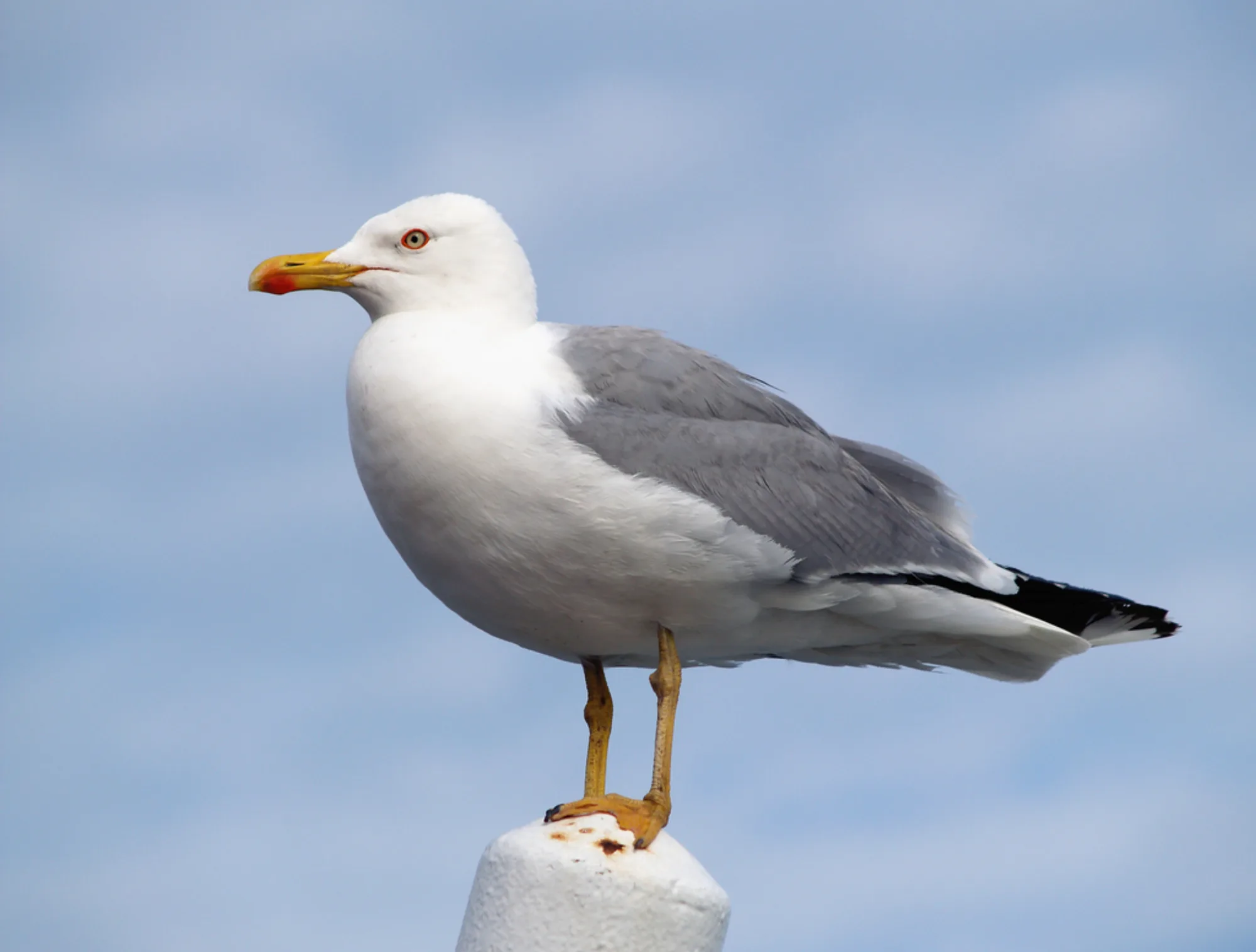
With its yellow legs, grey back and black wing tips, the adult Yellow-legged Gull cuts a distinctive figure along the coast. Look closer for a red spot on the bill, a red ring around the eye and a few white spots on the wing tips. Young birds look different: in their first year they have dark bills and eyes, pinkish grey legs and a clear black band across the tail. Their call is a loud laugh, deeper and more nasal than that of a herring gull.
This large gull lives across Europe, the Middle East and North Africa, with its breeding range centred on the Mediterranean. Colonies occur along Mediterranean shores and on Atlantic coasts and islands; the gull also breeds beside the Black Sea's western shores, where it favours sea cliffs. Some stay in the same area throughout the year, while others move to milder parts of western Europe or travel south for winter. After breeding, birds also disperse northwards, reaching southern England in late summer.
An opportunistic feeder, it searches fields and coasts for prey, scavenges at rubbish tips and sometimes steals catches from smaller gulls and other seabirds. In Rome, a shortage of food scraps during the 2020 lockdown prompted gulls to hunt prey including rats and rock doves. The birds usually breed in colonies, laying eggs in a mound of vegetation on the ground or a cliff ledge. In some places they have also begun nesting on buildings and even trees. They usually lay three eggs, defending them vigorously, and the young leave the nest after 35 to 40 days.
Written from the English Wikipedia article Yellow-legged gull (CC BY-SA 4.0).
- Records
- 882,066
- Countries
- 62
No atlas park has a record of the Yellow-legged Gull in or around it yet.
These are open occurrence records, so they show where people looked for and recorded the Yellow-legged Gull as much as where it lives. Cells are up to 25 km across, and every location is generalised to its cell.
Generalised encounter areas, not exact locations. Each shape is a grid cell coloured by how likely the species is there.
- Very likelySpain25 km zone · high confidence · 351983 records · updated 86 days ago
- Very likelyPortugal25 km zone · high confidence · 171944 records · updated 86 days ago
- Very likelyFrance25 km zone · high confidence · 166132 records · updated 86 days ago
- Very likelyMorocco25 km zone · high confidence · 36496 records · updated 86 days ago
- Very likelyItaly25 km zone · high confidence · 22965 records · updated 86 days ago
- Very likelyTürkiye25 km zone · high confidence · 21563 records · updated 86 days ago
- Very likelySwitzerland25 km zone · high confidence · 16869 records · updated 86 days ago
- Very likelyGreece25 km zone · high confidence · 16660 records · updated 86 days ago
- Very likelyBulgaria25 km zone · high confidence · 8961 records · updated 86 days ago
- Very likelyUnited Kingdom25 km zone · high confidence · 8429 records · updated 86 days ago
Conservation status not assessed here yet, so every location is generalised to its grid cell.