Lesser Black-backed Gull
Larus fuscus
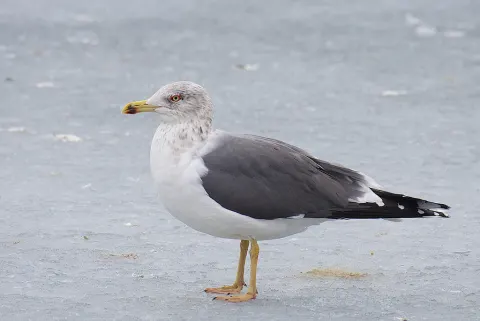
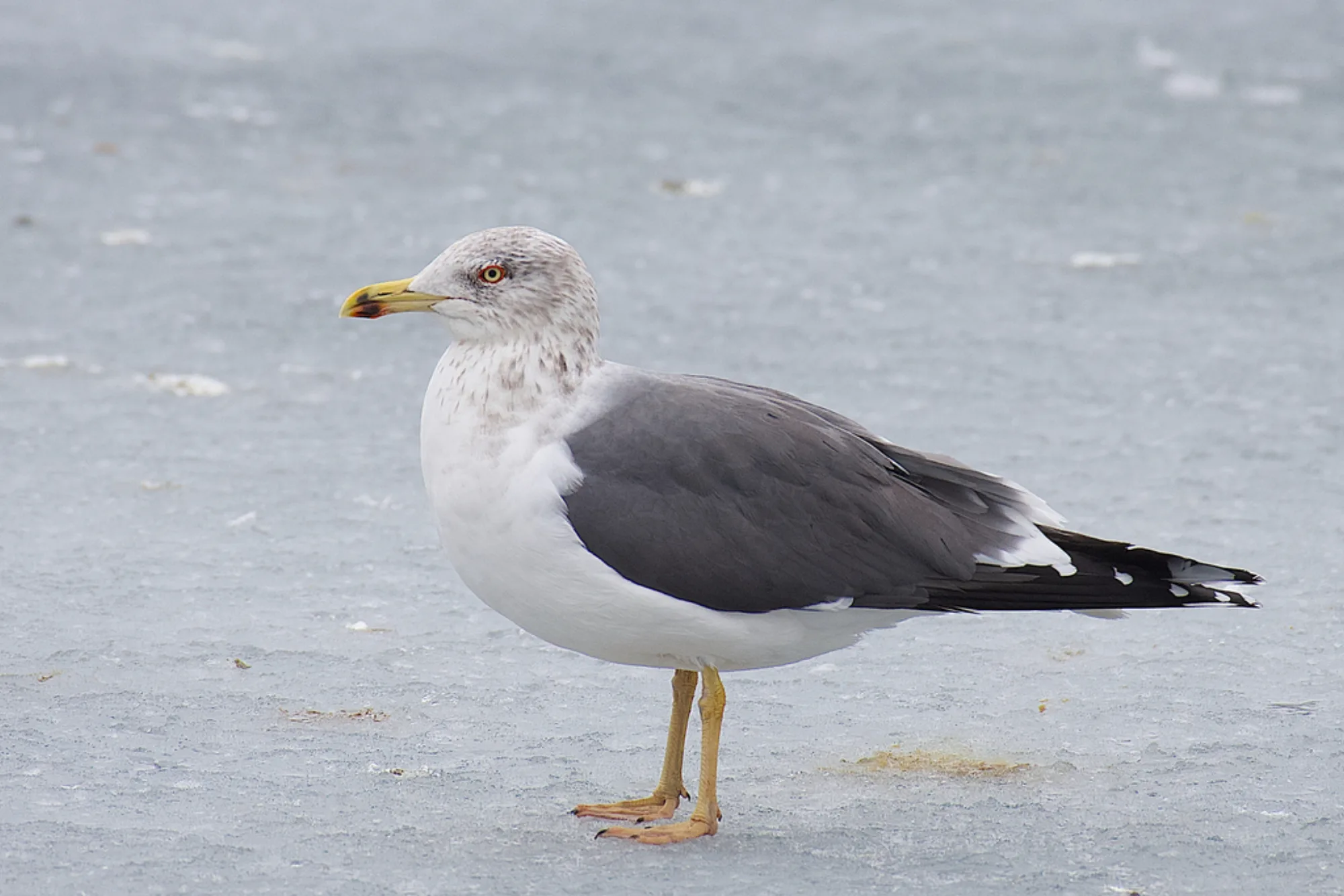
Along the Atlantic and Arctic coasts of Europe, the Lesser Black-backed Gull breeds in colonies beside the sea and at lakes. A large gull, it measures 51 to 64 cm long, with a wingspan of 124 to 150 cm. Adults have black or dark grey backs and wings, yellow legs and a yellow bill marked with a red spot. Young birds look different, with scaly black-brown upperparts and a neat pattern on their wings. Their call resembles a laugh, pitched noticeably deeper than that of a herring gull.
These gulls migrate, wintering between the British Isles and West Africa. Their range has also spread westwards: they first colonised Greenland in the 1980s. In North America, where they were once only winter visitors, they are now recorded throughout the year and can be numerous in some winters. On coasts and lakes, they make lined nests on the ground or on cliffs, usually laying three eggs. They also nest in some cities, often alongside herring gulls.
Their varied diet includes fish, insects, crustaceans, worms, starfish and molluscs. They also eat seeds, berries, small mammals, eggs, small birds and chicks, as well as scraps, offal and carrion. Young gulls take four years to reach maturity. There is serious concern about declines in many parts of the species' range. The UK holds 40 per cent of the European population, with over half of its birds concentrated at fewer than ten sites where they breed.
Written from the English Wikipedia article Lesser black-backed gull (CC BY-SA 4.0).
- Records
- 2,751,049
- Countries
- 161
- Atlas places
- 13
- Queen Elizabeth National Park· Uganda
- Serengeti National Park· Tanzania
- Aberdare National Park· Kenya
- Chitwan National Park· Nepal
- Hell's Gate National Park· Kenya
- Koshi Tappu Wildlife Reserve· Nepal
- Lake Nakuru National Park· Kenya
- Ngorongoro Conservation Area· Tanzania
- Nyungwe National Park· Rwanda
- Okavango Delta· Botswana
- Pilanesberg National Park· South Africa
- Tortuguero· Costa Rica
- Volcanoes National Park· Rwanda
These are open occurrence records, so they show where people looked for and recorded the Lesser Black-backed Gull as much as where it lives. Cells are up to 25 km across, and every location is generalised to its cell.
Generalised encounter areas, not exact locations. Each shape is a grid cell coloured by how likely the species is there.
- Very likelyBelgium25 km zone · high confidence · 885180 records · updated 86 days ago
- Very likelyUnited Kingdom25 km zone · high confidence · 371521 records · updated 86 days ago
- Very likelySpain25 km zone · high confidence · 330046 records · updated 86 days ago
- Very likelyFrance25 km zone · high confidence · 227016 records · updated 86 days ago
- Very likelyPortugal25 km zone · high confidence · 212517 records · updated 86 days ago
- Very likelyNorway25 km zone · high confidence · 103351 records · updated 86 days ago
- Very likelyFinland25 km zone · high confidence · 99129 records · updated 86 days ago
- Very likelyMorocco25 km zone · high confidence · 93580 records · updated 86 days ago
- Very likelyUnited States25 km zone · high confidence · 79556 records · updated 86 days ago
- Very likelyWestern Sahara25 km zone · high confidence · 76985 records · updated 86 days ago
Conservation status not assessed here yet, so every location is generalised to its grid cell.