Mew Gull
Larus canus
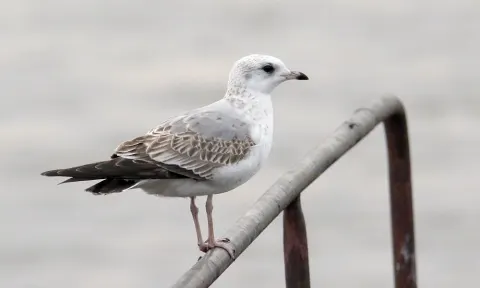
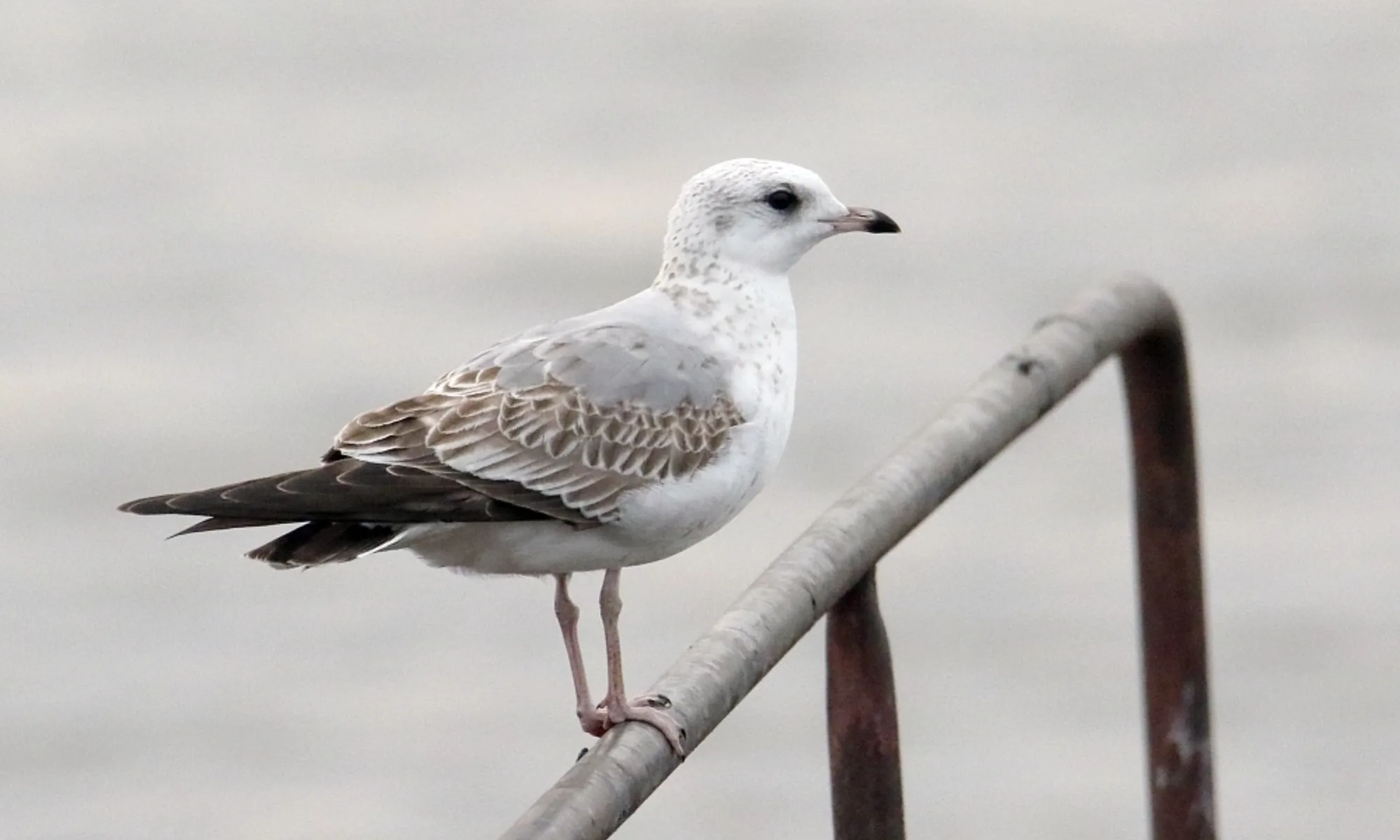
Look for the Mew Gull’s grey back, white underside and black wingtips, marked with large white patches. Adults are 40 to 46 cm long, with a wingspan of 100 to 115 cm, and are noticeably smaller than herring gulls. In the breeding season, their legs are yellow and their tapered, greenish-yellow bill is unmarked. In winter, grey streaks appear on the head, the legs become duller, and the bill often develops a faint blackish band near its tip. Young gulls are scaly black-brown above, with pink legs that turn greyish in their second year and later become yellow. Listen for a high-pitched cry with a laughing quality.
The species breeds across the northern Palearctic, from Iceland and Scotland east to the Russian Far East. Most birds migrate south for winter, reaching places including the Mediterranean, the southern Caspian Sea, and waters around China and Japan. Some birds from northwestern Europe stay in the region year-round. Breeding birds usually gather in colonies, though some nest alone. Both parents line a nest, placing it near water or in marshes, either on the ground or among the branches of a small tree. A clutch usually contains three eggs, although one or two are sometimes laid. Both parents incubate the eggs, which hatch after 24 to 26 days, and care for the chicks. The chicks stay near the nest and fledge at around 35 days old. Mew Gulls eat a varied diet, scavenging for food and hunting small prey.
Written from the English Wikipedia article Common gull (CC BY-SA 4.0).
- Records
- 926,883
- Countries
- 77
No atlas park has a record of the Mew Gull in or around it yet.
These are open occurrence records, so they show where people looked for and recorded the Mew Gull as much as where it lives. Cells are up to 25 km across, and every location is generalised to its cell.
Generalised encounter areas, not exact locations. Each shape is a grid cell coloured by how likely the species is there.
- Very likelyNorway25 km zone · high confidence · 417555 records · updated 86 days ago
- Very likelyUnited Kingdom25 km zone · high confidence · 167034 records · updated 86 days ago
- Very likelyFinland25 km zone · high confidence · 94971 records · updated 86 days ago
- Very likelyBelgium25 km zone · high confidence · 69495 records · updated 86 days ago
- Very likelySweden25 km zone · high confidence · 46253 records · updated 86 days ago
- Very likelyNetherlands25 km zone · high confidence · 20522 records · updated 86 days ago
- Very likelyGermany25 km zone · high confidence · 18473 records · updated 86 days ago
- Very likelyRussia25 km zone · high confidence · 11681 records · updated 86 days ago
- Very likelyIreland25 km zone · high confidence · 8771 records · updated 86 days ago
- Very likelyFrance25 km zone · high confidence · 8141 records · updated 86 days ago
Conservation status not assessed here yet, so every location is generalised to its grid cell.