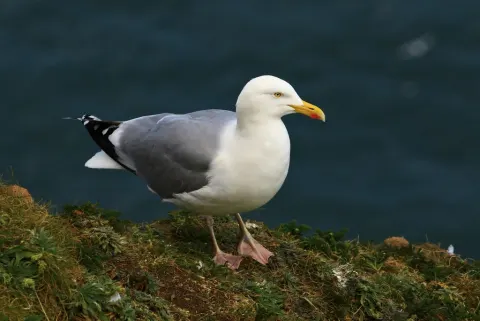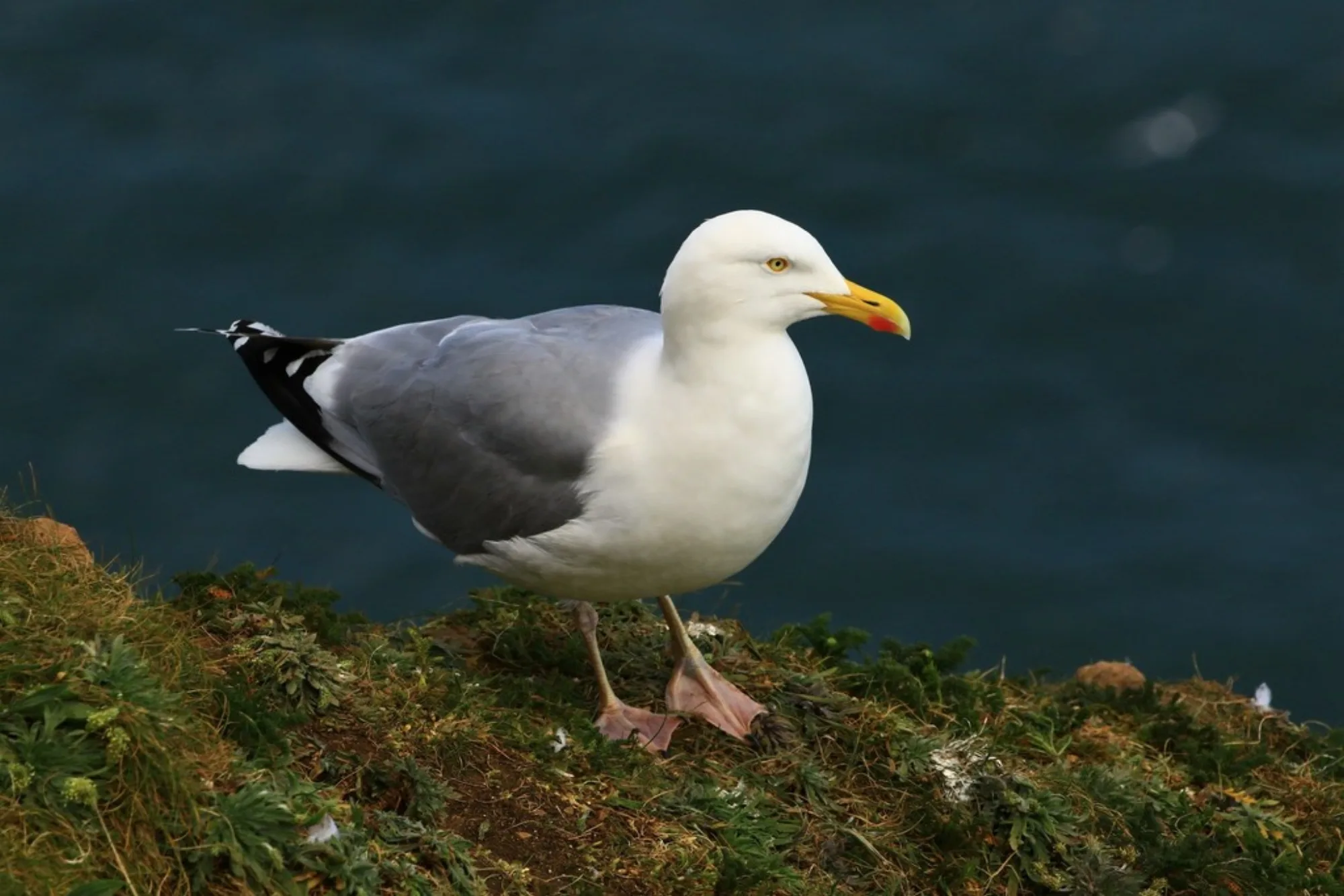
Herring Gull
Larus argentatus
A large gull with a loud, laughing call, the Herring Gull is a familiar presence along European shores. In breeding plumage, adults are pale grey above, with a white head and underside and white spots on their black wingtips. Their yellow bill has a red spot, and their legs are normally pink. In their first winter, young birds have brown plumage marked with darker streaks, as well as dark eyes and bills.
Herring Gulls breed along the northern and western coasts of Europe, including Iceland, Britain, Ireland and France. They have been recorded around Europe's coasts, including the Mediterranean, and occasionally inland. Many stay in the same area year-round, while birds from colder northern regions may move south for winter. In Britain, they can also be found throughout the year in streets and gardens, with rooftops providing nesting space. These sociable, noisy birds eat fish, crustaceans and plant material, and scavenge food waste and carrion. They also take other birds' eggs and young, and may carry shelled prey upwards before dropping it to crack the shell. On land, a gull may drum its feet on the ground to bring earthworms to the surface.
Pairs can remain together for life and return to the same nesting site in successive years. They nest in colonies on the ground or on cliff ledges, usually laying three eggs, which both parents incubate for 28 to 30 days. Young can fly 35 to 40 days after hatching and are generally fed by their parents until 11 to 12 weeks old. Herons, corvids, harriers and great black-backed gulls prey on breeding colonies; raptors and seals occasionally take adults. In the UK, the population has fallen by 50% in 25 years, even though numbers have increased in urban areas.
Written from the English Wikipedia article European herring gull (CC BY-SA 4.0).
- Records
- 3,013,229
- Countries
- 52
- Atlas places
- 1
These are open occurrence records, so they show where people looked for and recorded the Herring Gull as much as where it lives. Cells are up to 25 km across, and every location is generalised to its cell.
Generalised encounter areas, not exact locations. Each shape is a grid cell coloured by how likely the species is there.
- Very likelyBelgium25 km zone · high confidence · 1023788 records · updated 86 days ago
- Very likelyUnited Kingdom25 km zone · high confidence · 564198 records · updated 86 days ago
- Very likelyFrance25 km zone · high confidence · 482131 records · updated 86 days ago
- Very likelyNorway25 km zone · high confidence · 428898 records · updated 86 days ago
- Very likelyFinland25 km zone · high confidence · 287557 records · updated 86 days ago
- Very likelyIreland25 km zone · high confidence · 31960 records · updated 86 days ago
- Very likelySweden25 km zone · high confidence · 29077 records · updated 86 days ago
- Very likelyNetherlands25 km zone · high confidence · 24009 records · updated 86 days ago
- Very likelyIceland25 km zone · high confidence · 23651 records · updated 86 days ago
- Very likelyGermany25 km zone · high confidence · 21970 records · updated 86 days ago
Conservation status not assessed here yet, so every location is generalised to its grid cell.