Borneo Earless Monitor
Lanthanotus borneensis
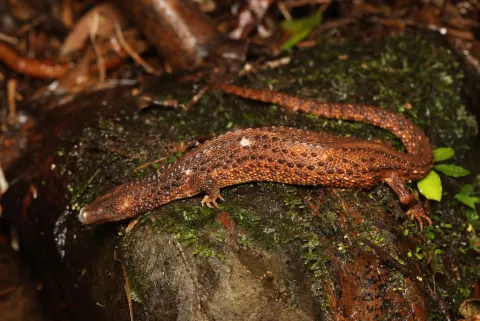
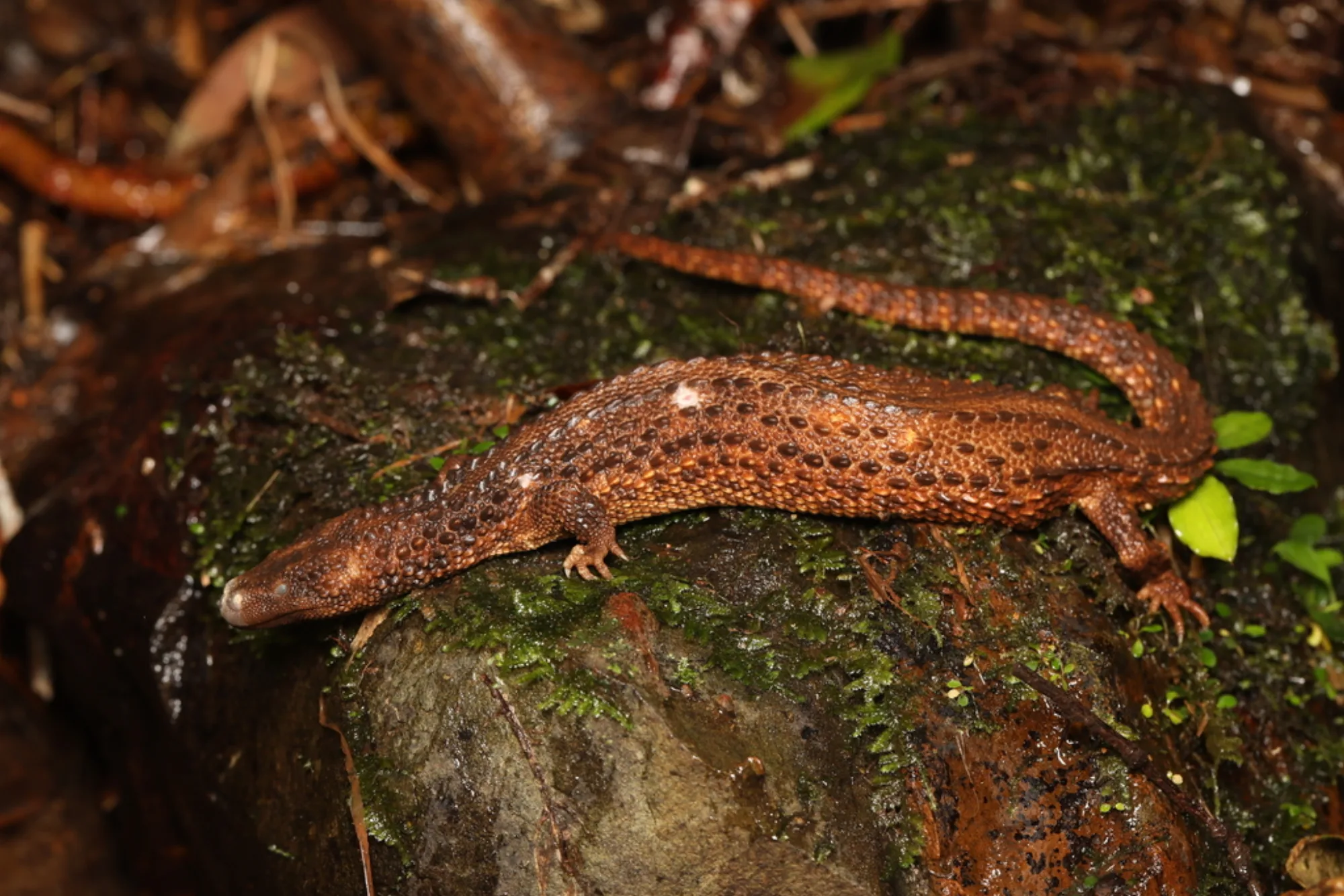
The earless monitor lizard is a semiaquatic, brown reptile found only on the island of Borneo. It is recognized by a long neck, short legs, and six rows of prominent, keeled scales running down its cylindrical body. Though it lacks visible ear openings, it is capable of hearing. Adults typically reach a total length of about 40 cm. While they look similar, males are distinguished by their wider heads and tail bases.
These lizards live in lowlands below 300 m, usually near rocky streams and marshes. While they inhabit rainforests, they are also found in agricultural areas like fruit gardens and palm oil plantations. They are generally nocturnal, spending their days in burrows up to 30 cm long or hidden under rocks and logs. In the water, they may remain still for hours, occasionally surfacing to breathe. Their diet consists of earthworms, fish, and crustaceans, which they can uniquely swallow while submerged.
Females lay an average of 8 leathery eggs on land, which take about three months to hatch. Travelers should be aware that while the species is often considered rare, it is frequently overlooked due to its inactive nature. The Borneo Earless Monitor faces significant threats from habitat loss as forests are converted into plantations. It is also targeted by wildlife traders for the international market, where individuals have been sold for very high prices despite legal protections in Malaysia, Brunei, and Indonesia.
Written from the English Wikipedia article Earless monitor lizard (CC BY-SA 4.0).
- Atlas places
- 0
These are open occurrence records, so they show where people looked for and recorded the Borneo Earless Monitor as much as where it lives. Cells are up to 25 km across, and every location is generalised to its cell.
No encounter zones yet
Where and when you can expect to see Borneo Earless Monitor is calculated from observation density. No zones have been computed for this species yet.