Loggerhead Shrike
Lanius ludovicianus
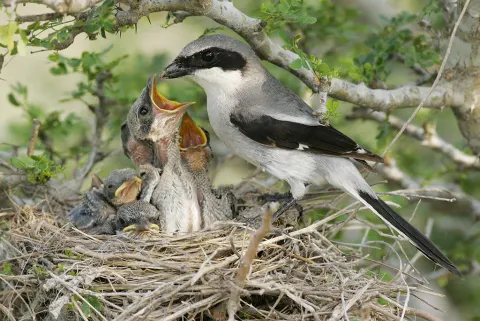
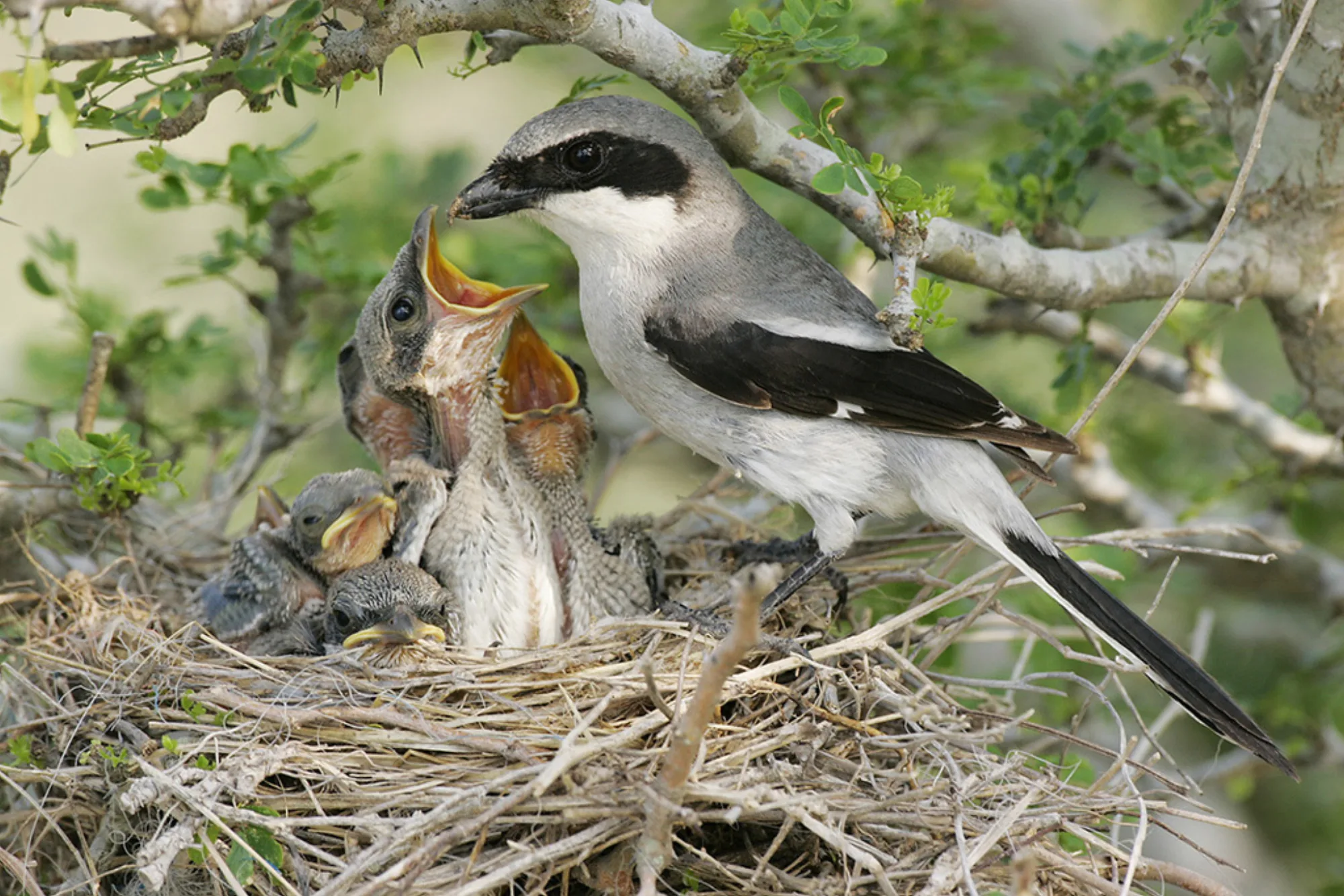
A large head, black eye mask and hooked black bill give the Loggerhead Shrike a distinctive look. This medium-sized North American songbird has grey upperparts and a breast ranging from white to pale grey, with black wings marked by white patches and a black tail edged in white. Its calls range from squeaky whistles to shrill trills and guttural warbles. Look for it in open pastures and grasslands, particularly where short vegetation makes hunting easier. It needs places to nest and raised perches from which to watch for prey, including outer tree branches and telephone wires. The species breeds from parts of southern Canada south to Mexico, using semi-open country with dense trees and shrubs for nest sites.
By day, the shrike waits on a perch, scans its surroundings and dives after prey. Insects make up much of its diet, but it also takes reptiles, amphibians, rodents, bats and small birds. It catches insects in flight, while larger prey may be impaled on a thorn or barbed wire, giving the bird an anchor as it tears off flesh. Food may also be left on a thorn for later. In a bulky cup of twigs and grass, the female produces a clutch of 4 to 8 eggs; both parents feed the nestlings. Young birds leave the nest after about 19 days and may stay nearby, relying on their parents for another 3 to 4 weeks. Populations have declined across North America since the 1960s, and the bird has disappeared from much of the northeastern United States. The reasons remain unclear, although habitat loss, pesticide contamination and human disturbance have all been suggested.
Written from the English Wikipedia article Loggerhead shrike (CC BY-SA 4.0).
- Records
- 746,950
- Countries
- 3
- Atlas places
- 2
These are open occurrence records, so they show where people looked for and recorded the Loggerhead Shrike as much as where it lives. Cells are up to 25 km across, and every location is generalised to its cell.
Generalised encounter areas, not exact locations. Each shape is a grid cell coloured by how likely the species is there.
- Very likelyUnited States25 km zone · high confidence · 722952 records · updated 80 days ago
- Very likelyMexico25 km zone · high confidence · 21703 records · updated 80 days ago
- Very likelyCanada25 km zone · high confidence · 2295 records · updated 80 days ago
Conservation status not assessed here yet, so every location is generalised to its grid cell.