Great Grey Shrike
Lanius excubitor
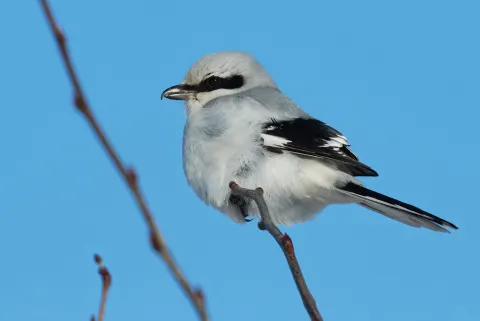
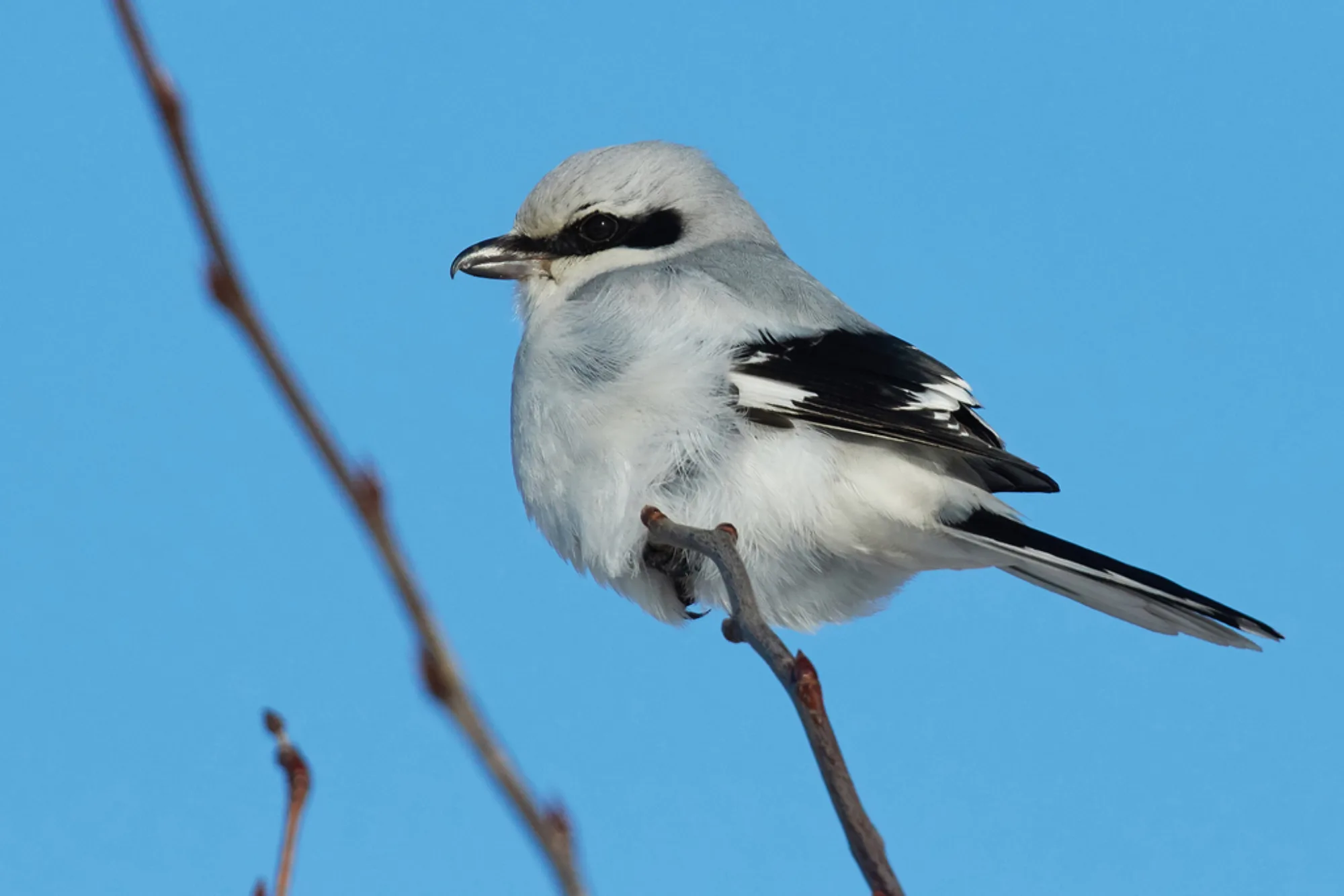
A black mask across the eyes gives the Great Grey Shrike a watchful look, set against pearly grey upperparts and a pale underside. This predatory songbird is about the size of a large thrush, measuring 22 to 26 cm long, with black wings marked in white and a long, pointed tail. Males and females look much alike, although females often have greyer, barred underparts. Its flight is undulating and rather heavy, usually low over the ground, while its calls include shrill, raspy whistles.
The breeding range stretches across Eurasia and northern Africa, and most populations move south for winter, though some remain year-round. Look for it in open grassland with shrubs and elevated lookout points, such as trees, fence posts or rocks. It also hunts over bogs, clearings and lightly farmed fields, while avoiding dense forest and open ground without suitable perches or nesting places. From an upright perch, it watches for prey, or hovers over grassland before dropping down to catch it. Small rodents make up at least half its prey by weight, with lizards, frogs, birds and large insects also on the menu. It may secure larger prey on thorns or barbed wire to tear it apart, and stores surplus food in the same way.
Pairs generally breed once each summer, building a cup-shaped nest in a tree, or occasionally a large shrub. The young leave the nest after 2 to 3 weeks and become independent several weeks later. Birds of prey hunt fledged shrikes, while corvids are significant predators of eggs and nestlings. European numbers have declined as agricultural land consolidation has removed hedgerows and other elevated growth, and pesticide use probably harmed populations by reducing breeding success.
Written from the English Wikipedia article Great grey shrike (CC BY-SA 4.0).
- Records
- 117,071
- Countries
- 31
- Atlas places
- 1
These are open occurrence records, so they show where people looked for and recorded the Great Grey Shrike as much as where it lives. Cells are up to 25 km across, and every location is generalised to its cell.
Generalised encounter areas, not exact locations. Each shape is a grid cell coloured by how likely the species is there.
- Very likelyNorway25 km zone · high confidence · 25285 records · updated 80 days ago
- Very likelyUnited Arab Emirates25 km zone · high confidence · 14713 records · updated 80 days ago
- Very likelyIsrael25 km zone · high confidence · 11891 records · updated 80 days ago
- Very likelyIndia25 km zone · high confidence · 11836 records · updated 80 days ago
- Very likelySpain25 km zone · high confidence · 10013 records · updated 80 days ago
- Very likelyBelgium25 km zone · high confidence · 8425 records · updated 80 days ago
- Very likelyFrance25 km zone · high confidence · 6797 records · updated 80 days ago
- Very likelyPalestinian Territories25 km zone · high confidence · 5053 records · updated 80 days ago
- Very likelyPoland25 km zone · high confidence · 3238 records · updated 80 days ago
- Very likelyJordan25 km zone · high confidence · 2826 records · updated 80 days ago
Conservation status not assessed here yet, so every location is generalised to its grid cell.