Garden Skink
Lampropholis guichenoti
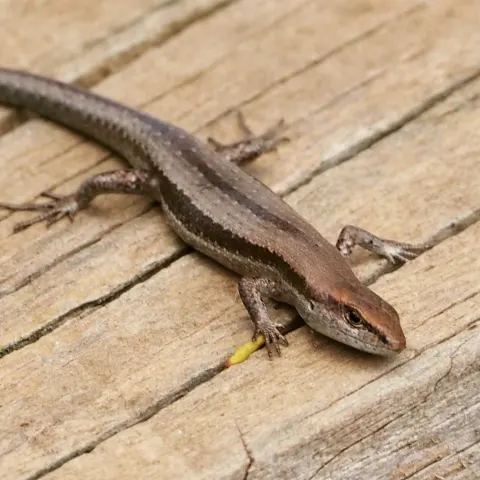
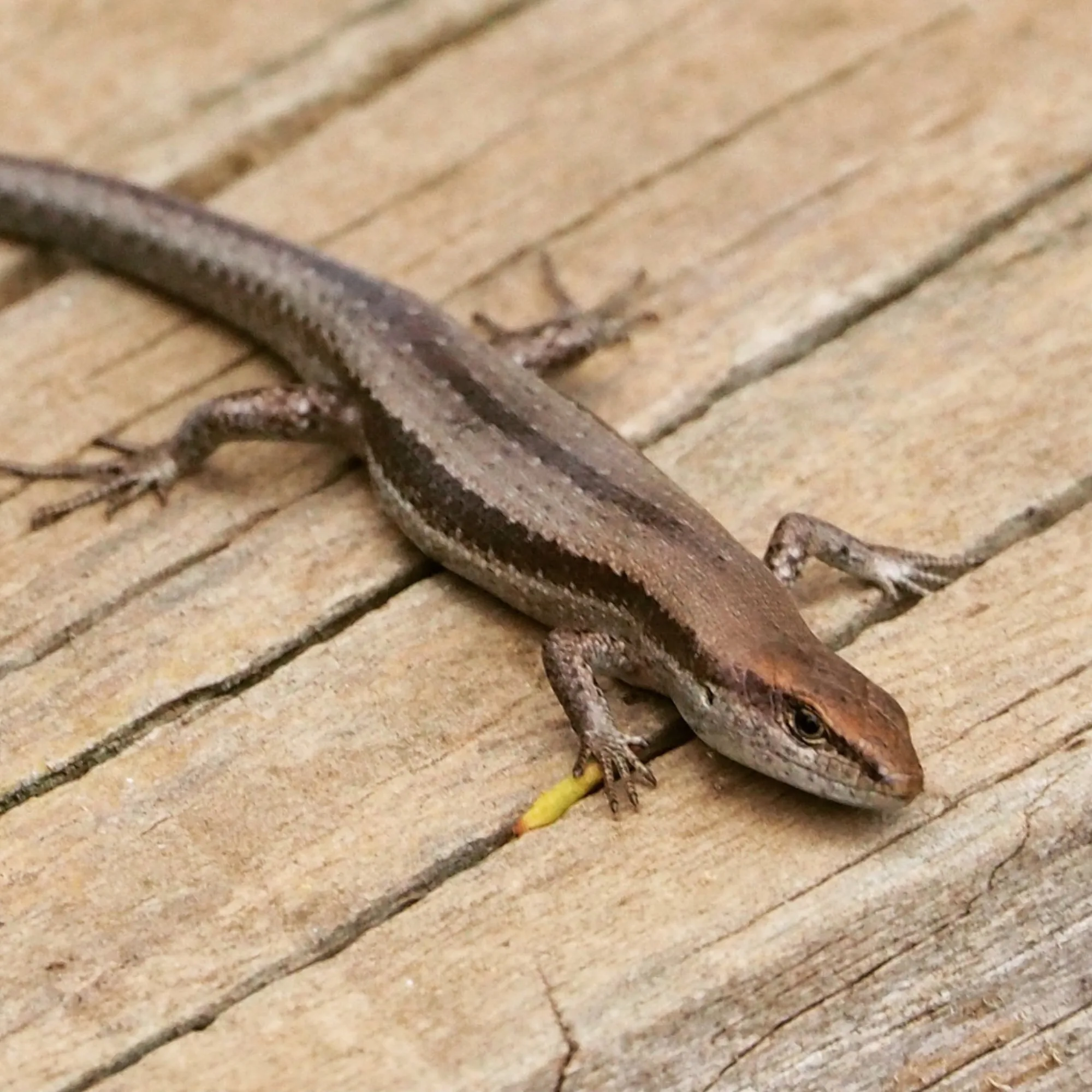
Watch for a small, brownish black lizard warming itself on a rock or path in the morning: it may be a Garden Skink. In sunlight, its colour can look dark red. Including the tail, it averages 8 to 10 cm long and can reach 14 cm. Females are often larger than males, with a yellowish, almost orange underside; males have a light grey underside. Even wild individuals are usually docile and rarely bite people who touch or pick them up.
Found only in Australia, this skink frequently turns up in suburban gardens from Perth and Adelaide to Melbourne, Canberra, Sydney and Brisbane. It is also common across most of southern Australia and Tasmania, and in parts of New South Wales. Look among leaves, long grass and rocks, or around rock tumbles where crevices provide cover. It favours dry places with hiding spots, as well as large areas with plenty of leaves and soft soil. Logs offer shelter from larger predators, while water offers another escape route: the skink can dive and stay submerged for several minutes.
The skink hunts by watching for movement, either lying in wait or chasing its prey, depending on how hungry it is. Its food includes crickets, moths, earthworms, slugs, small spiders and many other invertebrates, as well as dandelions. Birds, cats, larger lizards and snakes prey on it. If grasped roughly, it can shed its tail, which twitches and draws a predator's attention while the skink escapes; the tail eventually grows back. Between summer and mid autumn, females usually lay about six small white eggs, often with those of other females under rocks. These communal clutches can hold up to 250 eggs, which hatch within weeks.
Written from the English Wikipedia article Common garden skink (CC BY-SA 4.0).
- Records
- 17,851
- Countries
- 1
- Atlas places
- 5
These are open occurrence records, so they show where people looked for and recorded the Garden Skink as much as where it lives. Cells are up to 25 km across, and every location is generalised to its cell.
Generalised encounter areas, not exact locations. Each shape is a grid cell coloured by how likely the species is there.
- Very likelyAustralia25 km zone · medium confidence · 17851 records · updated 80 days ago
Conservation status not assessed here yet, so every location is generalised to its grid cell.