Eastern Milksnake
Lampropeltis triangulum
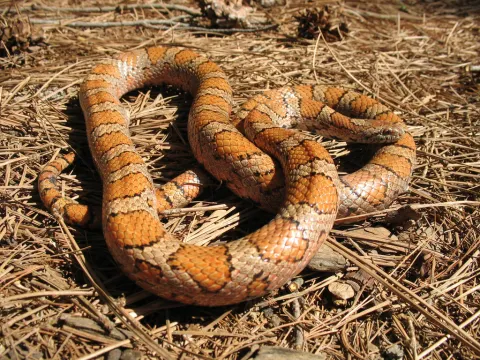
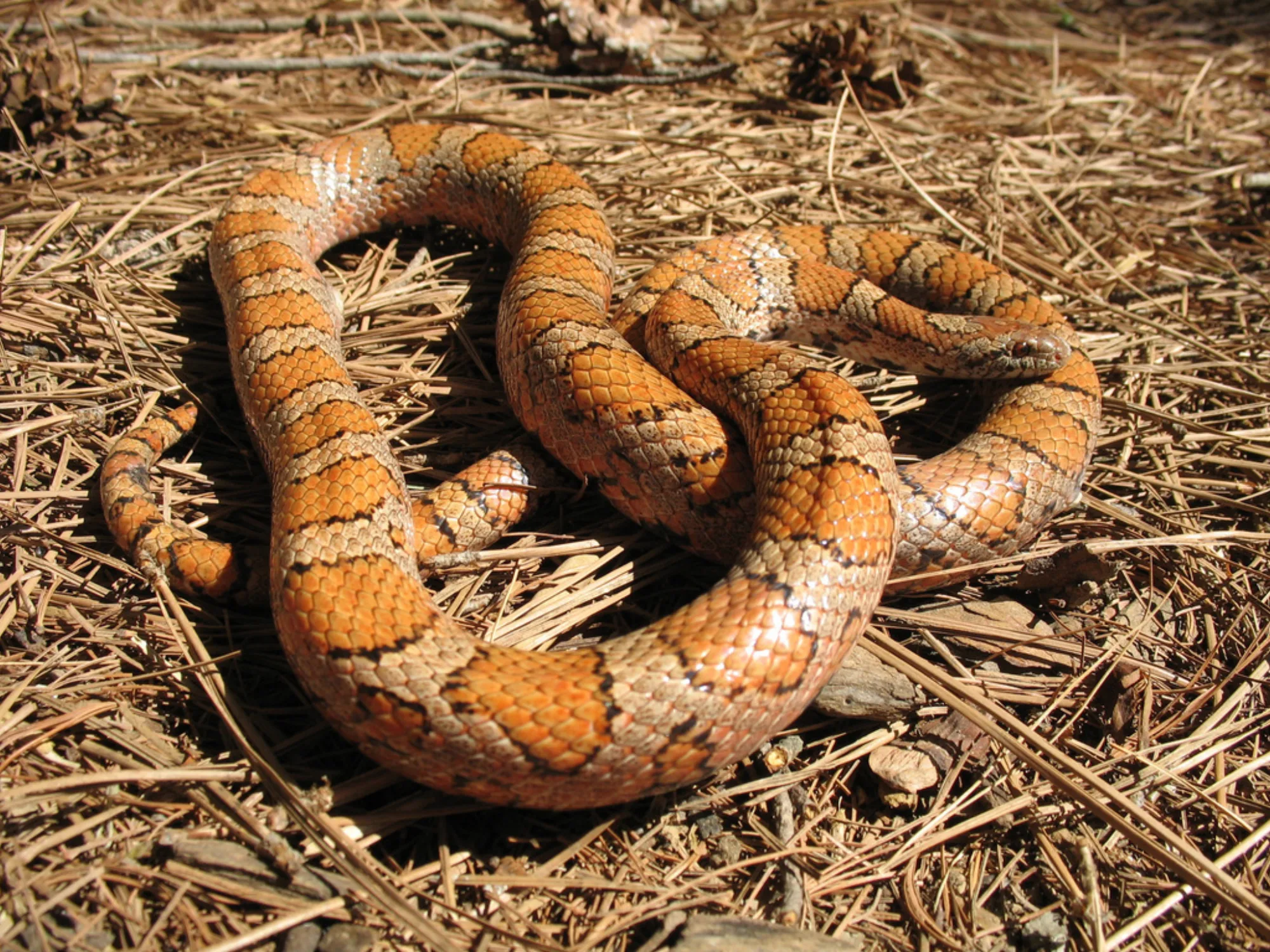
A pale V- or Y-shaped patch on the neck is one clue to recognising the Eastern Milksnake, a non-venomous kingsnake. Its colours can make it look like several other snakes, including venomous kinds. Young milk snakes are redder than adults and are sometimes killed after being mistaken for copperheads. Milk snakes have smooth, shiny scales, with patterns that can include red blotches or alternating bands of red, black and yellow or white, black and red.
Milk snakes occur across a broad range in North America, from southeastern Ontario and Maine south to Florida and west through several central states. They favour forests and open woodland, but also live in places ranging from farmland and prairie to rocky slopes, swamps and sand dunes. Some move seasonally, seeking higher, drier ground for winter hibernation and moister places for summer. Habitat destruction and fragmentation can limit these movements.
Secretive and mostly active at night, milk snakes spend much of their time hidden, blending into litter on the ground. They can climb and swim, and often rest by day under wood or in old barns, where rodents offer a ready food supply. Adults eat mainly small mammals, including mice and voles, as well as lizards and a variety of other animals. When threatened, a milk snake usually tries to escape, but may vibrate its tail and strike if cornered or harassed. Females lay between three and 24 eggs in June or July, sheltering them under rotting vegetation, rocks, boards or logs; hatching follows around August or September. Collection for the pet trade puts pressure on milk snakes in some areas, while mistaken identity also leads people to kill them.
Written from the English Wikipedia article Milk snake (CC BY-SA 4.0).
- Records
- 1,012
- Countries
- 6
- Atlas places
- 3
These are open occurrence records, so they show where people looked for and recorded the Eastern Milksnake as much as where it lives. Cells are up to 25 km across, and every location is generalised to its cell.
Generalised encounter areas, not exact locations. Each shape is a grid cell coloured by how likely the species is there.
- Very likelyUnited States25 km zone · medium confidence · 696 records · updated 80 days ago
- Very likelyCanada25 km zone · medium confidence · 292 records · updated 80 days ago
- Very likelyColombia25 km zone · medium confidence · 8 records · updated 80 days ago
- Very likelyPanama25 km zone · medium confidence · 8 records · updated 80 days ago
- Very likelyNicaragua25 km zone · medium confidence · 5 records · updated 80 days ago
- LikelyMexico25 km zone · medium confidence · 3 records · updated 80 days ago
Conservation status not assessed here yet, so every location is generalised to its grid cell.