Common Kingsnake
Lampropeltis getula
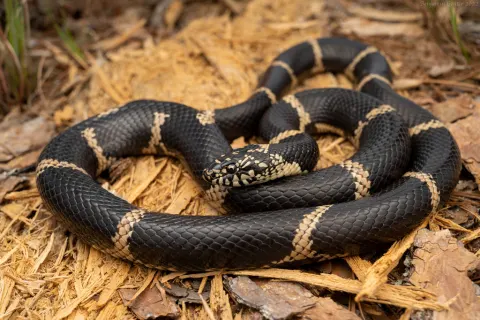
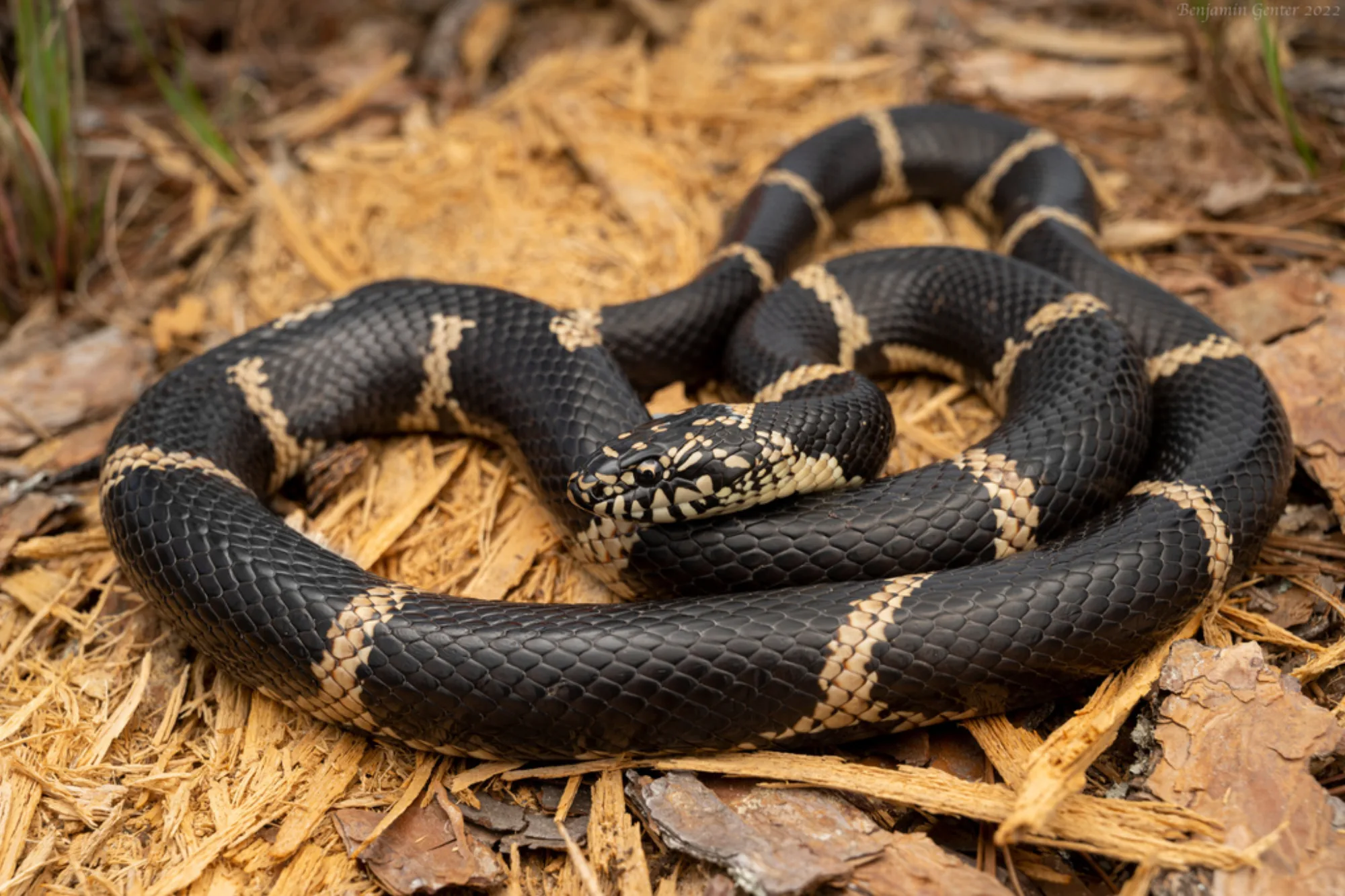
Glossy dark scales and pale, chain-like rings give the Common Kingsnake its distinctive appearance. Its background colour can be black, blue-black or dark brown, with 23 to 52 white rings. The pattern varies across its range: snakes on coastal plains have wider bands, while those in mountain areas may have thin bands or be entirely black. This harmless snake is native to the southeastern United States, where it occurs from southern New Jersey to Florida. Recorded specimens have reached 208.2 cm in total length.
Open ground, especially grassland, is favoured, but the snake also lives in oak woodland, chaparral, abandoned farms, desert and low mountains. Wet places form part of its range too, from swamps to canals and streams. Look for areas with dense shrubs and a thick covering of fallen leaves, although finding a snake may take patience: in one study, 79% of those tracked spent most of their time hidden beneath soil and leaf litter. It is commonly described as active by day, though reports suggest activity at dusk or night during the hottest parts of the year. Rodent burrows provide places to retreat at night. In most of its range, the eastern kingsnake is active from April to October.
Its varied diet includes other snakes, even venomous ones, as well as amphibians, lizards, small mammals and the eggs of birds and turtles. Breeding takes place in spring, and females lay up to several dozen eggs, which hatch after 2.0 to 2.5 months. Young snakes eat small snakes, lizards and rodents. A fungal disease called ophidiomycosis affects snakes, though the extent of its impact is still being researched.
Written from the English Wikipedia article Lampropeltis getula (CC BY-SA 4.0).
- Records
- 400
- Countries
- 1
- Atlas places
- 1
These are open occurrence records, so they show where people looked for and recorded the Common Kingsnake as much as where it lives. Cells are up to 25 km across, and every location is generalised to its cell.
Generalised encounter areas, not exact locations. Each shape is a grid cell coloured by how likely the species is there.
- Very likelyUnited States25 km zone · medium confidence · 400 records · updated 80 days ago
Conservation status not assessed here yet, so every location is generalised to its grid cell.