Scarlet Kingsnake
Lampropeltis elapsoides
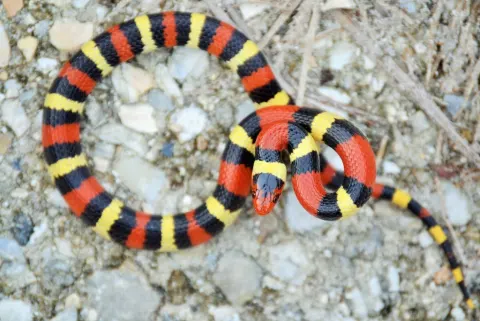
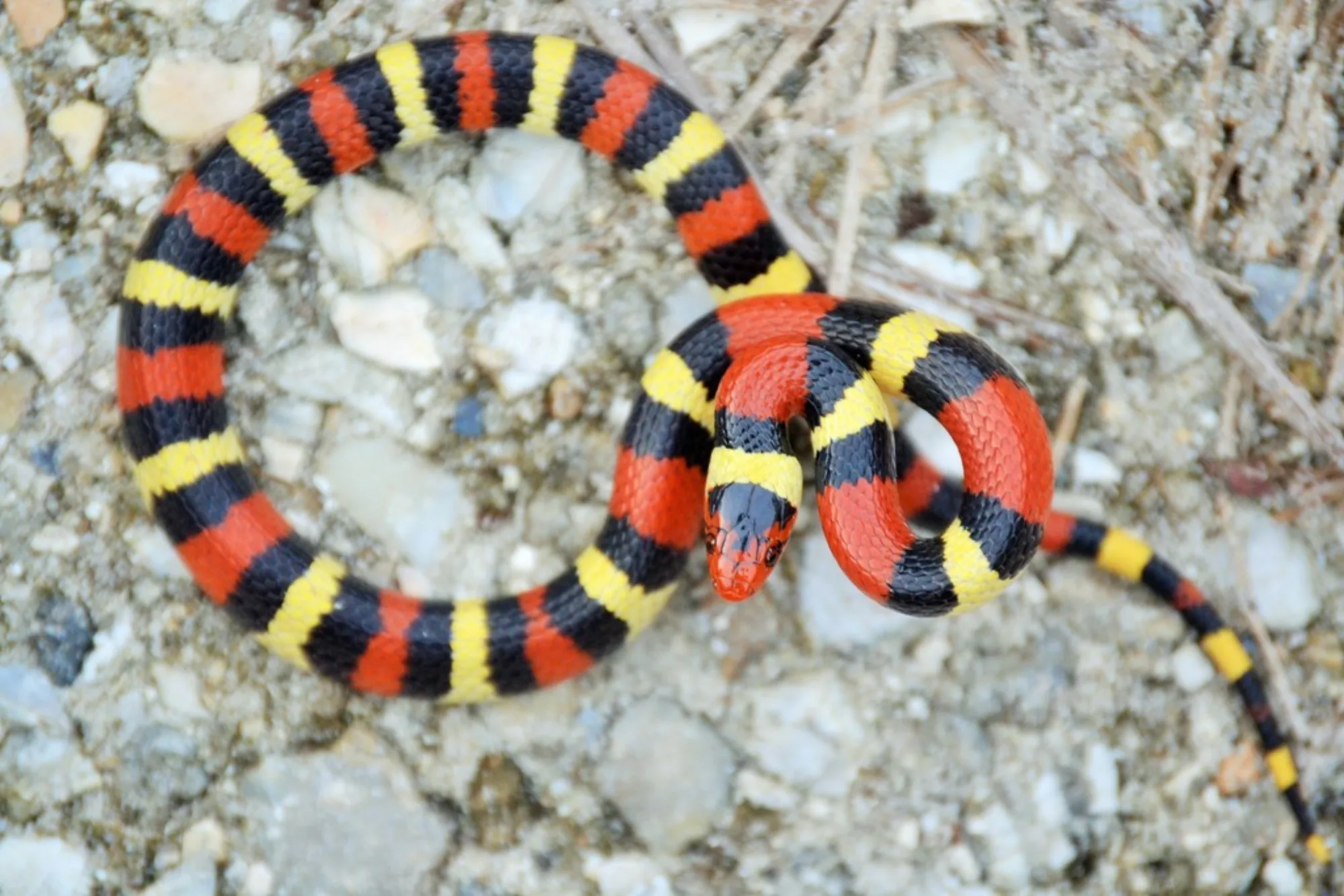
Bands of black, red and white mark a young Scarlet Kingsnake, while adults can develop yellow in shades ranging from lemon to apricot. This nonvenomous kingsnake has a red snout and resembles the venomous eastern coral snake, which has a prominent black snout. At maturity, it usually measures 40 to 50 cm, making it the smallest species in its genus.
Its range covers eastern and southeastern parts of the United States and extends farther north and northeast than that of the eastern coral snake. It lives in pine flatwoods, pine savannas and pine-oak forests, as well as prairies, cultivated fields and suburban habitats. People sometimes find it in swimming pools, especially in spring. Secretive and nocturnal, it spends much of its time underground and is seldom seen, although it is also an excellent climber. Loose bark on rotting pines is a favoured hiding place in spring or during heavy rain, and the snake also shelters beneath bark on dying pines and their stumps and in decaying wood.
There it hunts small snakes and lizards, especially skinks. Young snakes show a strong preference for ground skinks, often passing over other prey. In one study, skinks made up 74% of the elongated reptiles in the snakes' diet, while colubroid snakes accounted for 15%. Mating occurs in late May and early June; females lay their eggs in June and July. Clutches contain 4 to 12 eggs, usually placed under rotting wood or between rocks and logs. The eggs are white and slender and typically hatch within 2 to 2.5 months, though timing varies.
Written from the English Wikipedia article Scarlet kingsnake (CC BY-SA 4.0).
- Records
- 33
- Countries
- 1
- Atlas places
- 1
These are open occurrence records, so they show where people looked for and recorded the Scarlet Kingsnake as much as where it lives. Cells are up to 25 km across, and every location is generalised to its cell.
Generalised encounter areas, not exact locations. Each shape is a grid cell coloured by how likely the species is there.
- Very likelyUnited States25 km zone · medium confidence · 33 records · updated 80 days ago
Conservation status not assessed here yet, so every location is generalised to its grid cell.