C. G. Nigrita)
Lampropeltis californiae
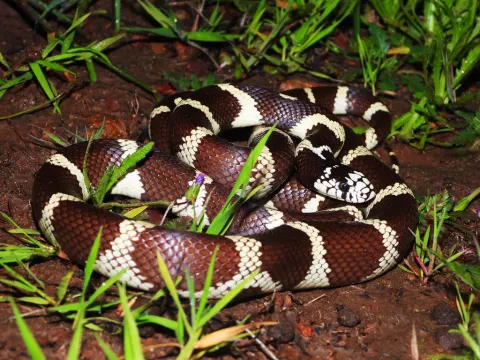
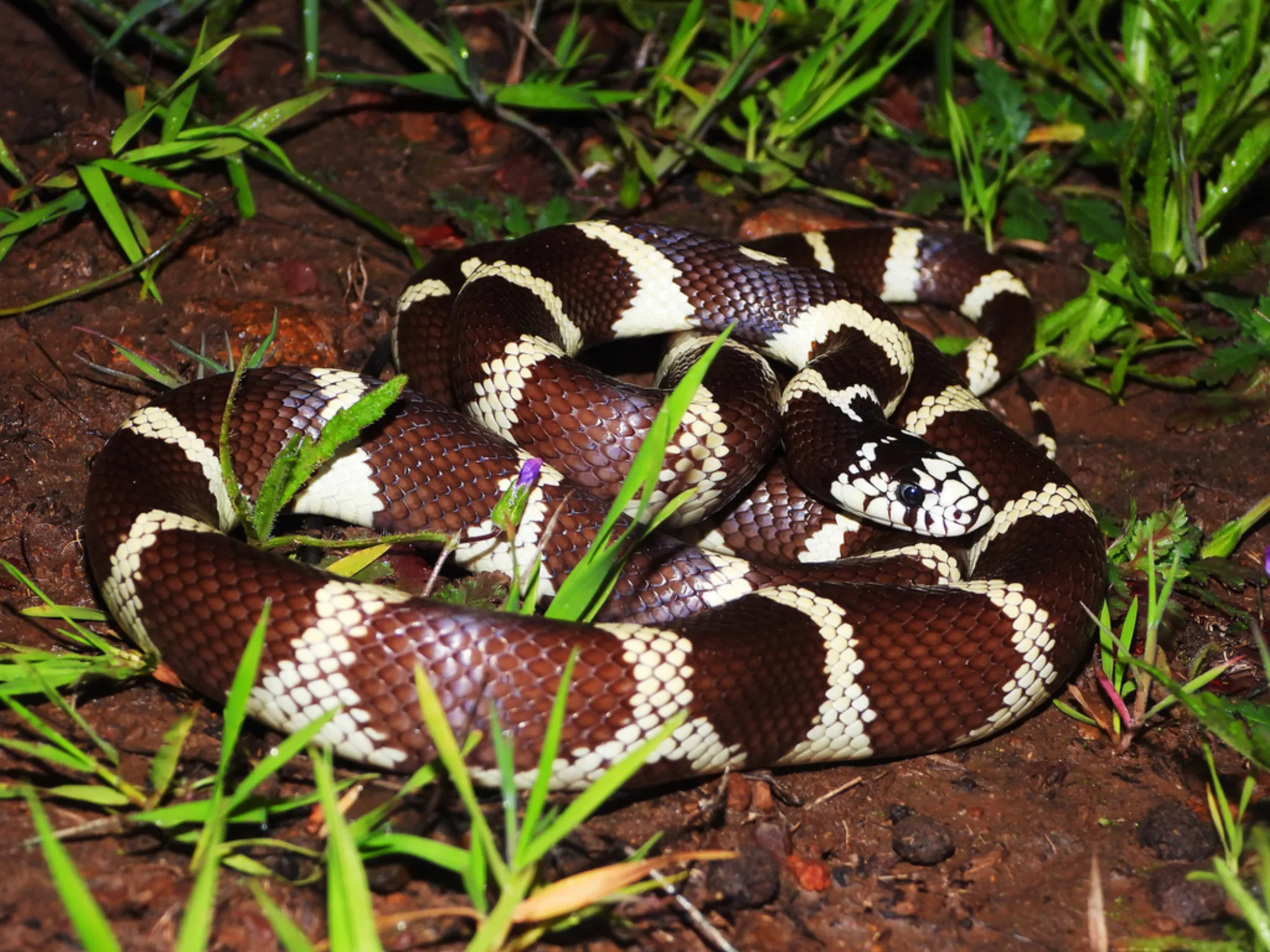
Across the western United States and northern Mexico, the C. G. Nigrita) (Lampropeltis californiae) can turn up in habitats ranging from desert to marsh. This nonvenomous snake usually has alternating dark and pale bands, with colours ranging from white and black to cream and brown. Some populations have lengthwise stripes instead, and both patterns help conceal the snake from predators. Wild individuals are typically 76 to 107 cm long, although larger snakes have been recorded.
Its range includes Oregon, California, Nevada, Utah and Arizona, as well as parts of Colorado, New Mexico and northwestern Mexico. It lives in woodland chaparral and grassland too, and can occur in suburban areas. On Gran Canaria, where it has become invasive, it tends to use rocky or stony places with plenty of vegetation cover. Depending on the temperature, it may be active during the day or at night. It basks to warm up and shelters beneath vegetation or other cover to cool down. Generally solitary, these snakes come together during mating season or winter brumation, when they conserve energy and occasionally wake to drink.
California kingsnakes eat rodents, birds, reptiles and amphibians, taking opportunities as they arise. They also hunt other snakes, including rattlesnakes, and kill their prey by constriction. Courtship begins in spring, and females lay eggs between May and August. A typical clutch contains five to 12 eggs, and hatchlings usually emerge 40 to 65 days later. Predators include birds such as eagles and hawks, mammals such as coyotes and foxes, and other kingsnakes.
Written from the English Wikipedia article California kingsnake (CC BY-SA 4.0).
- Records
- 784
- Countries
- 2
- Atlas places
- 6
These are open occurrence records, so they show where people looked for and recorded the C. G. Nigrita) as much as where it lives. Cells are up to 25 km across, and every location is generalised to its cell.
Generalised encounter areas, not exact locations. Each shape is a grid cell coloured by how likely the species is there.
- Very likelyUnited States25 km zone · medium confidence · 749 records · updated 80 days ago
- Very likelyMexico25 km zone · medium confidence · 35 records · updated 80 days ago
Conservation status not assessed here yet, so every location is generalised to its grid cell.