Porbeagle
Lamna nasus
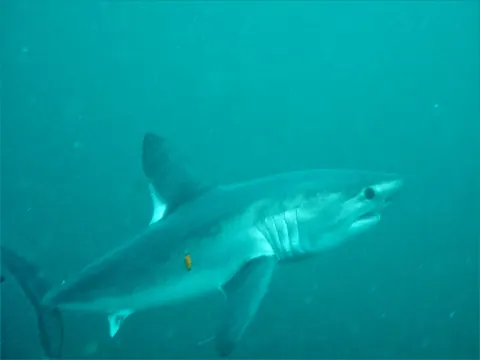
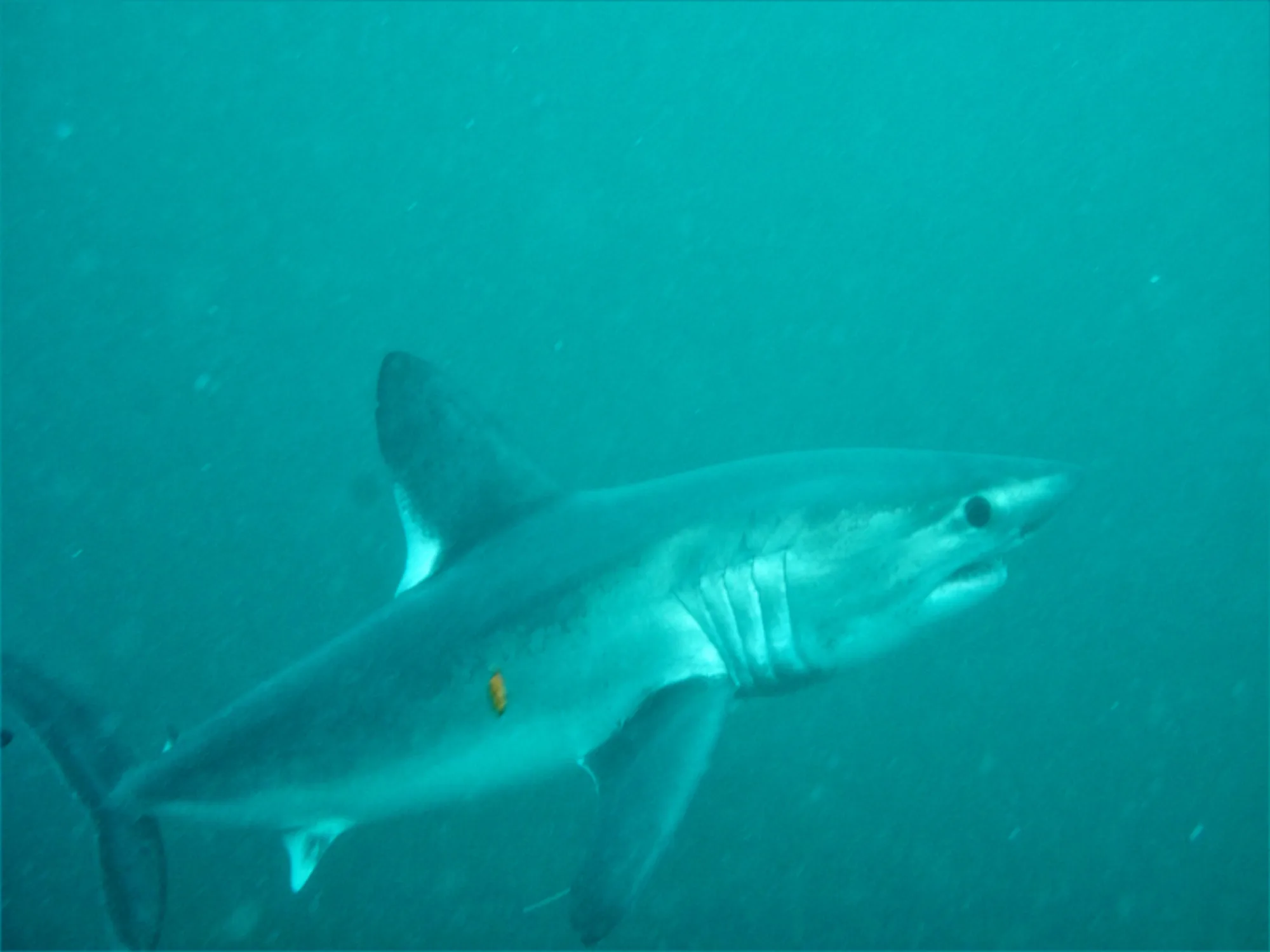
Built for speed, the Porbeagle is a stout mackerel shark with a pointed snout and a crescent-shaped tail. Its back is grey, its underside white, and a pale patch marks the rear of its large first dorsal fin. A typical adult is 2.5 m long, with North Atlantic sharks growing larger than those in the Southern Hemisphere. It lives in cold and temperate seas across the North Atlantic and Southern Hemisphere, including the Mediterranean, but is absent from the tropics. Food-rich offshore banks are its favoured habitat, but it also visits coastal waters and the open sea, descending to 1,360 m.
Fast and active, this shark travels alone or in groups and makes long seasonal movements between shallower and deeper water. Off Cornwall, porbeagles have been seen rolling and wrapping themselves in kelp near the surface, though the purpose of this behaviour is uncertain. They chase fish such as mackerel and herring, search near the bottom for cod and other fish, and also eat squid. Females usually produce four pups a year, after a pregnancy lasting 8 to 9 months. In the western North Atlantic, they give birth far offshore in the Sargasso Sea.
Porbeagle meat and fins are highly valued, and intensive fishing has caused stocks to collapse on both sides of the North Atlantic. The sharks are still caught deliberately and incidentally in fisheries across their range. Small litters and a long time to maturity make them susceptible to overfishing. In the Mediterranean, numbers have fallen by more than 99.99% since the middle of the 20th century, and the shark's range has shrunk to waters around the Italian Peninsula.
Written from the English Wikipedia article Porbeagle (CC BY-SA 4.0).
- Records
- 1,425
- Countries
- 8
No atlas park has a record of the Porbeagle in or around it yet.
These are open occurrence records, so they show where people looked for and recorded the Porbeagle as much as where it lives. Cells are up to 25 km across, and every location is generalised to its cell.
Generalised encounter areas, not exact locations. Each shape is a grid cell coloured by how likely the species is there.
- Very likelyCanada25 km zone · medium confidence · 1327 records · updated 80 days ago
- Very likelyAustralia25 km zone · medium confidence · 20 records · updated 80 days ago
- Very likelyNorway25 km zone · medium confidence · 16 records · updated 80 days ago
- Very likelyFrance25 km zone · medium confidence · 15 records · updated 80 days ago
- Very likelyNew Zealand25 km zone · medium confidence · 14 records · updated 80 days ago
- Very likelyUnited States25 km zone · medium confidence · 12 records · updated 80 days ago
- Very likelyUnnamed area25 km zone · medium confidence · 12 records · updated 80 days ago
- Very likelyIreland25 km zone · medium confidence · 9 records · updated 80 days ago
- Very likelyChile25 km zone · low confidence · 0 records · updated 80 days ago
Conservation status not assessed here yet, so every location is generalised to its grid cell.