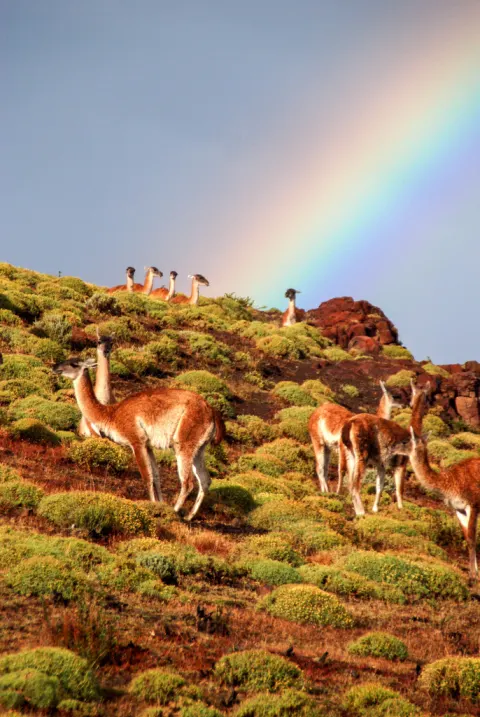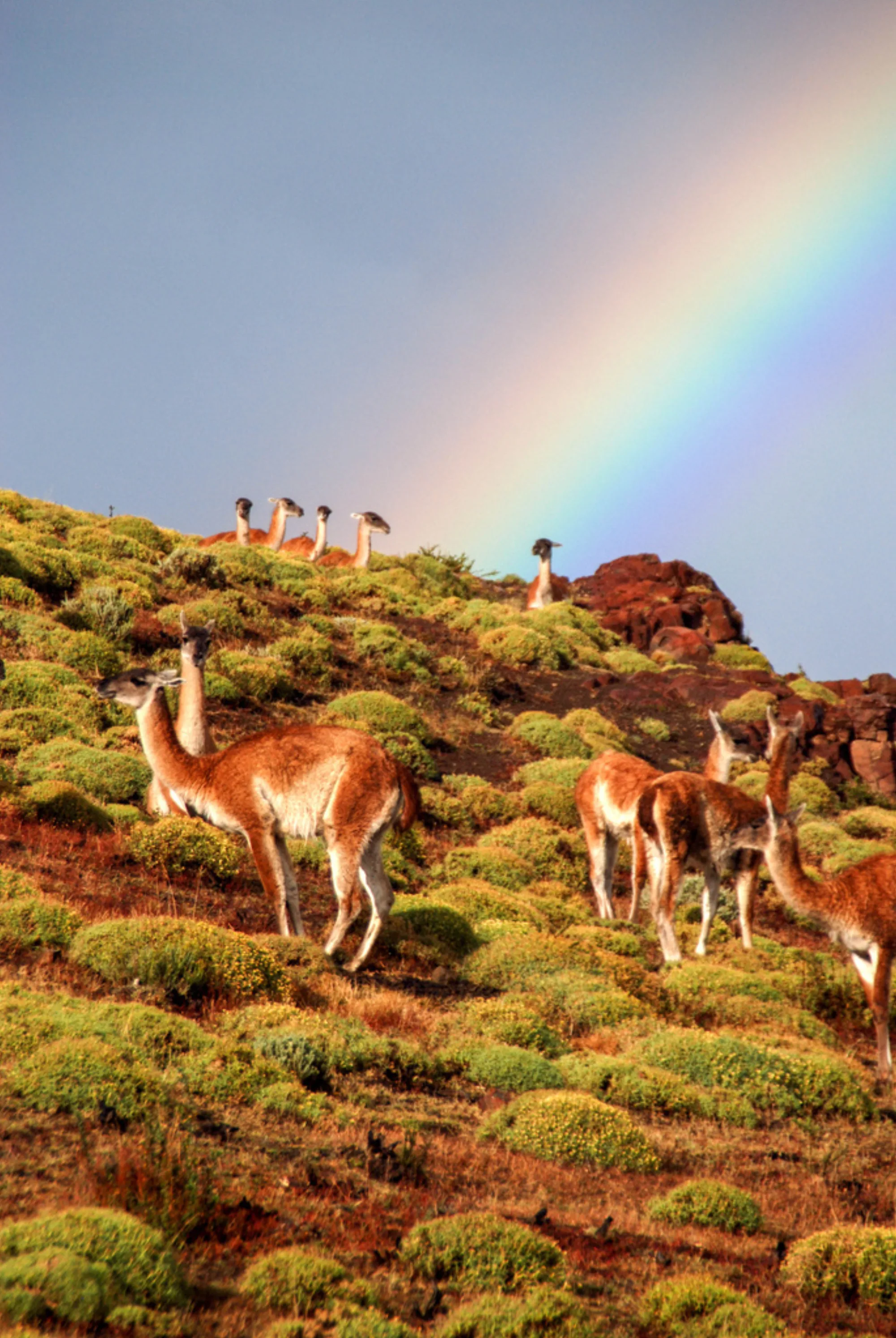
Guanaco
Lama guanicoe
A wild relative of the domesticated llama, the Guanaco is a South American camelid with a grey face and small, straight ears. Its coat ranges from light brown to dark cinnamon, fading to white beneath, and it stands 1.0 to 1.3 m at the shoulder. Guanacos inhabit steppes, scrublands and mountains, from the altiplano of Peru, Bolivia and Chile to Patagonia, with a small population in Paraguay. They live as high as 4,000 m above sea level, though in Patagonia ice covers the vegetation at such elevations. Some live in the Atacama Desert, where fog provides moisture for lichens and cacti that supply them with food.
Active during the day, guanacos live in herds of females and their young with a dominant male, while other males form bachelor herds. A male warns his group of danger with a bleat and usually runs behind the herd to defend it. Guanacos can run across steep, rocky ground and are excellent swimmers. They graze on plants including grasses, shrubs and herbs, as well as fungi and lichens. In the Atacama's fog oases, they eat cactus flowers and lichens. Mating takes place between December and February, and a single young guanaco, called a chulengo, is born eleven and a half months later. It can walk immediately after birth; males are driven from the herd at about a year old, then join bachelor groups.
Pumas and Andean foxes prey on guanacos, and herds may form a protective circle around their young when facing a fox. Fences can also be deadly when guanacos become entangled while trying to jump over them. In Bolivia, woody plants encroaching on their habitat pose another threat, while competition for grazing with livestock affects populations elsewhere.
Written from the English Wikipedia article Guanaco (CC BY-SA 4.0).
- Records
- 956
- Countries
- 4
- Atlas places
- 5
These are open occurrence records, so they show where people looked for and recorded the Guanaco as much as where it lives. Cells are up to 25 km across, and every location is generalised to its cell.
Generalised encounter areas, not exact locations. Each shape is a grid cell coloured by how likely the species is there.
- Very likelyArgentina25 km zone · medium confidence · 493 records · updated 80 days ago
- Very likelyChile25 km zone · medium confidence · 457 records · updated 80 days ago
- LikelyBolivia25 km zone · medium confidence · 4 records · updated 80 days ago
- PossiblePeru25 km zone · medium confidence · 2 records · updated 80 days ago
Conservation status not assessed here yet, so every location is generalised to its grid cell.