Yellow-tailed Woolly Monkey
Lagothrix flavicauda
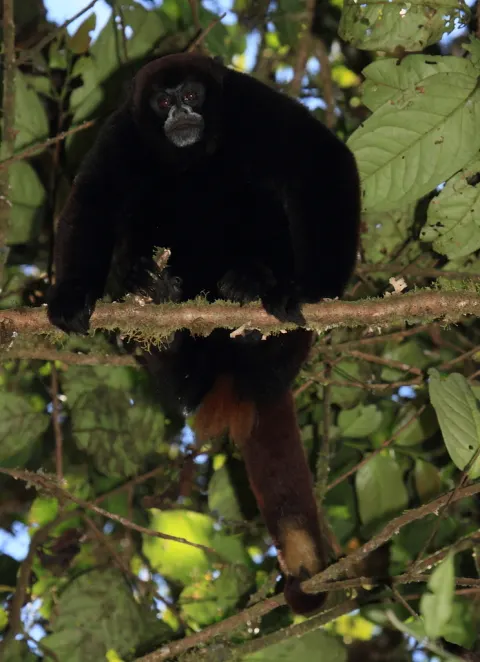
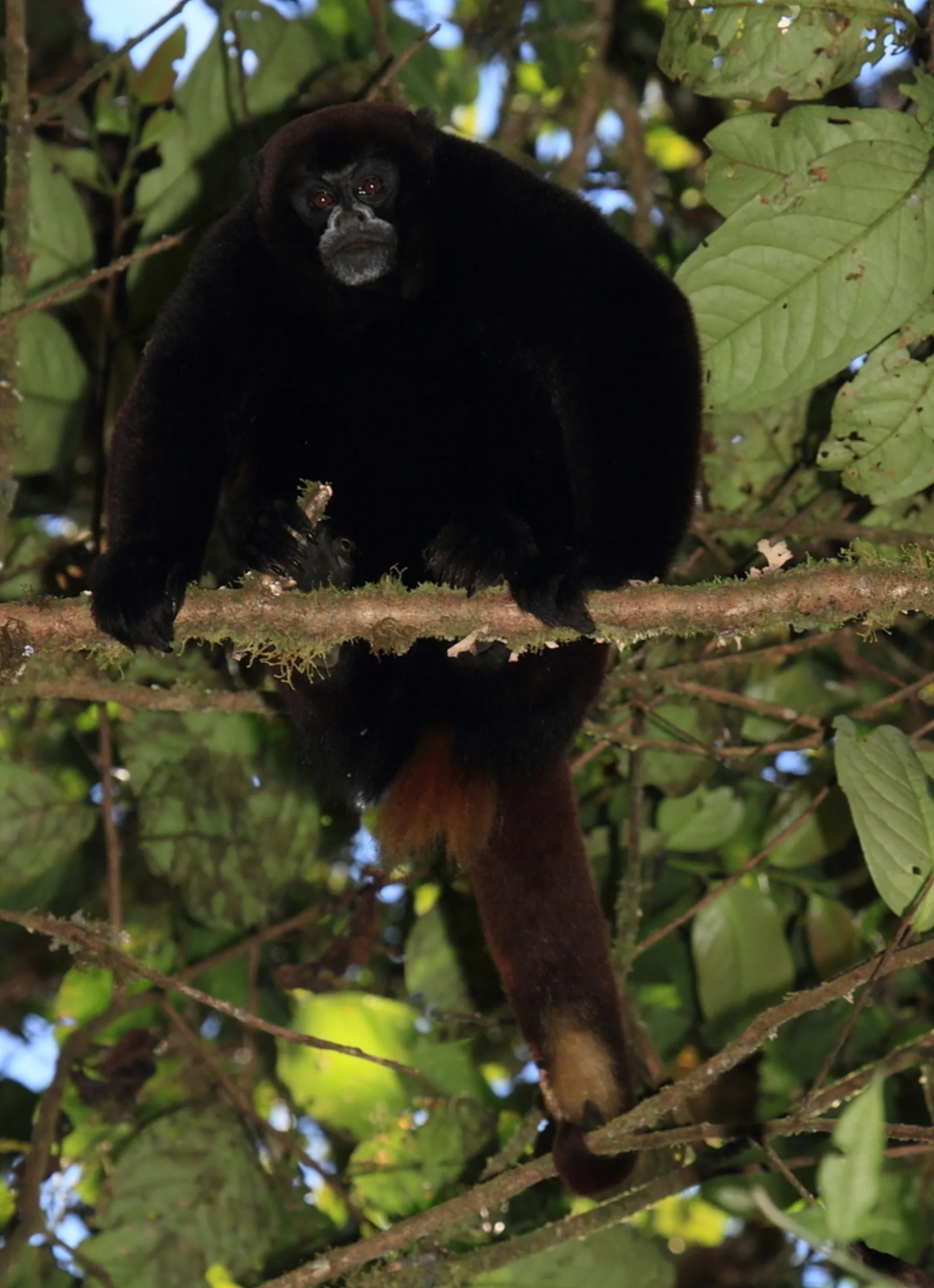
One of the largest Neotropical primates, the Yellow-tailed Woolly Monkey is a rare sight found only in the Peruvian Andes. It is distinguished by thick, deep mahogany or copper fur, a whitish snout, and a powerful prehensile tail. The final third of this tail is covered in yellowish hair, a feature not seen in younger monkeys. Adults weigh an average of 8 kg and reach head-and-body lengths of up to 53.5 cm. To survive the cold montane forests, they have developed denser coats than other woolly monkeys.
These agile primates live in the canopy of high-altitude cloud forests, often navigating steep mountain sides and deep river gorges at elevations between 1,500 and 2,700 m. They are active during the day, moving in social groups of about 23 individuals. Their diet consists mainly of fruit, though they also eat flowers, leaves, and insects. To supplement their intake of minerals like iron, they sometimes consume soil. When they encounter others, they may give a loud bark similar to a puppy or shake branches.
Because they mature slowly and have low reproductive rates, these monkeys are especially sensitive to modern threats. The current habitat is fragmented by the construction of roads and the spread of coffee plantations and cattle ranching. Logging and subsistence hunting also impact the population. While the monkeys were once protected by the inaccessibility of their terrain, recent immigration and the use of slash-and-burn agriculture have reduced their range, leaving an estimated population of fewer than 250 individuals.
Written from the English Wikipedia article Yellow-tailed woolly monkey (CC BY-SA 4.0).
- Records
- 3
- Countries
- 1
- Atlas places
- 0
These are open occurrence records, so they show where people looked for and recorded the Yellow-tailed Woolly Monkey as much as where it lives. Cells are up to 25 km across, and every location is generalised to its cell.
Generalised encounter areas, not exact locations. Each shape is a grid cell coloured by how likely the species is there.
- Very likelyPeru50 km zone · medium confidence · 3 records · updated 1 day ago