Lagopus scotica
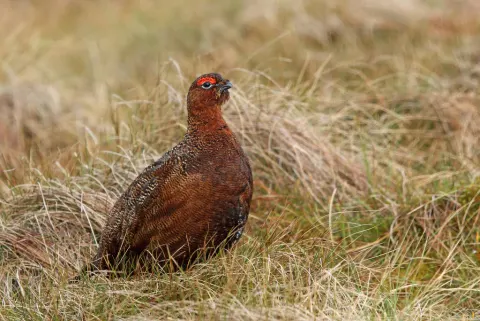
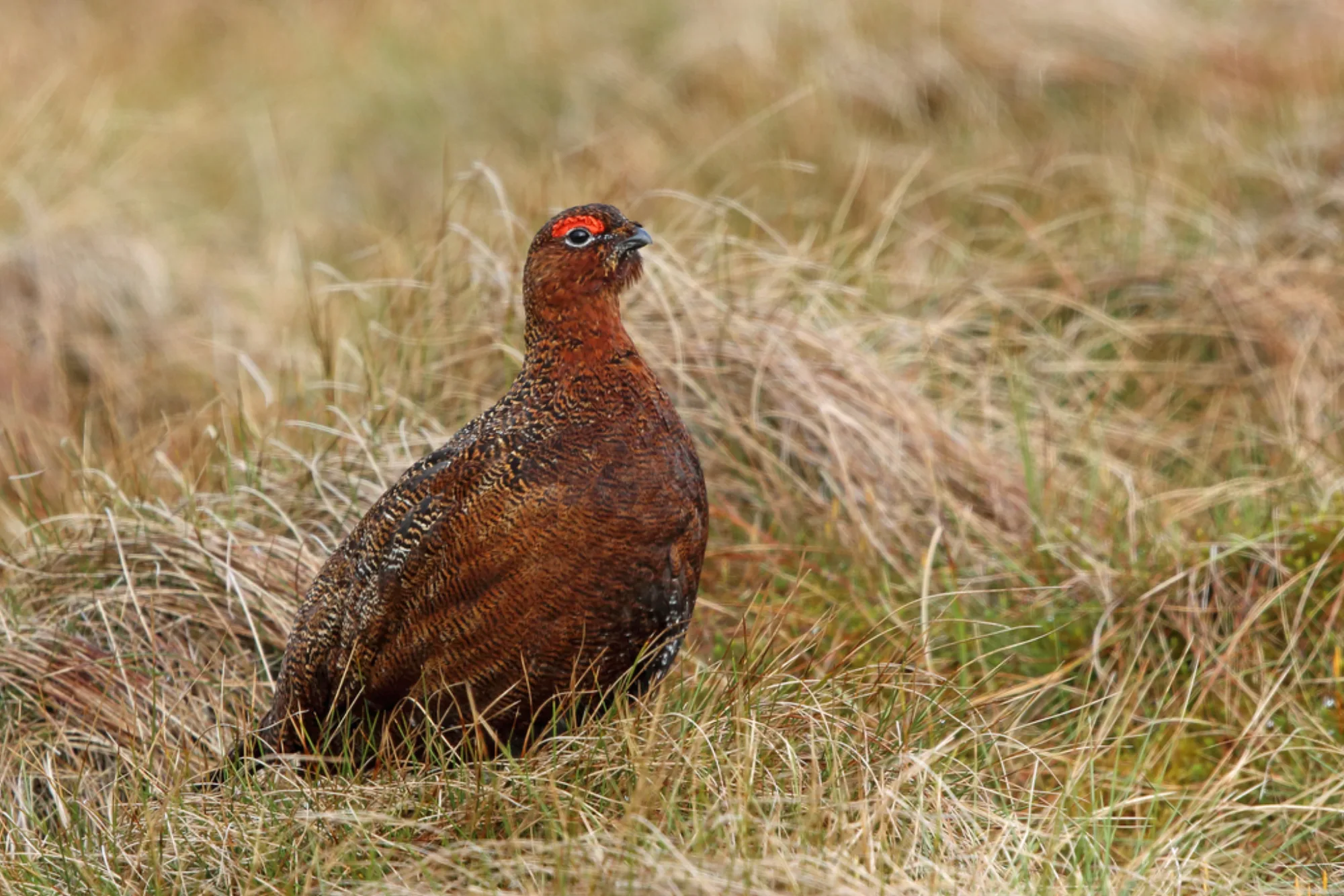
Across the heather moors of Britain and Ireland, the red grouse, Lagopus scotica, wears reddish brown plumage throughout the year. This medium-sized bird has a black tail, white legs and red crests above its eyes. Females are less reddish than males, while young birds are duller and lack the red crests. Listen for a repeated “Goback, goback, goback” call, or the whirr of wings when a resting bird is disturbed.
Red grouse favour treeless upland heather moorland, though they also live in some low-lying bogs. They occur across much of Scotland, including Orkney and Shetland, and mainly in northern England. In Wales their range has shrunk, with strongholds in Snowdonia and the Cambrian Mountains, as well as the Brecon Beacons. In Ireland they occur locally in higher areas and are most common in County Mayo. During harsh winter weather, birds may visit farmland and eat hawthorn berries from hedgerows.
Adults feed mainly on heather shoots, seeds and flowers, but also take berries, cereal crops and occasionally insects. Pairs begin to form in autumn, and males become more territorial as winter advances. A female lays about six to nine eggs, mainly in April and May, in a shallow, vegetation-lined scrape. Chicks can fly within 12 to 13 days and reach full size in 30 to 35 days. Numbers have declined in recent years as heather has been lost to overgrazing and new conifer plantations have been established. A decline in upland gamekeepers is also listed among the main causes, while parasites and viruses can have severe effects on populations. Many red grouse are shot each shooting season.
Written from the English Wikipedia article Red grouse (CC BY-SA 4.0).
- Records
- 77
- Countries
- 1
No atlas park has a record of the Lagopus scotica in or around it yet.
These are open occurrence records, so they show where people looked for and recorded the Lagopus scotica as much as where it lives. Cells are up to 25 km across, and every location is generalised to its cell.
Generalised encounter areas, not exact locations. Each shape is a grid cell coloured by how likely the species is there.
- Very likelyUnited Kingdom25 km zone · medium confidence · 77 records · updated 80 days ago
Conservation status not assessed here yet, so every location is generalised to its grid cell.