Rock Ptarmigan
Lagopus muta
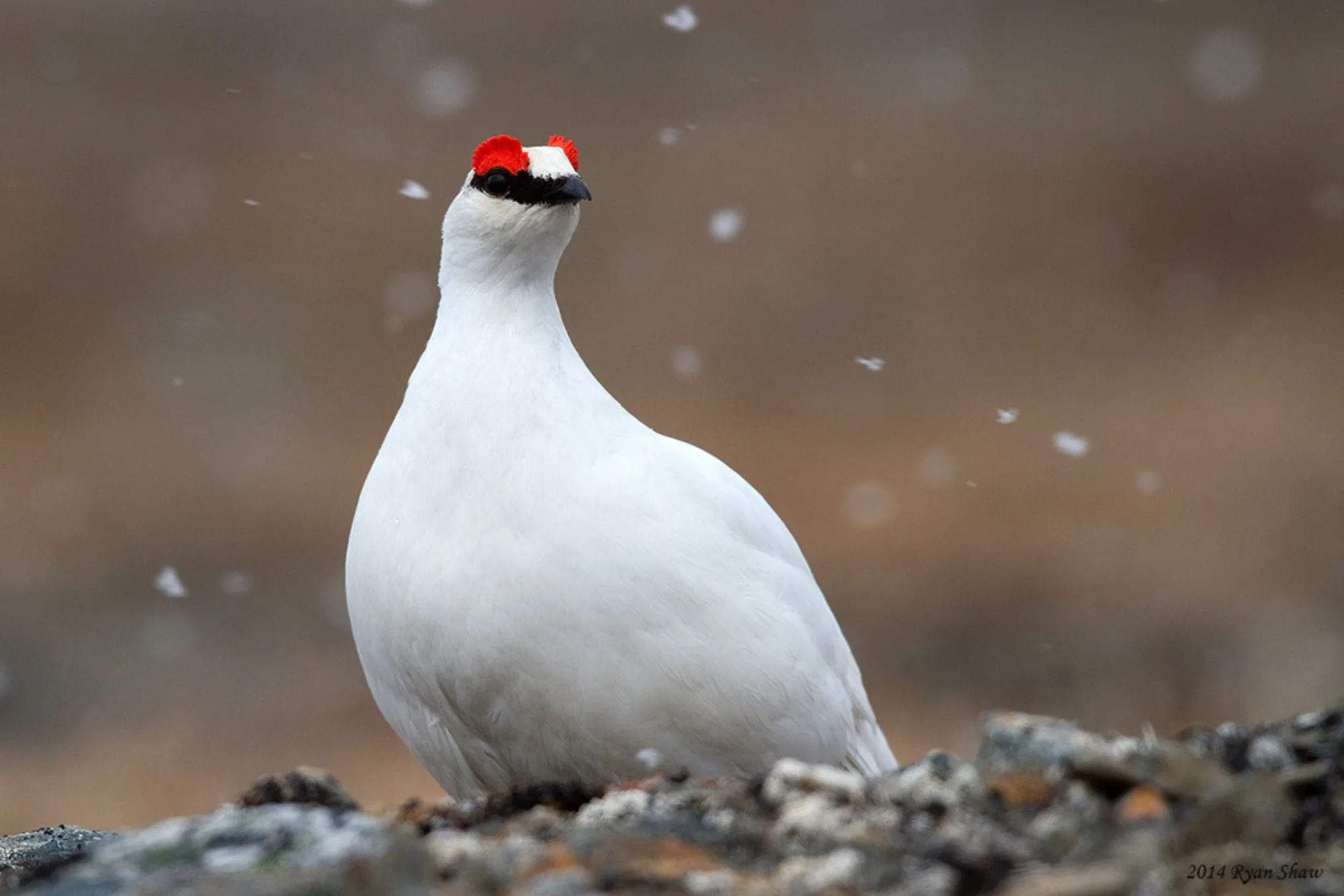
Camouflaged against its surroundings, the Rock Ptarmigan is a medium-sized grouse with feathered legs and a slender bill. Its winter plumage is white, changing to shades of grey and brown in the warmer months, while the breeding male has greyish upperparts and white wings and underparts. In winter, black outer tail feathers and a black line by the eye break up the white plumage.
The bird breeds on rocky mountainsides and tundra in Arctic and Subarctic regions of North America, Greenland and Eurasia. Isolated mountain populations also live in places such as the Scottish Highlands, the Pyrenees, the Alps and Japan. It often stays in the same area, although some birds in Scotland and Japan move to lower, more sheltered places in winter, while Arctic birds can travel much farther. Its remote habitat has few predators, and the bird can be surprisingly approachable.
Food changes with the season and region: in Alaska, winter fare includes aspen, dwarf birch and willow buds, followed by crowberry and cowberry shrubs in spring. In early summer it eats willow leaves, along with Dryas and locoweed foliage and flowers; berries, seeds and birch buds feature later in the year. Chicks eat insects, larvae and snails, and broods commonly contain up to six chicks. During the breeding season, males make guttural snores and rattles, call and chase rivals, and display on the ground and in the air. Gyrfalcons, golden eagles and arctic foxes prey on the birds; hunting is restricted in Iceland following a population decline.
Written from the English Wikipedia article Rock ptarmigan (CC BY-SA 4.0).
- Records
- 40,496
- Countries
- 15
- Atlas places
- 2
These are open occurrence records, so they show where people looked for and recorded the Rock Ptarmigan as much as where it lives. Cells are up to 25 km across, and every location is generalised to its cell.
Generalised encounter areas, not exact locations. Each shape is a grid cell coloured by how likely the species is there.
- Very likelyNorway25 km zone · high confidence · 9404 records · updated 80 days ago
- Very likelyUnited States25 km zone · high confidence · 9398 records · updated 80 days ago
- Very likelyFrance25 km zone · high confidence · 7950 records · updated 80 days ago
- Very likelyIceland25 km zone · high confidence · 7940 records · updated 80 days ago
- Very likelyCanada25 km zone · high confidence · 2292 records · updated 80 days ago
- Very likelyUnited Kingdom25 km zone · high confidence · 1470 records · updated 80 days ago
- Very likelyAustria25 km zone · high confidence · 488 records · updated 80 days ago
- Very likelySweden25 km zone · medium confidence · 428 records · updated 80 days ago
- Very likelySvalbard & Jan Mayen25 km zone · high confidence · 364 records · updated 80 days ago
- Very likelyJapan25 km zone · high confidence · 282 records · updated 80 days ago
Conservation status not assessed here yet, so every location is generalised to its grid cell.